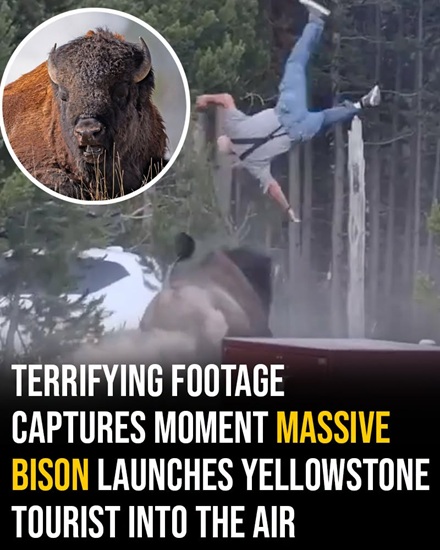
A frightening wildlife encounter at Yellowstone National Park has once again highlighted the unpredictable nature of one of America’s most iconic national parks. What began as an ordinary evening at Bridge Bay Campground quickly turned into a terrifying emergency when a large bull bison suddenly charged a visitor, leaving him with serious injuries. The shocking incident unfolded in front of dozens of campers and tourists, many of whom watched in disbelief as the massive animal pursued the man through the campground before launching him into the air.
The attack occurred on Friday evening at Bridge Bay Campground, one of Yellowstone National Park’s most popular camping areas during the busy summer travel season. Families from across the United States and around the world were enjoying the peaceful surroundings when the calm atmosphere was shattered by the aggressive behavior of a mature bull bison. According to eyewitnesses, the animal suddenly became agitated and began moving rapidly through the campground, creating panic among nearby visitors who immediately tried to move out of its path.
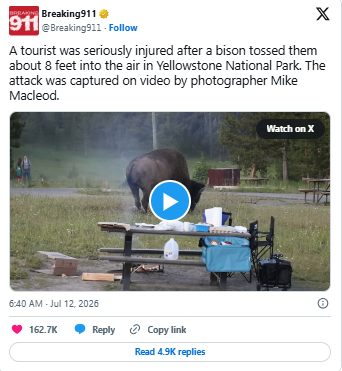
Among those present was photographer Mike MacLeod, who happened to be camping nearby when the frightening scene unfolded. MacLeod, who frequently photographs wildlife in Yellowstone, immediately realized that the situation was becoming dangerous and began recording what was happening. His video has since drawn widespread attention because it captured the dramatic sequence of events that led to the tourist being seriously injured.
According to witnesses, the unidentified man was walking through the campground with his grandson when the bull bison suddenly focused its attention on them. At first, both attempted to calmly move away from the animal in hopes of avoiding any confrontation. Park officials routinely advise visitors not to run if possible and to create as much distance as they safely can whenever large wildlife approaches. However, in this case, the bison continued following the pair despite their efforts to avoid it.
As the situation escalated, the grandson was able to move out of the animal’s path and escape without injury. The older man, however, was unable to get far enough away before the powerful bull caught up with him. Witnesses described several terrifying seconds during which the bison rapidly closed the distance, leaving almost no opportunity for the victim to reach safety.
The massive animal then struck the tourist with one of its horns before lifting and throwing him several feet into the air. According to eyewitness estimates, the force of the impact launched the man approximately eight feet before he landed on the ground. Those watching the incident described the sound of the collision and the force of the attack as both shocking and deeply disturbing. Several campers immediately feared that the victim had suffered severe injuries because of the tremendous power behind the animal’s charge.
The danger did not end after the initial attack. According to MacLeod and other witnesses, the bull remained extremely close to the injured man, creating concern that it might attack again before anyone could safely provide assistance. Campers found themselves facing a difficult decision as they tried to balance the need to help the injured tourist with the risk of approaching an aggressive wild animal weighing nearly a ton.
Realizing that immediate action was necessary, MacLeod stopped filming and attempted to distract the bison. He later explained that he shouted loudly while moving toward the animal in an effort to draw its attention away from the injured man. His quick reaction was soon joined by several other campers, who also made noise from a safe distance in hopes of encouraging the animal to leave the area without provoking another charge.
Fortunately, the combined efforts of several bystanders appeared to work. The bison eventually moved away from the victim, allowing people to carefully approach and begin checking his condition while emergency responders were contacted. Although those assisting the injured tourist wanted to help immediately, they remained cautious because bison can sometimes reverse direction unexpectedly and launch additional charges.
Once it appeared safe, witnesses rushed to the man’s side. According to MacLeod, the victim complained of severe pain, particularly in his hip and leg, immediately after the attack. Despite the force with which he had been thrown, those helping him initially reported seeing few obvious external injuries. However, they understood that significant internal injuries or fractures were still possible given the violence of the collision.
The man’s grandson remained nearby throughout the ordeal and later indicated that his grandfather had suffered serious injuries. Although official medical updates have not been released publicly, family members reportedly told witnesses that the victim was “not out of the woods,” suggesting that his condition remained serious following the attack.
Investigators have not yet determined exactly what caused the bull bison to become aggressive. Wildlife experts note that bison behavior can change rapidly depending on numerous factors, including environmental conditions, perceived threats, or seasonal biological changes. At the time of the incident, however, several experienced Yellowstone visitors believed the animal’s behavior may have been connected to the annual bison rut, which typically occurs during the summer months.
During the rut, mature male bison compete aggressively for breeding opportunities, often becoming far more territorial and unpredictable than during other times of the year. Large bulls may challenge one another, display intimidating behavior, or react aggressively when they perceive movement nearby. Park officials routinely warn visitors that bulls can become especially dangerous during this period, even when people believe they are maintaining what appears to be a safe distance.
MacLeod also recalled that this same bull had reportedly displayed aggressive behavior earlier that evening. According to his observations, the animal had already moved toward another group of visitors that included several children before later encountering the injured tourist. He described the bull as appearing unusually agitated and suggested that it seemed prepared to charge almost anything that entered its vicinity.
Despite these observations, MacLeod emphasized that the victim and his grandson did not appear to be provoking the animal. From what he witnessed, they seemed to be attempting to maintain a respectful distance while moving away after recognizing the danger. That detail has made the incident particularly concerning because it demonstrates how quickly wildlife behavior can change even when visitors believe they are acting responsibly.
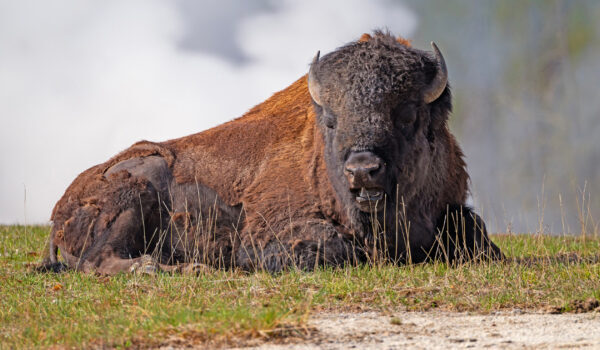
Yellowstone National Park is home to the largest free-ranging bison population in the United States, with thousands of animals living throughout the park. These impressive mammals can weigh more than 2,000 pounds and are capable of running at speeds approaching 35 miles per hour, making them significantly faster than most people realize. Although they often appear calm while grazing, wildlife experts repeatedly stress that bison remain wild animals and should never be approached.
Although attacks involving bison are relatively uncommon compared to the millions of people who visit Yellowstone National Park each year, wildlife experts continue to remind visitors that bison are responsible for more injuries inside the park than any other large animal. Their calm appearance often gives people a false sense of security, but experts stress that these massive mammals remain completely wild and can become aggressive without warning if they feel threatened or disturbed. This latest incident serves as another reminder that respecting wildlife from a safe distance is essential for both human safety and animal welfare.
Bison are among the largest land mammals in North America, with mature bulls weighing as much as 2,000 pounds (approximately 900 kilograms). Despite their enormous size, they are surprisingly agile and can run at speeds of up to 35 miles per hour—much faster than the average person can sprint. They are also capable of changing direction quickly, making it nearly impossible for someone on foot to outrun or evade a charging animal once it has committed to an attack. These natural abilities are why park officials repeatedly encourage visitors to remain alert whenever wildlife is nearby.
The annual bison rut, or breeding season, generally occurs during the summer months and is known for increasing aggression among mature males. During this period, bulls compete for access to females and often become far more territorial than usual. Wildlife biologists explain that elevated hormone levels can make bulls more unpredictable, causing them to react aggressively to other animals, vehicles, or even people who unknowingly enter their personal space. While the exact reason for Friday’s attack has not been officially determined, some observers believe the breeding season may have contributed to the bull’s unusually aggressive behavior.
One of the most striking aspects of this incident is that witnesses did not believe the victim was intentionally approaching or harassing the animal. According to photographer Mike MacLeod, both the man and his grandson appeared to recognize the danger and attempted to move away once the bull became aggressive. Despite those efforts, the bison continued pursuing them until it caught the older man. If confirmed, the incident demonstrates that even visitors who try to behave responsibly can find themselves in dangerous situations if wildlife suddenly changes its behavior.
The National Park Service has consistently advised visitors to maintain a minimum distance of at least 25 yards (23 meters) from bison, elk, deer, and other large herbivores. Even greater distances are recommended whenever an animal displays signs of agitation or begins moving toward people. If an animal approaches, park officials recommend calmly creating additional distance whenever possible rather than attempting to photograph it at close range or remain nearby. Following these guidelines greatly reduces the likelihood of dangerous encounters.
Wildlife specialists also note that animals often communicate their discomfort before attacking. Warning signs may include pawing the ground, snorting, swinging the head, raising the tail, or making direct movements toward nearby people. Recognizing these behaviors early allows visitors additional time to retreat safely before a situation escalates. However, experts caution that not every animal displays obvious warning signals, making constant awareness especially important when exploring areas where wildlife is present.
Yellowstone National Park attracts millions of visitors every year because of its extraordinary landscapes and remarkable wildlife. Bison, elk, wolves, bears, and many other species roam freely throughout the park, offering visitors unique opportunities to observe animals in their natural habitats. That freedom is one of Yellowstone’s defining characteristics, but it also means that every visitor shares responsibility for respecting wildlife and understanding that these animals are not accustomed to close human interaction.
Following Friday’s attack, emergency responders quickly arrived to assist the injured tourist after bystanders successfully distracted the bison. The man’s condition has not been updated publicly beyond reports that he sustained significant injuries. Medical professionals often evaluate victims of large-animal attacks for fractures, internal injuries, head trauma, and other complications resulting from the tremendous force involved. Family members have indicated that the victim remained in serious condition following the incident.
The National Park Service has not released additional details regarding the investigation or whether any specific management actions will be taken involving the bull bison. In many wildlife incidents, officials first review witness statements, photographs, and video footage to better understand exactly what occurred before making any decisions. Park authorities generally emphasize that wild animals behaving naturally should not automatically be blamed for incidents that occur within their habitat.
Incidents such as this also serve as valuable educational opportunities for future visitors. Every year, Yellowstone rangers conduct outreach campaigns reminding tourists that maintaining appropriate distances from wildlife is one of the simplest and most effective ways to prevent injuries. Despite these repeated warnings, some visitors continue approaching animals for photographs or underestimate the speed and strength of large mammals. Education remains one of the park’s most important safety tools.
The dramatic footage recorded by Mike MacLeod has drawn widespread attention because it captures the reality of how quickly a peaceful evening can turn into a life-threatening emergency. It also highlights the courage shown by bystanders who worked together to distract the animal while waiting for professional emergency responders to arrive. Their actions may have prevented the situation from becoming even more serious.
As the investigation continues, wildlife experts hope the incident will encourage greater awareness among those planning future visits to Yellowstone and other national parks. Respecting wildlife boundaries, remaining alert, and following park safety guidelines are essential precautions that help protect both visitors and the animals that make these landscapes so unique. While Yellowstone offers unforgettable opportunities to experience nature, Friday’s frightening encounter serves as a powerful reminder that wild animals deserve both admiration and distance.
