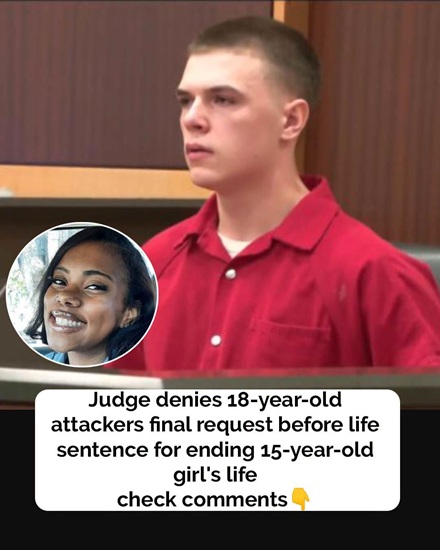
The tragic death of 15-year-old Kayla Rincon-Miller continues to leave a lasting impact on her family, friends, and the Cape Coral community. More than a year after the fatal shooting, one of the teenagers convicted in the crime has now been sentenced to spend the rest of his life in prison. The courtroom proceedings brought emotional testimony from loved ones, an apology from the defendant, and a final decision from the judge that marked the conclusion of one chapter in a case that deeply affected many people.
Thomas Stein, now 18 years old, appeared before a Florida court for sentencing after being convicted of first-degree murder and multiple counts of attempted armed robbery. The convictions stemmed from the fatal shooting of Kayla Rincon-Miller during an attempted robbery in March 2024. After hearing arguments from both prosecutors and defense attorneys, the court sentenced Stein to life in prison for the murder conviction, along with an additional 45 years for the attempted armed robbery charges.
The sentencing hearing was filled with emotion as members of Kayla’s family and several of her close friends addressed the court. Their statements described the enormous pain they have experienced since losing a young girl whose life had only just begun. Family members spoke about birthdays, holidays, school events, and future milestones that Kayla would never have the opportunity to experience. Friends recalled memories they had shared together and explained how difficult it has been to move forward after witnessing such a traumatic event.

Before the sentence was formally imposed, Thomas Stein addressed the court directly. Speaking quietly, he accepted responsibility for driving the vehicle during the robbery attempt and acknowledged that his actions contributed to the tragedy. He described his decision to participate that night as selfish and expressed regret for the suffering caused to Kayla’s loved ones. Stein stated that he never expected the robbery to end in violence but admitted that fleeing afterward only worsened the devastating consequences.
His statement immediately generated widespread discussion online. Some observers believed his apology reflected genuine remorse and an understanding of the pain caused by the crime. Others remained unconvinced, arguing that the comments came only after conviction and sentencing were unavoidable. The differing reactions reflected the emotional nature of the case, with many people continuing to debate whether expressions of regret can ever lessen the impact of such a tragic loss.
As the hearing came to an end, Stein made one final request before being taken into custody. He asked Judge Nick Thompson for permission to hug members of his family one last time inside the courtroom. The request created a brief pause before the judge responded. While acknowledging the emotional circumstances, Judge Thompson declined to allow physical contact. He informed Stein that he would be permitted to verbally say goodbye to his family but would not be allowed to embrace them before being escorted away by law enforcement officers.
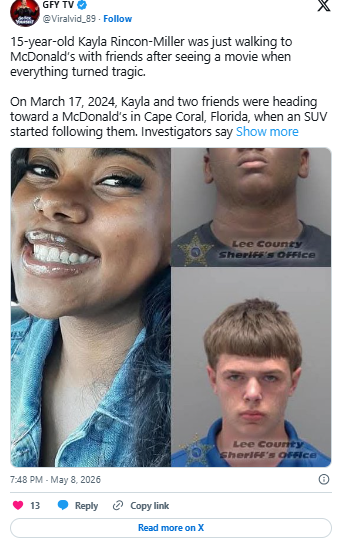
That brief courtroom exchange quickly spread across social media, where thousands of people expressed differing opinions about the judge’s decision. Some believed courtroom security procedures justified denying physical contact after sentencing. Others felt allowing a final family embrace would have been an appropriate gesture despite the seriousness of the convictions. Regardless of those opinions, the judge’s decision remained final, and Stein was escorted from the courtroom without being allowed to hug his relatives.
The case began on a tragic evening in March 2024 when Kayla Rincon-Miller was walking with two friends after leaving a movie theater in Cape Coral, Florida. According to prosecutors, Thomas Stein and Christopher Horner Jr. had been driving through the area looking for individuals to rob. Investigators alleged that the teenagers selected the group of young pedestrians as potential victims before pulling their vehicle alongside them.
During the attempted robbery, a gun was fired, striking Kayla in the chest. Emergency responders arrived quickly and transported her for medical treatment, but despite their efforts, she later died from her injuries. The shocking death of a 15-year-old girl during what prosecutors described as a random robbery attempt deeply affected the local community and prompted an extensive criminal investigation.
Law enforcement officers worked to gather surveillance footage, forensic evidence, witness testimony, and other investigative materials that eventually led to the arrests of those involved. Prosecutors argued throughout the trial that although Stein was not accused of personally firing the fatal shot, his participation in the robbery and his role as the driver made him legally responsible under Florida law for the murder committed during the felony.
Throughout the proceedings, prosecutors emphasized that the victim had simply been enjoying a normal evening with friends before her life was suddenly taken away. They argued that the decision to target strangers for robbery set into motion a chain of events that resulted in irreversible tragedy. The jury ultimately agreed with the prosecution’s evidence, finding Stein guilty of first-degree murder as well as three counts of attempted armed robbery.
During sentencing, the court also heard emotional victim impact statements describing the continuing grief experienced by Kayla’s family. Several speakers struggled through tears while recalling her kindness, personality, and dreams for the future. Friends described how difficult it has been to return to everyday life after witnessing the events of that evening. One close friend explained that life since Kayla’s death has often felt like living in “a coma” from which she cannot fully wake, illustrating the profound emotional trauma that remains.
The courtroom remained silent as each family member described the permanent void left by Kayla’s absence. They spoke about family traditions forever changed, unanswered questions, and the daily pain of remembering someone whose future was taken far too soon. Their statements reminded everyone present that criminal cases extend far beyond legal proceedings, leaving emotional consequences that continue long after verdicts and sentences have been delivered.
As the sentencing hearing continued, prosecutors reminded the court that this case was about much more than a single decision made in a matter of seconds. They argued that every choice leading up to the attempted robbery played a role in the tragedy that unfolded. According to the prosecution, the defendants deliberately drove through the area searching for people they believed would be easy targets. The decision to commit armed robbery created a dangerous situation that ultimately cost a young girl her life. Prosecutors emphasized that every participant in a violent felony carries responsibility for the foreseeable consequences of those actions under Florida law.
Throughout the trial, investigators presented evidence outlining the sequence of events before, during, and after the shooting. Witness testimony, surveillance footage, forensic evidence, and statements collected during the investigation helped prosecutors reconstruct the timeline. They argued that although Thomas Stein claimed he did not expect anyone to be killed, he willingly participated in an armed robbery, fully aware that introducing a firearm into such a situation carried enormous risks. The jury ultimately concluded that the evidence supported the charges beyond a reasonable doubt.
Florida’s felony murder law played an important role in the case. Under this legal principle, participants in certain dangerous felonies can be held criminally responsible for a death that occurs during the commission of the crime, even if they were not the individual who fired the fatal shot. Prosecutors argued that Stein’s role as the driver directly contributed to the attempted robbery and its deadly outcome. The court accepted that argument, leading to his conviction for first-degree murder alongside the robbery-related charges.
Defense attorneys acknowledged that Stein made terrible decisions but argued that he had shown genuine remorse following the incident. They pointed to his acceptance of responsibility during sentencing and asked the court to consider his age at the time of the crime. However, prosecutors maintained that the irreversible loss suffered by Kayla’s family outweighed those considerations. They stressed that the consequences of violent crime cannot be undone and argued that the sentence should reflect the seriousness of the offense.
The courtroom remained emotional as members of Kayla Rincon-Miller’s family continued describing how profoundly their lives had changed. Relatives explained that every family celebration now carries a sense of absence. Holidays, birthdays, graduations, and ordinary moments all serve as painful reminders that Kayla is no longer there to share them. Parents, siblings, extended relatives, and friends described the lasting emotional impact that continues long after the headlines surrounding the case have faded.
Several of Kayla’s closest friends also spoke during the hearing. Some described experiencing anxiety, nightmares, and emotional trauma following the shooting. Others explained how difficult it has been to return to places that remind them of the events of that night. One friend recalled that she often thinks about conversations left unfinished and plans they had made together before everything changed forever. Their statements highlighted that violent crime affects not only immediate family members but entire circles of friends and classmates.
Community members have continued to remember Kayla through memorial events, tributes, and messages honoring her life. Many described her as a caring teenager with a bright personality and a future filled with promise. Teachers, classmates, neighbors, and friends have shared memories of her kindness and positive attitude, emphasizing that she was much more than the victim of a tragic crime. Those who knew her hope she will be remembered for the life she lived rather than solely for the circumstances surrounding her death.
The case also sparked renewed conversations about youth violence, firearm-related crime, and the lasting consequences of impulsive decisions. Community leaders have emphasized the importance of education, mentoring programs, and violence prevention efforts aimed at steering young people away from criminal activity. Law enforcement officials noted that many violent crimes begin with choices that may initially seem small but quickly escalate into irreversible tragedies.
Legal experts observing the case explained that sentences involving first-degree murder convictions are designed not only to hold offenders accountable but also to reinforce the seriousness of crimes involving loss of life. While no court decision can restore what was taken from Kayla’s family, the legal process seeks to provide accountability through the justice system. For many families, however, they acknowledge that even the harshest sentence cannot erase grief or replace a loved one who has been lost.
Following the sentencing, reactions continued across social media and news platforms. Some people focused on Stein’s apology, debating whether it reflected sincere remorse or simply recognition of the inevitable outcome. Others centered their attention on the victim’s family, expressing sympathy for the unimaginable pain they continue to endure. Regardless of differing opinions surrounding the defendant, there was broad agreement that the loss of a 15-year-old life represents an immeasurable tragedy.
The judge concluded the hearing by formally imposing the sentence, bringing the criminal proceedings to a close. Thomas Stein will spend the remainder of his life in prison under the sentence handed down by the court, along with additional consecutive prison time for the attempted armed robbery convictions. As deputies escorted him from the courtroom, Kayla’s family remained focused not on the defendant but on honoring the memory of the daughter, granddaughter, friend, and student they continue to miss every day.
Although the legal case has concluded, the emotional journey for Kayla Rincon-Miller’s loved ones continues. They have repeatedly expressed hope that others will learn from this tragedy and understand how quickly violence can destroy countless lives. Their message has consistently centered on remembering Kayla for the joyful, compassionate young person she was and encouraging communities to work toward preventing similar tragedies in the future.
Cases like this serve as painful reminders of how a single criminal decision can leave permanent consequences for victims, families, friends, and entire communities. While the justice system can determine legal responsibility, it cannot restore lost futures or heal every emotional wound. Kayla Rincon-Miller’s story remains one that continues to resonate, reminding people of the importance of accountability, community support, and efforts to reduce violent crime so that fewer families experience such heartbreaking loss in the years ahead.
