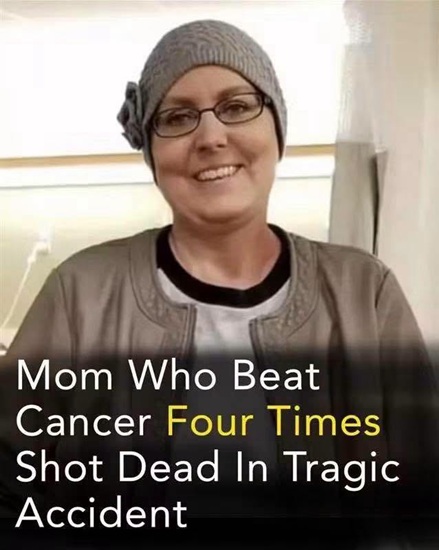
She Had Survived Cancer Four Times — Then a Bullet Entered Her Home
Jennifer James had already spent much of her adult life surviving things that might have broken someone else.
She had faced breast cancer again and again.
According to her family, she survived four separate battles.
And when cancer returned yet another time, she kept fighting.
Then came the night of April 28, 2025.
Jennifer was not in a hospital.
She was not traveling.
She was inside her own home in Berthoud, Colorado.
And just before 11:20 p.m., everything changed.
A Shot Reached Her Inside the House
Authorities said a bullet entered Jennifer’s home and struck her.
She suffered injuries to the chest and arm.
Jennifer was able to call 911.
Then she collapsed.
First responders arrived quickly.
But the 49-year-old mother of four could not be saved.
The Larimer County Coroner later confirmed that Jennifer died from a gunshot wound to the chest.
Her death was ruled a homicide.
At first, the central question was obvious.
How had a woman inside her own home ended up shot?
The answer began to take shape over the next several days.
Investigators Focused on a 20-Year-Old Man
On May 1, the Larimer County Sheriff’s Office announced the arrest of 20-year-old Ebenezer Worku.
He was charged with first-degree murder under an extreme-indifference theory.
A judge set his bond at $1.25 million cash only.
Authorities also made clear that the charge was an accusation.
Worku remained presumed innocent unless and until proven guilty in court.
That legal distinction is important.
But the affidavit described a sequence of events that made the case especially difficult for Jennifer’s family to comprehend.
The Shooting Was Allegedly Not Directed at Jennifer
According to media reports based on the arrest affidavit, Worku said he had been sitting inside a vehicle near Jennifer’s home while handling a gun.
He allegedly told investigators that the weapon had been given to him as a birthday gift.
He said he was attempting to clear or clean it.
Then it discharged.
According to the affidavit, another shot followed.
One of those bullets traveled toward Jennifer’s home.
She was struck inside.
Worku allegedly told investigators that he did not initially realize anyone had been hit.
That account remains part of the criminal case.
It has not replaced the need for the court to determine responsibility.
Why the Charge Was So Serious
The prosecution did not need to allege that Jennifer had been personally targeted in order to bring a very serious charge.
First-degree murder under an extreme-indifference theory can focus on conduct prosecutors say created a grave risk of death while showing extreme disregard for human life.
That is different from a claim that someone deliberately selected a particular victim.
The legal system will determine whether the evidence meets that standard.
But for Jennifer’s family, the legal terminology does not erase the core reality.
She was at home.
A gun was fired outside.
And she died because of it.
Jennifer Had Been Fighting Cancer Since Her 20s
Her daughter Ashley later explained that Jennifer had been dealing with breast cancer since the age of 29.
Over roughly two decades, treatment became part of her life.
So did recurrence.
Family members described Jennifer as a four-time breast cancer survivor.
At the time of her death, friends said she was battling cancer again and undergoing treatment.
That history made the shooting feel especially cruel.
Jennifer had spent years surviving something that repeatedly threatened her life.
Then an unrelated act of violence ended it.
She Was a Single Mother of Four
Jennifer’s identity was not defined by cancer alone.
She was also raising four children.
Friends and family described her as deeply devoted to them.
A GoFundMe created after her death focused on helping her children manage the financial and practical consequences of suddenly losing their mother.
The fundraiser described Jennifer as warm, generous and extraordinarily kind.
One phrase stood out.
She was remembered as “the epitome of sunshine.”
That is how the people closest to her wanted her life described.
Not simply as a victim.
Not simply as a patient.
But as a mother who kept showing up for her family.
Two of Her Children Were Reportedly Inside
Media reports indicated that two of Jennifer’s children were home when the shooting happened.
Authorities said no one else in the house was physically injured.
That does not mean they escaped the event untouched.
The home had been a place of routine.
A place where Jennifer had undergone years of family life, recovery and treatment.
In seconds, it became the scene of a homicide.
For her children, that night divided life into two parts.
Before the shot.
And after it.
Ashley Remembered a Mother Who Never Stopped Fighting
Jennifer’s oldest daughter, Ashley James, later spoke publicly about the loss.
She described her mother as the most selfless person she knew.
According to Ashley, Jennifer had spent years fighting cancer without allowing the struggle to consume everything around her.
She continued focusing on her children.
She continued giving.
She rarely complained.
Ashley said that resilience was one of the qualities she most admired.
And now, it was something she hoped to carry forward.
That is the part of Jennifer’s story that survived the headlines.
The Randomness Was Hardest to Accept
There was no known dispute between Jennifer and Worku.
Authorities did not describe the shooting as the result of a conflict involving her.
She was not reported to have been confronting anyone outside.
She was simply inside her home.
That is why the case felt so senseless to her family.
There was no warning.
No argument.
No sequence Jennifer could have recognized and avoided.
A bullet traveled from outside the house into her life.
And that was enough.
Surveillance Footage Helped Investigators
Reports citing the arrest affidavit said investigators used surveillance video from the area to reconstruct what happened.
The footage helped authorities identify the vehicle involved.
That led them toward Worku.
After his arrest, he allegedly made statements about the firearm and the shooting.
Those statements are part of the evidence prosecutors may rely on.
But they are still allegations within an active criminal process.
They must be tested in court.
That is why responsible reporting should distinguish clearly between the affidavit and facts established by official findings.
One Claimed Diagnosis Should Not Be Treated as Fact
Some reports quoted Worku making statements about his own mental health.
Those comments should not be treated as a confirmed psychiatric diagnosis.
A self-description is not the same as a clinical evaluation.
It also does not explain a violent act by itself.
Most people living with schizophrenia or other serious mental illnesses are not violent.
So it would be misleading to use one person’s reported statement as a simple explanation for Jennifer’s death.
The criminal case concerns conduct.
Any medical issues require separate evidence and professional assessment.
Worku Allegedly Reacted Emotionally After Learning Someone Had Died
According to reports based on the affidavit, Worku appeared distressed after discovering the shooting had killed someone.
He allegedly asked to be jailed.
Those comments may become relevant to the legal process.
But remorse after an event does not automatically determine criminal responsibility.
Nor does it decide whether the earlier conduct legally amounted to recklessness, extreme indifference or something else.
That is exactly why the case belongs in court.
The emotional aftermath is one detail.
The legal standard is another.
Jennifer’s Family Was Left With Immediate Practical Problems
Sudden death creates more than grief.
There are funeral costs.
Household bills.
Food.
Transportation.
Housing.
Support for children.
The fundraiser created after Jennifer’s death was intended to help with those burdens.
Hundreds of people contributed.
Some knew Jennifer personally.
Others were moved by the story.
The financial support could not change what happened.
But it could help her children navigate the difficult months that followed.
Jennifer’s Life Had Already Been a Story of Survival
For years, Jennifer’s family had lived with cancer.
That meant appointments.
Scans.
Treatments.
Waiting.
Fear.
Relief.
Then sometimes another diagnosis.
Her family had reportedly seen that cycle repeat four times.
And each time, Jennifer survived.
When cancer returned again, she kept fighting.
That history may have made her feel almost indestructible to the people who loved her.
Then one night proved otherwise.
Not because cancer finally won.
Because a bullet entered her home.
The Coroner’s Finding Was Clear
The Larimer County Coroner officially ruled Jennifer’s death a homicide.
The cause was a gunshot wound to the chest.
That finding does not decide whether any particular person is legally guilty.
But it does establish the nature of Jennifer’s death.
It was caused by another person’s act.
Not by her illness.
Not by treatment.
Not by a natural medical complication.
For a woman who had spent decades fighting cancer, that distinction carried enormous emotional weight.
Her Daughter Called the Death Senseless
Ashley said the shooting made her angry.
She described it as a senseless act of violence.
She also said her mother had devoted her life to her children.
That contrast defined the family’s grief.
Jennifer had spent years fighting to remain alive for them.
Then something completely unrelated took her away.
Ashley said she would always be grateful for everything her mother had done.
And for the resilience she had shown.
Those memories mattered more than the details of the arrest.
Public Attention Shifted to the Suspect
After Worku’s arrest, much of the news coverage naturally focused on the criminal case.
The firearm.
The vehicle.
The affidavit.
The charge.
The bond.
The statements.
But that is not the entire story.
A homicide case can easily become centered on the accused.
Jennifer’s family pushed the focus back toward the person who had been lost.
A mother.
A cancer survivor.
Someone described by friends as kind and selfless.
A person whose life was much bigger than the night she died.
The Phrase “Stray Bullet” Can Hide the Reality
It is common to describe incidents like this as stray-bullet shootings.
The phrase is understandable.
But it can sound almost accidental in a way that removes human action from the story.
A firearm was discharged.
A projectile traveled into a home.
Jennifer was struck.
She died.
The legal system still has to determine what level of criminal responsibility applies.
But the physical chain of events is clear.
The bullet did not appear on its own.
Someone fired the weapon.
And the consequences were permanent.
The Case Is About More Than One Night
April 28 is the date Jennifer died.
But the years before it matter more when trying to understand who she was.
She had lived through repeated cancer treatment.
Raised four children.
Kept her family moving forward.
Survived diagnoses that could have changed everything.
Then continued again.
And again.
And again.
Those years created a much fuller picture than any arrest affidavit ever could.
Her Resilience Became Part of Her Legacy
Ashley said she wanted to carry forward the resilience she had seen in her mother.
That is one of the strongest details in the story.
Jennifer’s final moments were violent.
Her legacy does not have to be.
For her children, the memories that remain are likely to be about ordinary things.
Support.
Sacrifice.
Parenting.
Treatment days.
Birthdays.
Meals.
Conversations.
The hundreds of ways a parent becomes part of a child’s life.
Those memories existed long before the shooting.
And they remain after it.
The Criminal Case Will Follow Its Own Course
Prosecutors will present evidence.
The defense will respond.
Courts will decide what can be proven beyond a reasonable doubt.
Until then, Worku remains accused, not convicted.
That is an important part of fair reporting.
But Jennifer’s death is not uncertain.
She died.
Her four children lost their mother.
Her family lost someone who had spent years fighting to remain with them.
And a community was left trying to understand how a person inside her own home could be killed by a bullet fired from outside.
The Final Irony Is the Part Her Family Cannot Escape
Jennifer James had spent roughly 20 years confronting a disease that repeatedly threatened her life.
She fought through treatment.
Survived recurrence.
Kept raising her children.
And when cancer returned, she fought again.
Then, on an ordinary April night, the threat came from somewhere she could never have prepared for.
A gun was fired outside.
A bullet crossed into her home.
And a woman who had survived cancer again and again was gone.
That is why the tragedy remains so difficult for her family to put into words.
Jennifer did not stop fighting.
Life simply gave her no chance to fight this time.
