
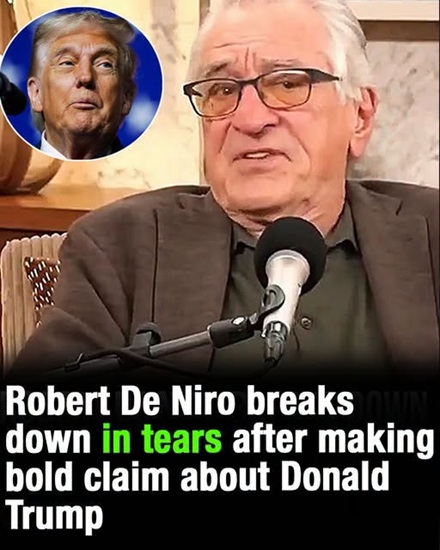
Robert De Niro, one of Hollywood’s most recognized and award-winning actors, has once again attracted significant public attention after making strong political comments about former U.S. President Donald Trump. The 82-year-old actor, known for iconic roles in films such as Taxi Driver, Raging Bull, and The Godfather Part II, has increasingly become vocal in political discussions in recent years, particularly regarding Trump’s leadership and its impact on American society.
His recent comments were made during an appearance on The Best People with Nicolle Wallace podcast, where he spoke openly about his concerns regarding the political direction of the United States. According to widely reported excerpts, De Niro expressed strong criticism of Trump and suggested that the country is experiencing deep political and social division. His remarks quickly spread across media outlets and social platforms, sparking renewed debate about the role of celebrities in political discourse.
During the conversation, De Niro emphasized what he sees as the importance of civic responsibility and public engagement. He argued that democratic systems depend on active participation from citizens and that political outcomes are shaped by collective action. His tone during the interview was described by listeners and commentators as emotional at times, particularly when discussing the state of national unity and political polarization.
De Niro has been consistently outspoken in past years regarding Donald Trump and American politics. He has previously participated in interviews, public statements, and campaign-related discussions where he expressed concern about democratic institutions and political leadership. In this recent podcast appearance, he reiterated similar themes, focusing on unity, accountability, and the importance of protecting democratic values through participation rather than disengagement.
He also referenced broader concerns about division in society, suggesting that political disagreements have become more intense and emotionally charged in recent years. While his comments were strongly worded, they reflect a wider trend among public figures who have increasingly used their platforms to comment on political developments, particularly in the United States where political polarization has grown significantly.
The response to De Niro’s remarks has been divided. Supporters of his views argue that he is exercising his right to free expression and using his public platform to draw attention to issues he believes are important for democracy. They see his comments as part of a long tradition of artists and entertainers engaging in political discourse and advocating for societal change.
Critics, however, argue that celebrities should be cautious when entering political debates, suggesting that their influence can sometimes amplify division rather than promote constructive dialogue. This tension between celebrity influence and political responsibility has been a recurring topic in media analysis, especially during election cycles where public figures often take more visible political positions.
Beyond this particular interview, De Niro has a long history of political commentary. Over the years, he has participated in various public campaigns and spoken at events where he expressed his views on leadership, governance, and democratic values. His statements often receive widespread media coverage due to his global recognition and long-standing reputation in the entertainment industry.
The broader issue highlighted by this situation is the increasing overlap between entertainment and politics. In the modern media environment, actors, musicians, and influencers often have direct access to large audiences through podcasts, social media, and streaming platforms. This allows them to express political opinions without traditional media filters, but it also raises questions about influence, responsibility, and the impact of celebrity voices on public opinion.
Political analysts note that such discussions contribute to ongoing debates about polarization in the United States. When high-profile figures make strong political statements, they can reinforce existing beliefs among supporters while also intensifying disagreements with مخالف viewpoints. As a result, celebrity political commentary often becomes part of larger national conversations about identity, governance, and democracy.
In De Niro’s case, his remarks reflect both personal conviction and broader concerns about the direction of political discourse. Whether viewed as advocacy or criticism, his statements have once again placed him at the center of a highly visible public debate. This illustrates how entertainment figures continue to play a significant role in shaping cultural and political conversations in modern society.
Ultimately, the reaction to his comments underscores the complexity of political expression in today’s media landscape. While some view celebrity involvement as valuable and engaging, others see it as a source of division or oversimplification of complex issues. What remains clear is that such statements will continue to generate attention, discussion, and differing interpretations across the public sphere.

