
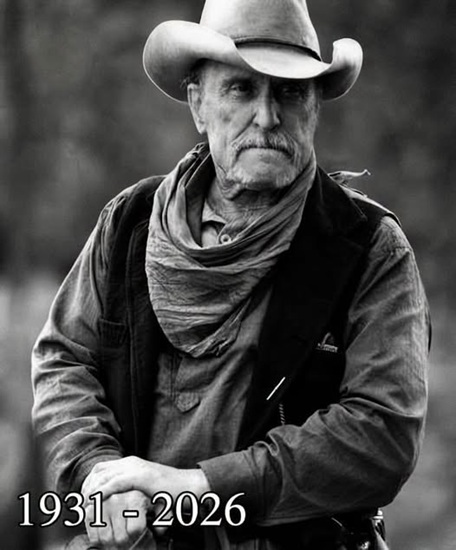
Robert Duvall, the Oscar-winning actor whose career stretched across more than six decades, died on February 15, 2026, at the age of 95. He died peacefully at his home in Middleburg, Virginia, with his wife, Luciana Duvall, beside him, according to information released by his representative and family. His death brought an end to one of the longest and most respected acting careers in American film and television. Across generations, audiences came to know Duvall through performances that were often restrained, precise and deeply believable.
Rather than relying on one kind of character, he built his reputation by repeatedly transforming himself for very different roles. Duvall appeared in an extraordinary number of important productions throughout his life. His credits included To Kill a Mockingbird, The Godfather, The Godfather Part II, Apocalypse Now, The Great Santini, Tender Mercies, Lonesome Dove, The Apostle and Broken Trail. These projects covered crime dramas, war films, Westerns, family stories and intimate character studies.
Few actors remained successful for such a long period while continuing to work in so many different genres. His performances often made even difficult or contradictory characters feel like people who existed beyond the boundaries of the script. Robert Selden Duvall was born on January 5, 1931, in San Diego, California. His path toward becoming one of the best-known character actors in American cinema did not happen overnight. Before Hollywood audiences recognized him widely, he spent years building experience through stage productions and television appearances.
Those early years helped him develop the disciplined style that later became central to his screen work. He was known for observing behavior carefully and avoiding unnecessary theatricality whenever a quieter choice could make a scene more convincing. One of Duvall’s first major film appearances came in the 1962 adaptation of Harper Lee’s To Kill a Mockingbird.
He played Arthur “Boo” Radley, the mysterious neighbor who remains largely unseen for much of the story. Although the role contained relatively little dialogue, Duvall created a memorable presence through silence, posture and expression. The performance became an early example of his ability to communicate emotion without needing lengthy speeches. Even in a small role, he showed the kind of screen control that would become increasingly important throughout his career.
During the following years, Duvall continued appearing in film and television while gradually building a strong professional reputation. He was not yet the internationally recognized star audiences would come to know in the 1970s, but he had become a dependable performer. Directors could place him in a wide range of situations because he rarely approached characters in a predictable way. Instead of trying to make himself more noticeable than everyone around him, he usually focused on making the character believable within the story.
The role that permanently changed Duvall’s standing in Hollywood arrived in 1972 with Francis Ford Coppola’s The Godfather. Duvall played Tom Hagen, the adopted son and trusted consigliere of the Corleone family. The character required a very different kind of authority from many of the people around him. Tom was often calm when others were angry, analytical when others acted impulsively and cautious when danger was increasing. Duvall used those characteristics to create a figure who could remain quiet and still dominate the emotional meaning of a scene.
Tom Hagen became one of Duvall’s most recognizable characters. Surrounded by unforgettable performances from Marlon Brando, Al Pacino, James Caan and other members of the cast, Duvall never needed to compete through exaggerated gestures. His strength came from restraint. A small change in his expression could communicate concern, calculation or disagreement. His performance helped audiences understand that Tom was constantly evaluating the people and events around him, even when he said very little.
Duvall returned as Tom Hagen in The Godfather Part II in 1974. The sequel placed the character in a Corleone family that had become increasingly complicated under Michael Corleone’s leadership. Once again, Duvall’s controlled approach provided a contrast to the tension surrounding him. Tom’s loyalty remained important, but his position became more difficult as relationships inside the family changed. Duvall communicated that tension without turning the character into someone dramatically different from the man audiences had already met.
Although Tom Hagen became one of the roles most closely associated with Duvall, his career soon demonstrated that he could not be defined by a single character. In 1979, he appeared in Francis Ford Coppola’s Apocalypse Now as Lieutenant Colonel Bill Kilgore. The performance could hardly have been more different from Tom Hagen. Kilgore was bold, commanding, aggressive and theatrical. Duvall transformed his voice, physical energy and screen presence to create a character who immediately stood apart from his earlier work.
The role of Kilgore became one of the most famous performances in Duvall’s career. His scenes combined confidence, danger, humor and absurdity inside one of cinema’s most memorable war films. The character demonstrated that Duvall’s preference for realism did not mean he could only play restrained men. When a larger personality was required, he could expand his performance while still grounding it in recognizable behavior. That ability to shift between quiet precision and explosive authority became one of the clearest signs of his versatility.
The same year also brought The Great Santini, another important film in Duvall’s career. He played Lieutenant Colonel Wilbur “Bull” Meechum, a Marine aviator whose forceful military personality extends into his home life. The character could be intimidating, proud and emotionally difficult, but Duvall resisted presenting him as a simple villain. Instead, the performance revealed contradictions beneath the surface. Strength existed beside insecurity, and authority existed beside emotional limitations.
This ability to portray complicated people became one of Duvall’s greatest strengths. His characters often contained qualities that made them difficult to categorize. They could behave badly while still remaining recognizably human. They could appear powerful while privately carrying fear, regret or uncertainty. Duvall rarely seemed interested in telling viewers exactly how they should judge a character. He preferred to make the person believable and allow the audience to decide what to think.
Another major turning point arrived with Tender Mercies in 1983. Duvall played Mac Sledge, a former country singer whose life had been damaged by alcoholism, personal loss and professional decline. The role required a quieter style than many of his earlier performances. Instead of dominating scenes through authority, Duvall allowed Mac’s history to emerge gradually. Much of the character’s emotional life appeared in pauses, silences and restrained reactions.
His work in Tender Mercies earned Duvall the Academy Award for Best Actor. The award recognized a performance that demonstrated how much emotional power could come from understatement. Mac Sledge was not built around spectacular speeches or constant dramatic conflict. Duvall created depth through small choices, suggesting that the character carried years of experience that the film did not need to explain directly. The Oscar became one of the most significant honors in a career already filled with acclaimed performances.
Winning the Academy Award did not cause Duvall to narrow his choices. He continued working in projects of very different sizes and styles. He appeared in major studio films, smaller character dramas, television productions and Westerns. The pattern remained consistent: he searched for characters that offered something specific and human rather than simply repeating roles that had already worked. This willingness to change helped him remain relevant through several different eras of American filmmaking.
One of the most beloved performances of his later career arrived in the 1989 television miniseries Lonesome Dove. Duvall played former Texas Ranger Augustus “Gus” McCrae opposite Tommy Lee Jones as Woodrow Call. Gus was humorous, talkative, stubborn, experienced and emotionally expressive in ways that many of Duvall’s earlier characters were not. The role gave him an opportunity to combine comedy, friendship, romance and tragedy inside a single performance.
Lonesome Dove became a major television success and remains one of the most celebrated Western miniseries ever produced. Duvall received an Emmy nomination for his performance, and he later said that Gus McCrae was his favorite role. That preference is especially notable because his career contained so many famous characters. Gus offered a combination of qualities that allowed Duvall to display warmth and humor while still working inside the detailed, realistic style that defined much of his acting.
Duvall also expanded his career beyond acting alone. He worked as a writer, director and producer on several projects. One of the most personal was The Apostle, in which he played a Pentecostal preacher struggling to rebuild his life after a serious personal crisis. Duvall wrote and directed the film as well as starring in it. His performance earned another Academy Award nomination, demonstrating that his strongest work continued long after his first period of major fame.
The Apostle reflected Duvall’s fascination with people who could not easily be described as completely good or completely bad. The central character was deeply flawed but also driven by sincere belief, emotional need and the desire for another chance. Duvall approached the role with the same curiosity he brought to many of his most memorable performances. Instead of simplifying the character into a symbol, he allowed contradictions to remain visible.
His television career continued to produce major achievements as he grew older. In 2006, Duvall starred in the Western miniseries Broken Trail as Prentice “Print” Ritter. The role returned him to a genre that had already given him extraordinary success in Lonesome Dove. Duvall’s performance earned him an Emmy Award for Outstanding Lead Actor in a Miniseries or Movie. He also served as an executive producer on the project.
The success of Broken Trail showed that Duvall could revisit familiar territory without repeating himself. Print Ritter and Gus McCrae belonged to the Western tradition, but they were different men shaped by different experiences. Duvall adjusted the physical and emotional details of each character accordingly. That ability to create distinctions within a genre was another reason his work remained interesting after so many decades.
Across his career, Duvall received seven Academy Award nominations and won once for Tender Mercies. He also received multiple Emmy nominations and won two Emmys. These awards reflected professional recognition across both film and television. Yet his reputation was never dependent entirely on trophies. Some of his most beloved performances became important because audiences continued returning to them long after award seasons ended.
Duvall’s longevity was especially remarkable. His professional life stretched through major changes in Hollywood, television and the broader entertainment industry. He worked during the era when traditional studio filmmaking was still influential. He became a major figure during the New Hollywood period of the 1970s. He remained active through the 1980s, 1990s and the first decades of the twenty-first century.
One reason this was possible was that Duvall never depended entirely on youthful celebrity. His career could change naturally as he aged. A younger Duvall could play Boo Radley or Tom Hagen. A middle-aged Duvall could become Mac Sledge or Gus McCrae. Later, he could portray older fathers, ranchers, judges, mentors and men whose faces and movements carried visible history. Age became another part of his acting vocabulary rather than something he needed to hide.
His method was closely connected to observation. Duvall became known for studying people and paying attention to the details that made them individual. That might involve a specific rhythm of speech, a physical habit, a way of standing or a particular reaction to another person. These details rarely felt decorative. They were used to suggest that a character had existed long before the camera began recording.
That quality can be seen clearly when comparing several of his famous performances. Tom Hagen moved and spoke differently from Bill Kilgore. Mac Sledge carried himself differently from Gus McCrae. Bull Meechum’s authority was not the same as Print Ritter’s. Duvall did not simply change costumes and names. He looked for a different internal logic behind each character’s behavior.
Silence was another important part of his technique. Some actors create energy by constantly speaking or moving. Duvall often demonstrated that stillness could be equally powerful. A pause could communicate hesitation. A glance could reveal disagreement. A shift in posture could show that a character had understood something before anyone else in the scene.
When Duvall did become loud or physically intense, the effect could be stronger because it was not his only tool. Kilgore in Apocalypse Now could command attention through force and confidence, while Mac Sledge in Tender Mercies could hold attention with very little movement. Both performances felt unmistakably like Duvall, yet neither seemed to be a copy of the other.
His collaborations with Francis Ford Coppola played a particularly important role in his career. Coppola directed Duvall in several films that became landmarks of American cinema. Their work together produced Tom Hagen and Bill Kilgore, two characters who could hardly be more different. Following Duvall’s death, Coppola publicly praised him and remembered him as one of the great actors he had worked with.
Duvall’s stage experience also formed an important part of his development. Before and during his film career, he appeared in theater productions, including Broadway work. Stage acting requires performers to sustain a character through an entire live performance and repeat that work consistently while keeping it emotionally alive. Those skills contributed to the discipline visible in Duvall’s screen performances.
By the time he became famous internationally, Duvall had already spent years working in multiple acting environments. Film viewers sometimes saw only the final result, but the natural quality of his performances came from extensive experience. His acting often looked effortless precisely because the preparation did not call attention to itself. Technique remained hidden beneath the character.
This helped explain why he earned so much respect from other performers. Actors often recognize how difficult it is to make complex work appear simple. Duvall could stand beside major stars without needing to compete visibly for attention. He listened, reacted and allowed scenes to develop rather than forcing every moment toward himself. That discipline made ensemble films stronger.
The phrase “character actor” was frequently used to describe Duvall, but his career demonstrated how broad that term can be. He certainly excelled in supporting roles, yet he was equally capable of carrying a film or television production as the central character. Tom Hagen strengthened The Godfather without being its protagonist. Mac Sledge became the emotional center of Tender Mercies. Gus McCrae became one of the defining figures of Lonesome Dove.
His work in Westerns occupied a particularly important part of his legacy. Duvall had a strong interest in the genre and returned to it repeatedly. Westerns gave him opportunities to explore aging, friendship, loyalty, violence, independence and the changing meaning of the American frontier. His performances avoided turning these themes into simple nostalgia. The characters remained flawed human beings rather than idealized legends.
Lonesome Dove remains perhaps the clearest example. Gus McCrae was not merely a heroic cowboy. He was funny, sentimental, stubborn and sometimes contradictory. Duvall gave the character enough warmth to become deeply likable without removing his imperfections. That balance helped explain why the role continued to resonate with audiences decades after the original broadcast.
Broken Trail showed another side of his Western work. By then, Duvall was considerably older, and the character naturally carried a different sense of experience. Instead of repeating the energy of Gus McCrae, he adjusted his performance to match a man shaped by age and responsibility. The Emmy victory confirmed that audiences and critics still regarded his work as exceptional.
Duvall’s ability to work with several generations of performers also contributed to his long career. His early work connected him with actors from an earlier period of Hollywood. During the 1970s, he worked with some of the central figures of New Hollywood. Later, he appeared alongside performers who had grown up watching the films that had first made him famous.
He never seemed satisfied simply being included as a respected veteran. Even in later years, he continued trying to make each role function dramatically. His age could add weight to a character without turning him into a symbolic presence who existed only because of his reputation. That commitment helped prevent his later work from becoming purely nostalgic.
Duvall also developed a life outside Hollywood. He and his wife, Luciana, spent significant time in Virginia, where horses and rural life became important parts of their world. His interests extended beyond film, and he became connected with the Middleburg area. Those aspects of his life offered a sharp contrast to the enormous visibility of his film career.
Living away from the center of the entertainment industry did not reduce his professional standing. Duvall remained widely recognized and respected while maintaining a home in Virginia. When news of his death was announced, national media focused on his extraordinary body of work while local publications also remembered the man who had become part of their community.
His relationship with Argentine culture also became an important personal interest, particularly through his marriage to Luciana Pedraza. Duvall developed an affection for tango and for cultural traditions connected with Argentina. These interests reflected the same curiosity about people and ways of life that often appeared in his approach to acting.
That curiosity may help explain why his characters rarely felt generic. Duvall seemed interested in the way people from specific communities actually talked, moved and understood themselves. Whether playing a country singer, lawyer, military officer, preacher or cowboy, he looked for details that belonged to that person’s world. Those details made the performances feel grounded rather than decorative.
When Duvall died in February 2026, tributes naturally returned to the roles that had defined different periods of his career. Some remembered Tom Hagen first. Others thought immediately of Kilgore. Fans of Tender Mercies highlighted Mac Sledge, while viewers who loved Westerns frequently returned to Gus McCrae. The variety of those responses demonstrated how difficult it was to reduce his legacy to one performance.
His wife, Luciana Duvall, described him publicly not only as an acclaimed performer but as a husband and storyteller. Her statement emphasized the private person behind the famous characters. That distinction is important because audiences understandably know actors largely through the roles they play, while family members experience a completely different side of their lives.
The announcement of his death did not include a specific medical cause. Therefore, responsible reporting should not speculate about one. What was publicly confirmed was that Duvall died peacefully at his home in Middleburg, Virginia, on February 15, 2026, at age 95, with Luciana beside him. The documented facts of his career provide more than enough material to understand the significance of his passing without adding unverified details.
His Academy Award record alone illustrates the breadth of his professional recognition. Duvall earned seven Oscar nominations during his career and won Best Actor for Tender Mercies. Those nominations came across different decades, showing that his strongest work was not limited to one short period. He remained capable of delivering award-recognized performances long after he had already become famous.
His Emmy record provides another perspective on his achievements. Television became an important part of his legacy through Lonesome Dove, Broken Trail and other productions. He demonstrated that television could offer acting opportunities every bit as meaningful as major theatrical films. His success in both mediums reflected a willingness to follow characters rather than prestige alone.
Awards, however, tell only part of the story. Duvall’s performances survive because the films and television productions remain available for audiences to watch. Someone discovering The Godfather today can experience Tom Hagen without knowing anything about Duvall’s later career. A viewer watching Tender Mercies for the first time can respond to Mac Sledge without first knowing that the performance won an Oscar.
The same is true of Lonesome Dove. A new audience can meet Gus McCrae decades after the original broadcast and still understand the character’s humor, pride, loyalty and sadness. That is one of the remarkable qualities of recorded performance. An actor’s work can continue reaching people who were not alive when it was created.
Duvall’s filmography also serves as a valuable example for students of acting. His performances demonstrate that powerful screen acting does not always require dramatic speeches or constant movement. Small reactions can matter. Listening can matter. Silence can become part of a conversation.
These principles may appear simple, but they require enormous control. A performer has to trust the camera and trust the audience to notice details. Duvall seemed comfortable doing exactly that. He did not need every emotional state to be explained. Sometimes the character’s uncertainty or pain became more convincing because it remained partly hidden.
This quality allowed him to portray authority particularly well. Tom Hagen’s authority came from intelligence and access. Kilgore’s came from military command and personal confidence. Bull Meechum’s came from discipline and family hierarchy. Duvall adjusted each form of authority so that the characters never felt interchangeable.
He was equally effective when playing vulnerability. Mac Sledge’s struggle in Tender Mercies depended on emotional damage rather than conventional power. Duvall allowed the character to appear tired, uncertain and hopeful without making him sentimental. The performance suggested a man trying to rebuild his life one small step at a time.
This contrast between strength and vulnerability appeared throughout Duvall’s career. Many of his characters seemed strongest when the audience could also sense what they feared or lacked. That combination made them feel three-dimensional. Viewers could disagree with their choices while still recognizing something human underneath.
His career also demonstrates how aging can expand an actor’s range rather than reduce it. Duvall’s later characters possessed histories that younger performers could not easily replicate. Age became visible in posture, voice and physical movement, but those changes added meaning. He allowed older characters to carry the weight of years rather than pretending that time had not passed.
Because he never depended entirely on a glamorous image, Duvall could move naturally into those roles. He did not have to protect a fixed screen persona. He could become weathered, difficult, ordinary or physically vulnerable when the story required it. That flexibility gave him opportunities across several decades.
Duvall’s death also represented the passing of an actor closely connected with the transformation of American cinema during the second half of the twentieth century. He worked during the years when new directors, writers and performers were reshaping Hollywood. He then remained active long after that period ended, adapting to new styles without abandoning the fundamentals of his craft.
His presence in The Godfather and Apocalypse Now alone would have secured an important place in film history. Yet his career continued far beyond those landmarks. Tender Mercies, Lonesome Dove, The Apostle and Broken Trail expanded the range of what audiences associated with him. Each new chapter prevented his reputation from becoming frozen in the 1970s.
For that reason, different generations may always remember different Robert Duvalls. Some will picture the calm face of Tom Hagen. Others will hear the energetic voice of Gus McCrae. Some will remember the emotional restraint of Mac Sledge. Others will immediately think of Kilgore’s overwhelming presence in Apocalypse Now.
There is no single wrong choice among them. The fact that several performances can reasonably be described as defining roles is one of the clearest signs of his career’s unusual depth. Many actors spend an entire lifetime hoping to create one character that audiences remember. Duvall created several.
His work also avoided one of the common problems of long careers: repetition. Although certain themes returned, the characters themselves remained distinct. He played military men more than once, but they were not the same type of person. He played Western figures more than once, but each had a different emotional rhythm.
That distinction came from his attention to behavior. Duvall seemed less interested in presenting a category than in understanding an individual. A profession or social role could provide the starting point, but it was never the complete character. The rest came from temperament, history, habits and relationships.
This is why his performances could feel as though they began before the first scene. Audiences often sensed that these people had already lived full lives. Their pasts shaped the way they entered a room, answered a question or avoided an emotion. Even when the script did not explain everything, Duvall’s behavior suggested that the character knew more than the audience did.
That sense of hidden history is one of the hardest things for an actor to create. Too much explanation can make a performance feel artificial. Too little detail can make the character feel empty. Duvall often found the balance between the two.
For filmmakers, that reliability made him valuable. A director could give him a supporting role and expect him to add depth without overwhelming the story. A leading role could depend on him to carry complicated emotional material without reducing it to obvious dramatic signals. That flexibility helped explain why he continued being hired by respected directors and producers for so many years.
His professional reputation was also strengthened by the seriousness with which he treated the craft. Fame never appeared to become the entire purpose of his work. Duvall was certainly a major celebrity, but his public identity remained closely connected to acting rather than to constant publicity. His filmography carried more weight than a manufactured public image.
That may be one reason audiences continued respecting him even when he was no longer appearing constantly in major releases. Older films remained important, and later performances demonstrated that the ability had not disappeared. Duvall’s reputation became cumulative. Each strong role added another layer to what viewers already understood about him.
When discussing his legacy, it is also important not to exaggerate beyond the documented facts. Duvall had an extraordinary career, but there is no need to describe every project as equally important. Like any performer who worked for decades, he appeared in films that received different levels of attention. His strongest achievements stand on their own.
Those achievements include an Academy Award, seven Oscar nominations, Emmy victories and participation in some of the most acclaimed productions in American screen history. They include performances that continued being watched long after their original release. They also include the respect of filmmakers, actors and audiences across several generations.
Perhaps the most revealing description of Duvall’s acting is that he could command attention without always appearing to seek it. Some of his most memorable moments involved stillness. He allowed other actors to speak while his reactions quietly changed the meaning of the scene. That kind of presence is difficult to teach and even harder to sustain over decades.
At other times, he could become impossible to ignore. Kilgore’s scenes in Apocalypse Now are a perfect example. The energy is bold and immediate. Yet even there, the performance remains controlled. Duvall understood exactly how far to push the character without losing the sense that this was a real person existing inside the film’s extraordinary world.
That balance between control and spontaneity became part of his identity as a performer. His characters felt carefully constructed but rarely stiff. They could surprise audiences while remaining consistent with who they were. That is one reason his best work rewarded repeated viewing.
A viewer watching Tom Hagen again may notice a reaction missed the first time. A second viewing of Tender Mercies can reveal how much Mac Sledge communicates without speaking. Lonesome Dove becomes richer as Gus McCrae’s humor and sadness begin to overlap. Duvall’s performances often contained more detail than could be absorbed immediately.
This depth also explains why his films remain useful to younger actors. They offer examples of how to create a character through behavior rather than simply through dialogue. They demonstrate that acting for the camera can become more powerful when unnecessary movement is removed. They also show that listening is one of the most important actions a performer can take in a scene.
By the end of his life, Duvall had become part of American film history while still remaining associated with individual characters rather than abstract prestige. That may be the most impressive aspect of his legacy. People do not remember only that he was respected. They remember specific faces, scenes and personalities.
They remember Tom Hagen sitting quietly while powerful men make decisions around him. They remember Bill Kilgore moving through chaos with overwhelming confidence. They remember Mac Sledge speaking softly about a life that has already taken a heavy toll. They remember Gus McCrae bringing warmth and humor into a Western filled with hardship.
Those characters remain available because cinema preserves performances in a unique way. Duvall aged, changed and eventually died, but the younger versions of him remain on screen. A film made in 1972 does not grow older in the same way the people who made it do. New audiences can encounter the performance almost exactly as the original audience did.
That permanence gives Robert Duvall’s career an afterlife that extends beyond obituary headlines. His death closes the possibility of new roles, but it does not end the relationship between audiences and the work he already created. Every future screening introduces him again.
For longtime admirers, his passing naturally brings sadness. For younger viewers, however, it may also become an invitation to explore a filmography spanning more than sixty years. Beginning with To Kill a Mockingbird and moving through The Godfather, Apocalypse Now, Tender Mercies, Lonesome Dove and later work reveals an actor who continually changed without losing his fundamental approach.
That approach centered on making people believable. Whether the character was powerful, broken, funny, frightening, honorable or difficult, Duvall looked for something recognizable underneath. He did not need viewers to approve of every character. He needed them to believe that the character could exist.
Robert Duvall died peacefully at his home in Middleburg, Virginia, on February 15, 2026, at the age of 95. His wife, Luciana, was beside him. No specific medical cause was included in the initial public announcement, and there is no reason to speculate beyond what his family and representative confirmed.
What can be stated with confidence is the scale of the career he left behind. Duvall worked across film, television and theater for more than six decades. He earned some of the industry’s highest honors and participated in projects that continue to be watched around the world. His performances became part of the history of American cinema without ever feeling like museum pieces.
His legacy does not depend on nostalgia alone. The work remains effective because the characters still feel human. The settings may belong to another era, but fear, ambition, loyalty, regret, pride and hope remain recognizable. Duvall understood how to place those emotions inside physical behavior rather than simply announcing them.
That skill separated him from performers who relied primarily on charisma or theatrical intensity. Duvall certainly possessed charisma, and he could deliver intense performances when necessary, but those tools were never the entire foundation. Observation came first. Character came first.
As a result, Robert Duvall leaves behind a body of work that remains difficult to summarize in one sentence. He was an Oscar winner and an Emmy winner. He was a leading man and a supporting actor. He was a filmmaker, television performer and stage actor. Most importantly, he was a performer capable of becoming many different people without losing the credibility that made audiences trust what they were watching.
His passing marks the end of a remarkable life, but the characters remain. Boo Radley still waits quietly inside To Kill a Mockingbird. Tom Hagen still advises the Corleone family. Kilgore still dominates the chaos of Apocalypse Now. Mac Sledge still searches for redemption in Tender Mercies.
Gus McCrae still rides through Lonesome Dove, carrying humor and sadness in equal measure. Print Ritter still brings an older Western world to life in Broken Trail. These characters now form part of the lasting record of Duvall’s talent. They ensure that future audiences will encounter him not only as a historical name but as a living presence on screen.
Robert Duvall’s career did not require exaggeration to become extraordinary. The documented achievements are substantial enough: more than six decades of work, seven Academy Award nominations, an Oscar victory for Tender Mercies, Emmy recognition and a long list of memorable performances. Few actors manage to remain important across so many different periods of the entertainment industry.
In the end, perhaps the most fitting way to remember Robert Duvall is through the quality that connected all of those roles. He made acting look less like performance and more like observation. He could enter a scene, become another person and allow the audience to forget the technique behind what they were seeing.
That ability is why his work endured while trends changed around him. It is why Tom Hagen, Mac Sledge, Gus McCrae and so many others remain recognizable decades after they were first created. Robert Duvall is gone, but the performances remain exactly where audiences have always found them: on screen, ready for another generation to discover.

