
When I married Daniel, I believed I had entered a life built on stability, kindness, and emotional safety. He was not the kind of man who demanded attention or spoke loudly to be noticed. Instead, his strength was quiet, steady, and reassuring. Being with him felt like stepping away from chaos into something calm and predictable. I thought I understood him completely, and I never questioned the foundation of our marriage.
After the wedding, we moved into the home he shared with his mother, Margaret. She had been living alone since the death of her husband, and Daniel insisted she should not remain isolated. The house itself was old but dignified, filled with creaking wooden floors, narrow corridors, and an atmosphere that carried both warmth and memory. At first, it felt like a home where life could settle peacefully into routine.
Margaret welcomed me politely, though she was naturally reserved. She spent most of her time in her room, only appearing during meals or brief conversations in the kitchen. There was nothing immediately unusual about her behavior, but she carried a quiet heaviness that I could not quite understand. Still, I told myself that grief affects people differently, and I did not push further.
For the first few weeks, our life followed a normal rhythm. Daniel worked during the day, I adjusted to the new house, and evenings were calm. But everything began to shift in ways I could not ignore. One night, I woke up and realized Daniel was no longer beside me. At first, I assumed he was getting water or checking something in the house.
When I stepped into the hallway, I noticed a faint light coming from beneath Margaret’s bedroom door. Daniel was inside with her. I didn’t hear shouting or distress, only silence. I returned to bed, but the image stayed with me. Over the following nights, the same thing happened again and again. He would leave quietly after I fell asleep and remain in her room until morning.
At first, I tried to rationalize it. I told myself that she was elderly, grieving, and possibly struggling with loneliness. But as the pattern continued, doubt began to grow inside me. Why was it always at night? Why did he never mention it openly? And why did it feel like something was being deliberately hidden?
The emotional distance slowly began to affect me. I would lie awake, listening to the house settle into silence, feeling increasingly disconnected from my own marriage. Margaret also seemed different during the day—sometimes anxious, sometimes distant, as though she was carrying a burden she could not express. The uncertainty made the house feel heavier over time.
Eventually, I confronted Daniel. I asked him directly why he spent every night in his mother’s room. He paused for a long moment before answering calmly. He told me she struggled deeply at night after his father’s death and feared being alone. He said he stayed with her until she fell asleep, simply to keep her calm.
On the surface, his explanation sounded reasonable. But emotionally, it didn’t fully settle with me. Something about the secrecy, the routine, and the silence felt incomplete. My mind began filling in gaps with fear and suspicion, even though I wanted to trust him. Slowly, that uncertainty turned into emotional exhaustion.
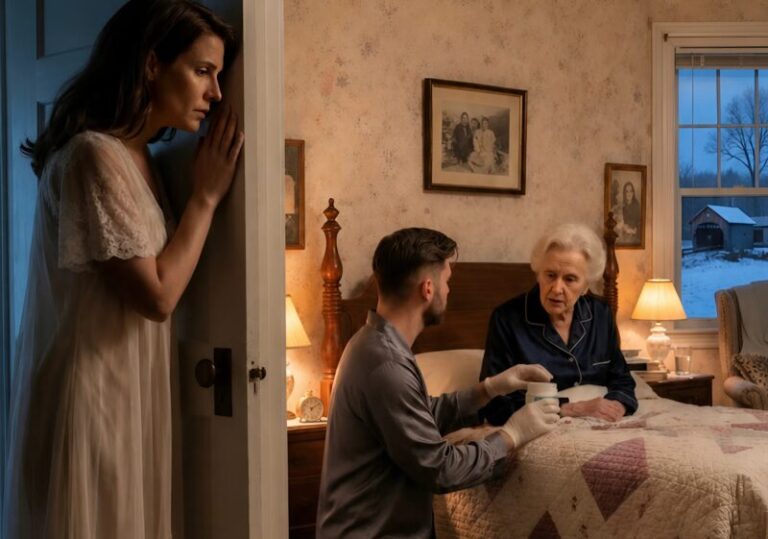
Months passed in the same pattern until one night I could no longer ignore my instincts. When Daniel left the bed again, I quietly followed him down the hallway. My heart was racing as I moved carefully across the creaking floorboards, unsure of what I would find but unable to stay in the dark any longer.
When I reached Margaret’s door, it was slightly open. Warm light spilled into the hallway. I looked inside—and what I saw immediately changed everything I thought I understood.
Margaret was sitting upright in bed, visibly distressed, shaking and crying as though she was trapped in a terrifying moment. Daniel was beside her, holding her hands and trying to calm her. Her voice broke as she spoke about seeing things in the room, reliving memories that did not feel like the present.
Daniel tried to reassure her softly, telling her she was safe and that she was home. On the nightstand, I noticed medication bottles and old photographs of a man in uniform. The atmosphere was not secretive in the way I had imagined—it was painful, fragile, and deeply emotional.
Later, Daniel finally explained the truth. His father had taken his own life years earlier in that same house after suffering from severe mental health struggles. Margaret had been the one who found him, and the trauma of that moment had never left her. Since then, she had suffered from intense nighttime episodes, including panic, hallucinations, and fear that felt completely real to her.
Daniel told me he had spent years staying with her during those episodes because she could not remain alone at night. Some nights were manageable, but others were overwhelming and frightening. He feared what might happen if she was left unattended during her worst moments.
The reason he never told me the full story was because Margaret had begged him to keep it private. She was ashamed of the past and afraid of being judged or abandoned. Daniel respected that request, even though it meant carrying the burden alone and allowing me to misunderstand what was happening.
Standing there that night, I felt a deep shift inside me. What I had interpreted as secrecy and emotional distance was actually responsibility, grief, and silent caregiving. The suspicion I had carried for months suddenly felt unfair and misplaced. I realized I had been watching only fragments of a much deeper reality.
Daniel was not hiding another life. He was holding together a family shaped by trauma, loss, and emotional dependency. Margaret was not distant because of rejection, but because she was still living with wounds that had never fully healed. And I had been standing in the middle of it, unaware of the full story.
That night changed how I understood love, silence, and trust. Sometimes, what looks like distance is actually protection. Sometimes, what feels like secrecy is really sacrifice. And sometimes, the truth behind closed doors is far more painful—and far more human—than anything we imagine in the dark.

