
Most adults understand that independence comes with responsibilities, but to a child, adulthood can appear simple and effortless. From a young perspective, daily comforts seem automatic, without much thought about the work required behind them.
A stable home, consistent meals, electricity, and internet access often feel like basic, guaranteed parts of life. However, these essentials require time, effort, planning, and financial responsibility that children rarely notice or fully appreciate.
This gap in understanding can sometimes lead to conflict between parents and children, especially during the teenage years, when young people begin testing boundaries and asserting independence without fully grasping consequences.

One widely discussed parenting story illustrates this dynamic clearly. It involves a mother who chose a creative and structured way to teach her teenage son a valuable life lesson about responsibility and appreciation.
In 2015, a single mother named Heidi Johnson faced ongoing challenges with her 13-year-old son, Aaron, who had begun displaying defiant behavior and resistance to household expectations.
At the time, Aaron had started earning a small amount of money through online content creation, which contributed to a growing sense of independence and confidence in his own decision-making.
This newfound income, although modest, led him to believe that he had reached a level of self-sufficiency that justified ignoring parental guidance, particularly when it came to schoolwork and responsibilities.
According to Johnson, her son began pushing boundaries more aggressively, refusing to complete homework and dismissing instructions, creating tension within the household and raising concerns about his long-term development.
During one argument, Aaron reportedly declared that he was a “free person” because he was making his own money, a statement that highlighted his misunderstanding of independence and responsibility.
Rather than responding with immediate punishment or anger, Johnson chose a more thoughtful and strategic approach aimed at teaching rather than simply disciplining her son.

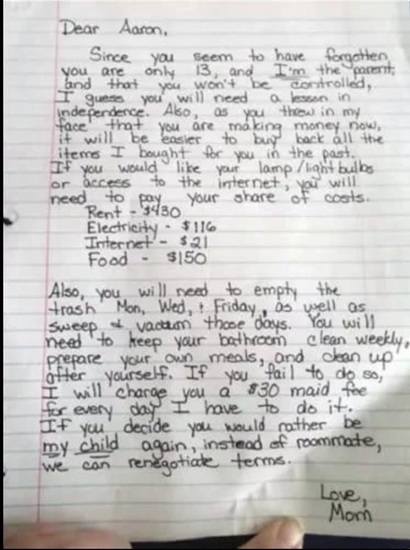
She decided to write a letter that would simulate a real-world scenario, presenting her son with a “roommate contract” designed to reflect the financial and personal responsibilities of independent living.
The letter began with a firm but calm tone, acknowledging his claim of independence while also reminding him of his age and the reality that he was still under parental care.
Johnson explained that if he truly wished to act as an independent individual, he would need to take on the responsibilities that come with that role, including financial contributions and self-sufficiency.
The contract outlined specific expectations, such as paying a portion of rent, covering utilities, and contributing to shared household expenses, reflecting the obligations most adults face daily.
In addition to financial responsibilities, the agreement also required him to manage his own daily needs, including preparing meals and maintaining cleanliness in shared living spaces.
Access to certain privileges, such as internet use and lighting, was also included in the contract, reinforcing the idea that these conveniences are not automatically guaranteed but come with associated costs.
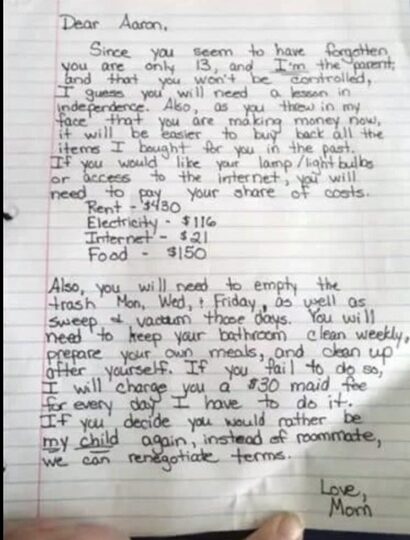
Despite the firm nature of the message, Johnson concluded the letter with a simple and caring sign-off, emphasizing that her actions were rooted in love and a desire to teach rather than punish.
When Aaron first saw the letter, his reaction was emotional and dismissive. He reportedly crumpled the paper and left the room, expressing frustration and resistance to the unexpected approach.
This reaction is not uncommon among teenagers, who may initially reject lessons that challenge their perception of independence or highlight gaps in their understanding.
However, Johnson remained patient, allowing her son time to process the situation rather than escalating the conflict or forcing immediate compliance.
During this time, she took practical steps to reinforce the lesson by removing certain items from his room, symbolizing the idea that ownership and access are tied to responsibility.
This action was not intended as punishment but as a tangible demonstration of the principles outlined in the letter, helping bridge the gap between abstract ideas and real-world consequences.

After some time, Aaron began to reconsider his position. The initial frustration gave way to reflection, and he approached his mother to discuss what steps he could take to regain his privileges.
This shift marked an important moment in the learning process, as it showed that he was beginning to understand the connection between actions, responsibilities, and outcomes.
Johnson later explained that her goal was never to collect money from her son but to help him develop an appreciation for the effort and cost associated with everyday living.
She emphasized that the exercise was designed to provide perspective, helping him realize that independence involves far more than simply earning a small amount of money.
Aaron quickly recognized that he would not be able to cover the expenses outlined in the contract, including rent, utilities, and food, which helped ground his understanding in reality.
This realization became a turning point, reinforcing the importance of parental support while also highlighting the responsibilities that come with true independence.
The story gained widespread attention after Johnson shared it publicly on social media, where it resonated with many parents facing similar challenges with their children.

Online reactions were largely supportive, with many users praising her approach as both creative and effective in teaching a meaningful life lesson without resorting to harsh discipline.
Some commenters noted that the agreement was not overly punitive but instead mirrored real-world expectations in a way that was both educational and fair.
Others highlighted the importance of preparing children for adulthood, emphasizing that lessons about responsibility are essential for long-term success and personal growth.
The discussion also sparked broader conversations about parenting styles, particularly the balance between discipline, guidance, and fostering independence in children.
While many praised Johnson’s method, some critics raised concerns about whether sharing the story publicly might embarrass her son or expose him to unnecessary attention.
In response, Johnson addressed these concerns by explaining her intentions and reaffirming that her primary goal was to teach, not to shame or criticize her child.
She pointed out that adolescence is a developmental stage where individuals naturally test boundaries as they transition from childhood toward adulthood.
This period often involves a desire for independence combined with limited experience, making it essential for parents to provide guidance while allowing room for growth and learning.
Johnson emphasized that her approach was rooted in preparing her son for the realities of adult life, where responsibilities cannot be ignored or postponed without consequences.
She noted that in the real world, expectations from employers, educators, and society require accountability, consistency, and the ability to follow through on commitments.
By introducing these concepts early, she aimed to equip her son with the tools needed to navigate future challenges successfully and responsibly.
Her message also underscored a broader truth: that the comforts of daily life are supported by effort, sacrifice, and planning, often carried out by parents or caregivers.
Understanding this reality can foster gratitude and respect, qualities that are essential for healthy relationships and personal development.
The story serves as a reminder that effective parenting often involves creativity and adaptability, especially when addressing complex behavioral challenges.
Rather than relying solely on punishment, Johnson’s approach focused on education, encouraging her son to think critically about his actions and their implications.
This method aligns with modern parenting strategies that emphasize teaching life skills and promoting long-term understanding rather than short-term compliance.
It also highlights the importance of communication, as the letter provided a clear and structured way to express expectations without escalating emotional conflict.
By framing the lesson as a real-world scenario, Johnson helped her son connect abstract ideas about responsibility to tangible experiences he could understand and relate to.
Such experiences can be particularly impactful during adolescence, when individuals are developing their sense of identity and independence.
The outcome of the situation suggests that the approach was effective, as Aaron eventually acknowledged his limitations and began working toward regaining trust and privileges.
This process of reflection and adjustment is a key part of personal growth, helping young people learn from their mistakes and develop a stronger sense of accountability.
The story continues to resonate years later because it addresses universal themes of parenting, responsibility, and the transition from childhood to adulthood.
It also illustrates how challenges within families can become opportunities for learning and development when approached thoughtfully and constructively.
Ultimately, Johnson’s experience highlights the importance of preparing children for the realities of life, ensuring they understand that independence comes with both freedom and responsibility.
Her creative solution demonstrates that lessons about accountability can be both firm and compassionate, balancing discipline with care and understanding.
For parents, the story offers inspiration and practical insight into how to address similar situations with patience, creativity, and a focus on long-term growth.
For young people, it serves as a reminder that independence is not defined solely by earning money but by the ability to manage responsibilities and contribute meaningfully to daily life.
The broader message is clear: nothing truly comes without effort, and understanding this principle early can lead to greater success and appreciation in the future.
By teaching this lesson in a memorable and engaging way, Johnson helped her son gain valuable insight that will likely benefit him throughout his life.
In the end, the story is not just about discipline but about guidance, growth, and the ongoing journey of learning what it truly means to be independent.

