
For millions of viewers, Macaulay Culkin remains closely associated with the holiday classic Home Alone. His portrayal of Kevin McCallister made him one of the most recognizable child actors of the 1990s and turned his face into a permanent part of popular culture. Behind that extraordinary success, however, Culkin has described a childhood that was far more complicated than audiences could see on screen. Fame arrived quickly, professional responsibilities became enormous, and tensions inside his family eventually became part of a highly publicized legal dispute.
Years later, Culkin would explain that one of his most important decisions as a teenager was to remove both parents from control of his trust and place his finances under independent management. Culkin was born on August 26, 1980, and entered acting at a very young age. By the time Home Alone was released in 1990, he was already experienced enough to carry a major studio comedy despite still being a child. The movie became an enormous commercial success and transformed him almost overnight from a promising young performer into an international star.
Kevin McCallister became one of the defining movie characters of the decade, and Culkin suddenly found himself at the center of one of Hollywood’s most successful family films. His early compensation reflected how rapidly his career changed. Culkin reportedly received about $110,000 for the first Home Alone, a substantial amount for a child actor but modest compared with what followed. After the film became a worldwide phenomenon, his value to the studios increased dramatically. For Home Alone 2: Lost in New York, his reported salary rose into the millions. That extraordinary jump showed how quickly Hollywood had come to regard him as a major box-office attraction.
More high-profile roles followed. Culkin appeared in My Girl in 1991, a film that became another memorable part of early-1990s cinema. He later took on a much darker character in The Good Son in 1993, demonstrating that his career was not limited to comedy. Projects including The Pagemaster, Getting Even with Dad and Richie Rich kept him working at a pace that few children could have sustained for long.
From the outside, the career looked enviable. Culkin had fame, major roles and income that most adults could never imagine earning. From his own later perspective, however, the schedule eventually became exhausting. He has said that acting began to feel less like an adventure and more like work. He wanted to spend more time in school and experience a life closer to that of an ordinary teenager.
The situation was further complicated by the fact that his parents were deeply involved in managing his career. Culkin’s father, Kit Culkin, had substantial influence over professional decisions during the years when Macaulay was becoming famous. His mother, Patricia Brentrup, was also involved in the family and career structure. This meant that business, parenting and family relationships were closely connected at a time when huge amounts of money were beginning to flow through Culkin’s work.
Years later, Macaulay described his relationship with his father in very negative terms. He has said he viewed Kit as controlling and abusive. Those statements are Culkin’s own recollections of his childhood and should be presented as such rather than as an independent judicial finding about every event. His memories nevertheless provide important context for understanding why he later wanted greater independence over both his career and his finances.
Culkin has recalled situations in which he felt his father used control to remind him who held authority in the household. In one interview, he described being made to sleep on a couch despite the fact that his acting had already made him extremely successful. The way Culkin told the story, the point was not comfort but power. To him, the incident represented the contradiction of being financially valuable while still lacking basic authority over his own circumstances.
He also said he was kept in the dark about how much money he was earning. According to Culkin, newspapers containing information about his finances could be hidden from him. That meant he could see himself becoming famous without necessarily understanding the scale of the contracts and income being negotiated on his behalf.
This imbalance is one of the most unusual features of childhood celebrity. A child can become more financially successful than the adults around him while remaining legally dependent on those same adults. He may be the person whose work generates the money, but parents, managers, lawyers and trustees still control the practical decisions surrounding it. Culkin’s experience became a particularly visible example of that problem.
The family situation became far more public when Kit Culkin and Patricia Brentrup separated in the mid-1990s. Their separation developed into a bitter custody dispute that attracted extensive media attention. Because both had been involved in managing the careers of their children, the legal conflict raised questions about who would also have influence over Macaulay’s professional and financial future.
During that period, serious allegations were made on both sides. Patricia accused Kit of mistreatment and controlling behavior, while Kit disputed accusations made against him. Courts had to deal with custody questions while the media closely followed the family’s finances and the enormous amount Macaulay had already earned.
The money involved became one of the most widely discussed parts of the story. Some reports from that period estimated Culkin’s total earnings or career value at figures reaching tens of millions of dollars. Later accounts have suggested that the trust itself was worth considerably less than the often-repeated figure of $50 million. Because different reports were measuring different things, it is more accurate to say that Culkin had accumulated a very large multimillion-dollar fortune rather than treating one exact number as indisputable.
What mattered most to Culkin was who controlled the money. He later explained that watching the family conflict made him want financial management separated from both parents. He did not want the trust to become another area in which one parent could be placed against the other.
That decision eventually gave rise to one of the biggest misconceptions about his childhood. For years, headlines claimed that Culkin had legally “divorced” or “emancipated” himself from his parents. Culkin has repeatedly said that this was not an accurate description of what happened.
According to his own explanation, he legally removed both parents’ names from his trust and appointed an independent executor to oversee the money. The purpose was not to erase his family relationship through a dramatic act of rebellion. It was to place his earnings under neutral financial management so that neither parent had direct control over them.
Culkin has said he intentionally removed both names rather than only his father’s. If he had taken Kit off while leaving Patricia in control, the decision could have appeared to favor one side in the family dispute. By removing both, he believed he was making the arrangement more neutral.
That nuance is important. The story often became simplified into the image of a famous teenager going to court to sever ties with his parents. In reality, Culkin’s own account focuses much more specifically on trust management and financial independence. The legal step was designed to protect the money he had earned from becoming another part of the conflict.
The fact that he was still a teenager makes the situation especially remarkable. Most people at that age are learning basic financial responsibility. Culkin was dealing with lawyers, trustees and millions of dollars because his childhood work had already produced enormous wealth.
At the same time, he was also trying to step away from acting. After years of constant work, Culkin largely withdrew from major film roles in the mid-1990s. He wanted a break from an industry that had dominated much of his childhood. That decision coincided with the family dispute and gave him an opportunity to experience a quieter adolescence.
His withdrawal did not make him less famous. Home Alone had already become a cultural institution. Every holiday season returned Kevin McCallister to television screens, and younger generations continued discovering the film. Culkin could stop making new children’s movies, but his most famous character remained visible year after year.
That created an unusual kind of lifelong recognition. As Culkin grew older, audiences continued associating him with a child who never aged on screen. The contrast between adult Macaulay and ten-year-old Kevin became part of his public identity.
For a time, Culkin appeared relatively distant from traditional Hollywood. When he returned to acting, he often selected projects that had little resemblance to the family films that had made him famous. This allowed him to establish a different adult identity without trying to recreate the career he had experienced as a child.
One of his most notable adult roles came in Party Monster, released in 2003. Culkin played Michael Alig, a character radically different from Kevin McCallister. The project demonstrated that he was interested in taking risks rather than simply repeating the persona audiences already knew.
He continued making occasional appearances in television, film and comedy projects while avoiding the relentless schedule of his early career. His choices became increasingly unconventional. At different times he worked in independent films, comedy projects and music-related ventures.
One of the most unusual examples was The Pizza Underground, a comedy rock project that rewrote Velvet Underground songs with pizza-themed lyrics. The project reflected Culkin’s willingness to approach fame with humor and to participate in work that had little to do with conventional movie-star expectations.
He also became involved in online comedy and podcasting. These projects allowed him to joke about his own celebrity and the strange experience of having been one of the most famous children in the world. Instead of constantly trying to escape Home Alone, he gradually appeared more comfortable acknowledging it while also making fun of the cultural mythology surrounding his childhood.
His television work later included American Horror Story: Double Feature. The role gave Culkin another opportunity to show audiences an adult performance far removed from the holiday comedy that had defined his childhood image. The appearance was widely noticed because it reminded viewers that he remained an active and capable performer.
In more recent years, Culkin continued choosing projects selectively. He joined the voice cast of Zootopia 2, known as Zootropolis 2 in some markets. He voiced Cattrick Lynxley, while his partner Brenda Song also appeared in the animated film as another member of the same fictional family.
Culkin also became involved in the second season of Fallout, the television adaptation of the popular video-game franchise. The science-fiction setting represented another dramatic departure from the kind of work people associated with him during childhood.
He has also made playful appearances connected with Running Point, the Netflix comedy starring Brenda Song. These projects show how different his relationship with acting became in adulthood. Instead of constantly working because a management structure demanded it, he could choose when and how he wanted to participate.
That freedom is closely connected with the financial decisions he made while young. Because his earnings were protected and he remained financially secure, Culkin did not need to accept every available project simply to survive. He could take long breaks, experiment with unusual work or return to mainstream entertainment when something interested him.
This is an important part of his story. Many former child actors face serious financial difficulties later in life. Culkin’s trust arrangement appears to have helped preserve enough of his earnings to give him independence as an adult.
Financial independence changed the meaning of acting for him. As a child, he had described performance as increasingly feeling like work he wanted to escape. As an adult, he could treat acting as an option rather than an obligation.
His personal life also became much more stable. Culkin began a relationship with actress Brenda Song after the two worked together on Changeland. They later became engaged and built a family together. The couple have two children.
Becoming a father gave Culkin a dramatically different role from the one he occupied during his own childhood. He had spent his early years being managed within a family business while surrounded by international attention. As an adult, he had the opportunity to decide how much exposure and pressure his own children would experience.
Culkin and Song have generally kept many details of their children private. That approach stands in sharp contrast with the enormous visibility Culkin experienced before he was old enough to decide whether he wanted it. His sons are growing up with two famous parents, but their childhood does not have to follow the same pattern as his own.
Culkin has also become more reflective about the difficult aspects of his past. He does not deny the family conflict or the behavior he says he experienced. At the same time, he has said that he eventually reached a point where he could recognize that his life had also given him substantial advantages.
In interviews, he has discussed the fact that he came through childhood fame with money, recognition and the ability to create a comfortable adult life. His perspective is not that the difficult experiences did not matter. Rather, he has tried to place them inside a larger story that includes survival, independence and personal happiness.
This is a much more complicated position than simply saying childhood fame ruined him. Culkin has clearly described painful experiences. He has also resisted allowing those experiences to become the only explanation of his adult life.
His relationship with his father appears to have remained deeply strained. Culkin has continued speaking critically about Kit in adulthood and has described their estrangement. Other members of the Culkin family have also publicly discussed complicated relationships with their father.
Those family accounts add context, but they should still be presented carefully. Personal recollections are not the same thing as court findings. The most accurate way to describe the situation is that Macaulay has consistently characterized his father’s behavior in strongly negative terms and has explained how he believes that behavior affected his childhood.
The public record also shows that the parental custody dispute involved serious accusations and counterclaims. It was not a simple situation in which every detail was proven exactly as reported in tabloids. That is another reason responsible retellings should distinguish personal allegations from established legal facts.
The same caution should be used with the money. Claims that Culkin definitely had a $50 million trust fund continue circulating online, but later reporting suggests the trust itself may have been closer to the $15 million to $20 million range. Some larger numbers appear to have referred to career earnings or estimates rather than the amount directly sitting under trust management.
This may sound like a technical difference, but it matters when trying to tell the story accurately. Gross earnings are not the same as personal assets. Taxes, commissions and professional expenses can significantly reduce the amount an actor actually retains.
Culkin’s early salaries show how fast the earnings accumulated. The first Home Alone salary was a fraction of what he later received. By the sequel, he was commanding millions. Other major films added further substantial payments.
That financial growth also meant that his parents’ roles were no longer ordinary parental supervision. They were participating in a multimillion-dollar entertainment career. Contracts, agents, studios and legal structures were becoming part of family life.
This can be difficult even in stable households. In a family already experiencing conflict, the pressures can become much greater. Culkin’s experience demonstrates how quickly money and caregiving can become intertwined when a child becomes the household’s most financially successful member.
The decision to use an independent executor was therefore more than a technical adjustment. It represented an attempt to create a boundary between family relationships and financial control.
The money was his.
The parents were in conflict.
The trust needed neutral management.
That was the logic Culkin later described.
Once framed that way, the famous “divorced his parents” story looks much less sensational. It becomes a financial-protection decision rather than a dramatic rejection of family.
Culkin has said that removing the money from the center of the dispute helped parts of the conflict move more quickly. If neither parent controlled the fortune, one major incentive for fighting over management disappeared.
This does not mean money was the only source of the custody dispute. Family relationships were clearly complicated on their own. But separating the trust removed one especially sensitive issue from the equation.
The episode became one of the most famous examples of why child performers need independent protection of earnings. Children may have enormous financial value while still lacking the maturity or legal authority needed to oversee contracts themselves.
Parents can help.
Managers can help.
Trustees can help.
But conflicts of interest become possible when the same adults are simultaneously parents, business managers and beneficiaries of the child’s work.
Culkin’s case made those tensions visible to a huge public audience.
The story also helps explain why he eventually valued privacy and independence so strongly. Childhood fame had exposed nearly every part of his family life to public scrutiny. Court arguments became entertainment news. His salary became a headline. His relationship with his parents became part of celebrity culture.
As an adult, Culkin built a much more selective public presence.
He still gives interviews.
He still works in entertainment.
He still jokes about Home Alone.
But he is no longer constantly available to the industry.
That ability to control access is itself a major change from childhood.
His relationship with Brenda Song appears to have become part of that stability. The couple have been together for years and have created a family life that Culkin often describes warmly.
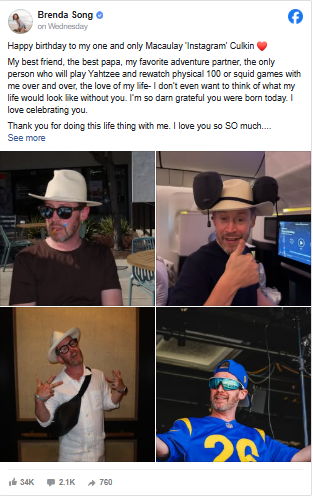
His birthday in 2026 offered a small example of how far his public image had shifted. Instead of headlines focused on custody battles or child-star money, attention centered on his relationship, family and continuing career.
The man being discussed was no longer simply “the kid from Home Alone.”
He was an adult actor with a partner, children and the freedom to choose his projects.
Still, Home Alone remains impossible to separate completely from his identity. The film became too culturally important and too emotionally meaningful to audiences. Culkin appears to understand that now more than he did when he was younger.
Rather than rejecting the movie, he has participated in affectionate references and parodies. This suggests he has found a way to accept what the film means to other people without allowing it to define every part of his life.
That is perhaps one of the clearest signs of how his relationship with fame evolved.
As a teenager, fame was something he wanted to escape.
As an adult, he could decide how to use it.
The same applies to money.
As a child, the fortune existed largely around him.
Adults discussed it.
Adults managed it.
Courts heard arguments connected to it.
As an adult, financial security gave him choices.
That transformation from being controlled by success to controlling what success meant is one of the most important themes in Culkin’s story.
It also explains why his later comments can sound unexpectedly calm given what he says he experienced.
He does not claim the past was easy.
He does not deny the damage.
But he also does not present himself as permanently trapped by it.
Instead, he has emphasized the things he eventually built.
A stable home.
A long-term relationship.
Children.
Financial independence.
And a career that operates largely on his own terms.
That perspective is important because former child stars are often discussed only through extremes. They are either presented as perfect success stories or as cautionary tales.
Culkin’s life does not fit neatly into either category.
His childhood included extraordinary success and serious family turmoil.
His adolescence included legal conflict and withdrawal from acting.
His adulthood included experimentation, long breaks and eventual stability.
All of those things are true at the same time.
The trust-fund decision belongs within that larger process.
It was one step in gaining control.
Not a complete solution to every family problem.
Not a dramatic divorce from his parents.
But a practical attempt to keep the money he earned from being controlled by either side in a bitter dispute.
That distinction makes the story both less sensational and more meaningful.
It shows a teenager trying to create neutrality in a situation where every adult around him appeared to be taking sides.
The fact that he had millions of dollars only made the stakes higher.
It also made the problem more unusual than what most teenagers would ever face.
The career that created those millions began with a holiday comedy about a child accidentally left home alone.
There is an undeniable irony in that.
The fictional Kevin McCallister became famous for proving he could handle himself without adults.
The real child actor playing him eventually had to make difficult decisions about adult control over his own life and earnings.
The two stories are not the same, of course.
But the contrast is striking.
Today, Culkin’s life looks very different from both.
He is no longer the isolated child in a comedy.
He is no longer the teenager caught inside a custody battle.
He is an adult who has had decades to decide what parts of his early life he wants to keep, reinterpret or leave behind.
He continues to act.
He continues to be recognized.
And every Christmas, Kevin McCallister returns.
But the man behind that character has moved far beyond the circumstances that first made him famous.
That is why the most accurate version of Macaulay Culkin’s story is not simply about a child star with a large trust fund.
It is about a young performer who became enormously successful before he was old enough to control what success meant.
It is about family relationships becoming entangled with money and career.
It is about a teenager choosing independent financial management during a painful custody dispute.
And it is about an adult who eventually built a life in which acting, fame and money were no longer controlled by other people.
Culkin has never suggested that everything about childhood fame was good.
Nor has he suggested that everything was ruined.
His own reflections are more balanced than that.
He experienced things he has described as deeply painful.
He also came away with resources and opportunities that helped him create a very different adulthood.
That complexity should remain part of any responsible account.
So should the factual distinctions.
He did not simply “divorce” his parents.
He removed both parents from control of the trust.
The exact size of that trust should not be exaggerated.
And accusations involving his father should be attributed to Culkin rather than presented as blanket legal conclusions.
With those corrections in place, the story remains powerful without needing sensationalism.
Behind the holiday nostalgia of Home Alone was a child experiencing adult levels of fame, money and responsibility.
Years later, Macaulay Culkin has been able to explain that chapter in his own words.
And perhaps the biggest difference between then and now is simple.
As a child, much of his life was being decided by others.
As an adult, he finally gets to decide for himself.
