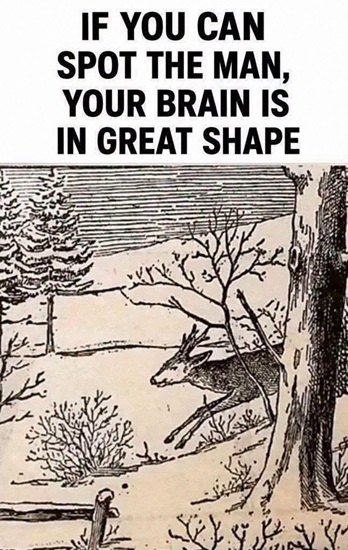
At first glance, the picture appears to show nothing more unusual than a peaceful winter landscape. Snow covers the ground, tall trees dominate the forest, and a deer stands out as the easiest recognizable subject in the scene. Because these elements fit naturally together, the eye can quickly accept the picture as an ordinary woodland view. But there is another pattern waiting to be discovered among the trunks, branches, shadows and pale areas of snow.
A human face has been incorporated into the scenery, and finding it requires looking beyond the objects that attract attention first. The challenge works because people do not consciously examine every visible detail with equal attention. Vision constantly organizes complicated information into recognizable objects and backgrounds. When the deer appears immediately recognizable, attention naturally tends to settle on it, while the surrounding trees and snow are interpreted as scenery
This is normally an efficient way to understand a visual environment. In a hidden-image puzzle, however, the same tendency can make another carefully constructed pattern much easier to overlook. The deer therefore acts as a particularly effective visual distraction. Its shape is recognizable without much effort, giving the viewer an obvious subject to examine.
Once the animal has been identified, the trees behind it can seem less important. Yet those apparently ordinary background elements contain the clues needed to perceive the hidden face. Discovering the second image often requires treating the background as though it were just as important as the obvious subject.
Instead of staring continuously at the deer, try scanning the entire picture slowly. Begin at one edge of the forest and gradually move toward the other. Pay attention not only to tree trunks and branches but also to the spaces between them. Look for unusual curves, contrasting edges and areas where several separate shapes appear capable of forming something larger. The hidden man may not resemble a conventional portrait until the relevant pieces are mentally grouped together.
Negative space can play an important role in illusions of this kind. The empty-looking areas between objects are not necessarily meaningless parts of the composition. A patch of snow can help suggest the shape of a cheek or forehead, while a darker gap between trees might contribute to the appearance of an eye. A branch may create one side of a nose without looking like a nose when examined independently. Meaning appears when several separate elements begin to function as parts of the same pattern.
That is why searching for a complete outline may not be the best strategy. The hidden face does not necessarily need a continuous border around the head, eyes, nose and mouth. One tree might provide an edge, another branch might suggest a facial feature, and a shadow could complete an area that initially seemed unrelated. Each component continues to look like part of the forest when viewed separately. The face emerges only when the viewer begins connecting them.
Human beings are highly familiar with faces, and the visual system can recognize face-like arrangements even when information is incomplete. This tendency can sometimes cause people to notice faces in clouds, rocks or other everyday patterns. In a deliberately constructed visual puzzle, similar perceptual tendencies can be used intentionally. Natural shapes are arranged so that they still resemble a forest while also supporting a second interpretation.
If the hidden man remains difficult to locate, changing the viewing distance may help. Move slightly farther away from the screen and examine the entire scene again. From close range, individual branches and textures can dominate attention. At a greater distance, some of those small details visually blend together, potentially making the larger pattern easier to notice. The picture has not changed; only the scale at which it is being examined has changed.
Making the image smaller can produce a related effect. When fine details become less prominent, broader shapes may stand out more clearly. A viewer who cannot identify the hidden face in a large image may occasionally notice it more easily in a reduced version. This does not happen for everyone or every puzzle, but it can be a useful technique when attention has become trapped among small details.
Another approach is to relax the gaze instead of concentrating intensely on one location. Staring harder does not necessarily make an alternative pattern appear. If attention remains fixed on the wrong area, increased concentration can simply reinforce the first interpretation. Looking at the picture more broadly can make relationships between separate trees, shadows and areas of snow easier to notice.
Temporarily covering the deer can also change the search. Because the animal is such a familiar and recognizable object, the eye may repeatedly return to it without the viewer consciously intending to do so. Removing it from view reduces one strong competitor for attention. The remaining landscape can then be examined as a collection of shapes rather than simply as scenery surrounding an animal.
Light and shadow are especially worth examining. The boundary between a bright area and a darker region can create an edge that resembles part of a facial feature. Snow naturally provides large light surfaces, while tree trunks and shadows create stronger dark contrasts. When these elements are arranged appropriately, the visual boundary between them can contribute to the appearance of a forehead, nose, mouth or other feature.
Branches are equally useful for constructing a hidden image because their shapes can appear completely natural inside a forest. A curved branch might contribute to the suggestion of an eyebrow. A vertical trunk could become part of the side of a head. Smaller branches may provide additional lines that acquire a different meaning once the face has been recognized. Before that moment, they remain ordinary pieces of vegetation.
Snow can function in much the same way. Large pale areas are easily dismissed as empty background because viewers expect snow throughout a winter landscape. Yet a bright region surrounded by carefully positioned darker shapes can become an important part of another visual form. Once the hidden image appears, an area that previously seemed empty may suddenly become essential to the face.
The most entertaining moment often occurs when one recognizable feature finally becomes visible. A viewer might spend several minutes seeing only trees and snow before suddenly noticing something that resembles an eye. Once that first feature is identified, nearby shapes can begin falling into place rapidly. The forehead, nose or outline of the head may then become much easier to recognize.
This sudden transition can make the experience feel almost surprising. A few seconds earlier, the viewer may have been convinced that no face was visible at all. After recognition, the same person may wonder how it was possible to overlook something that now seems obvious. Nothing in the picture has physically changed. The viewer has simply adopted a second way of organizing the same information.
After the face has been discovered, returning completely to the original view can become difficult. The branches that previously looked unrelated are now mentally connected. A shadow that originally appeared random may continue looking like part of an eye or mouth. The viewer already knows which pieces belong together, making the hidden interpretation much easier to recover.
This is one reason hidden-image puzzles can remain memorable after they have been solved. When the same picture appears again later, someone who struggled during the first attempt may recognize the face almost instantly. Memory now guides attention toward the relevant shapes. The puzzle has become easier because the viewer no longer needs to discover the alternative arrangement from scratch.
Context can also influence what people notice. If someone is simply shown a picture described as a snowy forest with a deer, they have little reason to search for a human face. The visual system interprets the available information according to that expectation. Once the person is told that someone is hidden in the scene, attention changes and potentially meaningful shapes receive closer examination.
This makes carefully chosen hints particularly effective. Instead of immediately revealing the location, tell another viewer to stop focusing on the deer. If that does not work, suggest examining the spaces between the trees or the boundaries between light and shadow. Such clues change the search strategy without completely removing the challenge. The viewer still experiences the moment of recognition independently.
Different people can discover the same face through different clues. One viewer may first notice an eye-like shape, while another recognizes the forehead or nose. Someone else may perceive the general outline of a head before identifying individual facial features. There is no requirement that recognition begin at exactly the same point for everyone.
The amount of time required can also vary considerably. One person may see the hidden man almost immediately, while another might need several minutes. That difference should not be treated as a meaningful measurement of general intelligence. Hidden-image puzzles are recreational visual challenges, not standardized intelligence tests, and solving one quickly does not establish a person’s overall cognitive ability.
Experience with similar puzzles can make a substantial difference. Someone who frequently looks at optical illusions may already know to search negative space and examine larger patterns. Another viewer may naturally focus on the most obvious object because that is how ordinary photographs are usually interpreted. Familiarity with a particular kind of puzzle can therefore influence performance without indicating a broader difference in intelligence.
Screen size can affect the experience as well. On a large display, every branch and texture may be clearly visible, which can encourage close examination of small details. On a smaller display, some of those details blend together and larger shapes can occasionally become more noticeable. At the same time, an image that is too small may hide useful visual information, so there is no single viewing size that works best for every person.
Contrast and brightness can also influence visibility. Dark shadows may appear differently across phones, tablets and computer monitors. A subtle boundary that contributes to the hidden face could be clearer on one display than another. This provides another reason not to interpret differences in solving speed as evidence about someone’s intelligence or visual ability.
Fatigue and concentration can affect the search too. Someone who has been staring at the same image for several minutes may repeatedly inspect the same locations without noticing anything new. Taking a short break can sometimes be more useful than continuing to stare. When the viewer returns, attention may no longer follow exactly the same unsuccessful pattern.
This is why some people suddenly find the answer after looking away for a while. The hidden figure was always present, but the initial search strategy had become repetitive. Returning with fresh attention can allow a different part of the picture to stand out. A previously ignored shape may then provide the clue needed for recognition.
Rotating the image can be another interesting experiment. When a forest scene is turned sideways or upside down, familiar objects become less immediately recognizable in their normal orientation. Trees no longer appear upright, and the deer no longer occupies its expected position. This can weaken the first interpretation and encourage the viewer to focus more on abstract lines, shapes and contrasts.
The same principle applies when reducing the image to a thumbnail. Smaller versions emphasize the overall arrangement while minimizing some fine details. If the hidden face depends strongly on a large silhouette, this can make it easier to recognize. These techniques do not introduce any new visual information; they simply alter how strongly different elements compete for attention.
Searching for a single facial feature can also be easier than searching for an entire person. Instead of asking, “Where is the man?” try asking whether any combination of shadows resembles an eye or whether a curved line could form part of a nose. Once one feature seems plausible, inspect the surrounding area for other features that support the interpretation.
Recognition can then spread outward from that first clue. An eye provides a reference point for where a nose or forehead might logically appear. Nearby branches that previously seemed random can begin to fit the expected structure of a face. The brain now has a possible pattern to test against the remaining visual information.
The winter forest is an effective setting for this type of puzzle because natural environments contain many irregular forms. Tree trunks create strong vertical lines, branches cross at unpredictable angles, and shadows produce shapes with no simple geometric structure. Snow adds large bright areas that contrast sharply with darker vegetation. Together, these elements provide many opportunities for concealing a second recognizable image.
A forest also allows unusual shapes to remain believable. A strangely curved branch does not automatically reveal that something has been intentionally hidden because real trees already contain complicated forms. Shadows can fall across snow in countless ways, and gaps between trunks naturally vary in size. An artist can therefore construct a hidden pattern without making the overall landscape appear obviously artificial.
The deer strengthens the illusion because it gives the viewer an immediate subject. Once a recognizable animal has been found, the mind has a convenient explanation for what the picture is about. The surrounding landscape becomes supporting scenery. In that sense, the deer does not need to hide anything physically; it simply attracts enough attention to make the background easier to overlook.
This demonstrates a general feature of selective attention. Visually prominent objects tend to receive more attention than less obvious surrounding information. In ordinary life, this helps people concentrate on relevant objects instead of consciously processing every detail simultaneously. Hidden-image puzzles turn that useful tendency into part of the challenge by placing important information where viewers initially expect only background.
The puzzle should nevertheless remain entertainment rather than a psychological diagnosis. Failing to find the hidden man does not demonstrate a problem with someone’s intelligence, personality or cognitive health. Similarly, recognizing the face within seconds does not prove exceptional intelligence. Making such claims would require evidence from appropriate validated assessments rather than a single recreational image.
Claims sometimes attached to viral puzzles should therefore be approached carefully. Statements such as “only one percent of people can see this” or “finding the face in ten seconds proves you are a genius” require credible evidence before they can be presented as factual. Without such evidence, they are better avoided. The puzzle remains interesting without exaggerated statistics or unsupported promises about what the result supposedly reveals.
Its genuine appeal comes from the perceptual shift. One moment the viewer sees a deer surrounded by snow and trees. The next moment, several of those same trees and shadows become part of a human face. Both interpretations rely on exactly the same picture. The surprise comes entirely from discovering another way to organize what was visible from the beginning.
Sharing the puzzle with friends can make that experience even more entertaining. Show them the winter scene without immediately pointing toward the hidden figure. Ask what they notice first. Many may naturally mention the deer because it is the clearest recognizable subject. Then tell them that another figure is hidden somewhere in the landscape and allow them time to search.
If they struggle, offer a small hint rather than revealing the answer. Suggest looking away from the animal or examining the gaps between trees. Another hint could mention the contrast between snow and darker areas. Gradually changing the viewer’s attention preserves the challenge while making the solution more accessible.
After everyone discovers the face, compare which clue worked first. Some people may have recognized the eye, others the nose, and others the overall outline. One viewer may have needed to move away from the screen, while another may have discovered it after shrinking the image. These different experiences demonstrate that people can reach the same visual interpretation through different paths.
The discussion can be more interesting than simply comparing completion times. Ask whether the face now seems impossible to ignore. See whether participants can switch deliberately between seeing the forest and seeing the hidden man. Notice which branches appear meaningful in one interpretation but ordinary in the other. The same image can continue producing two different visual experiences.
This ability to support more than one interpretation connects the puzzle with a wider family of visual illusions. In ambiguous images, a stable arrangement can sometimes be perceived in different ways depending on which features receive attention. The physical picture remains unchanged while the viewer’s interpretation shifts. Hidden-image puzzles use this effect by making one interpretation obvious and another deliberately less noticeable.
Once the second interpretation has been learned, it often becomes much stronger. Memory tells the viewer where the relevant shapes are located and how they should be grouped. What originally required active searching can later happen automatically. That is why showing the same puzzle to someone twice rarely produces the same challenge.
There is no digital movement required for the effect. The trees do not rearrange themselves, the deer does not need to move, and the hidden face does not suddenly appear through animation. Everything required for both interpretations can remain present in a single static picture. The changing element is the viewer’s organization of the scene.
This simplicity is part of what makes hidden-image puzzles so widely appealing. They require no special equipment, complicated instructions or specialized knowledge. A viewer needs only an image and enough curiosity to search for another pattern. The result can be understood almost instantly once it has been discovered.
The winter scene therefore offers more than a simple search for a hidden man. It provides an entertaining illustration of how quickly familiar objects can dominate attention and how background elements can acquire a completely different meaning once they are reconsidered. The forest remains a forest, but it can simultaneously contain another recognizable pattern.
If the man still seems impossible to find, avoid forcing the search. Look away briefly, return to the image from a slightly greater distance and examine the overall arrangement instead of individual branches. Try reducing the image size or temporarily ignoring the deer. Sometimes a change in strategy is all that is needed.
And when the face finally appears, notice how quickly the puzzle changes. What once looked like random branches, shadows and snow may suddenly seem carefully organized. The surprising part is not that new information has appeared. It is that information visible all along has acquired a second meaning.
That moment captures the real pleasure of the challenge. Hidden-image puzzles remind viewers that seeing an object involves more than simply receiving visual information. Recognition also involves organizing that information into patterns that make sense. When another pattern becomes available, the exact same scene can suddenly feel completely different.
So take another look at the snowy forest before asking for the answer. Ignore the deer for a moment, scan beyond the most obvious objects and pay attention to the relationships between light areas, shadows, branches and tree trunks. Do not worry about how quickly someone else solved it. The challenge is simply to discover the second image concealed within the first.
Once you have found the hidden man, share the scene without immediately revealing his location. Give other viewers enough time to experience the same transition from confusion to recognition. A subtle hint can help if necessary, but the most satisfying part is often discovering the pattern independently. The forest never changes; what changes is the way its shapes are seen.
