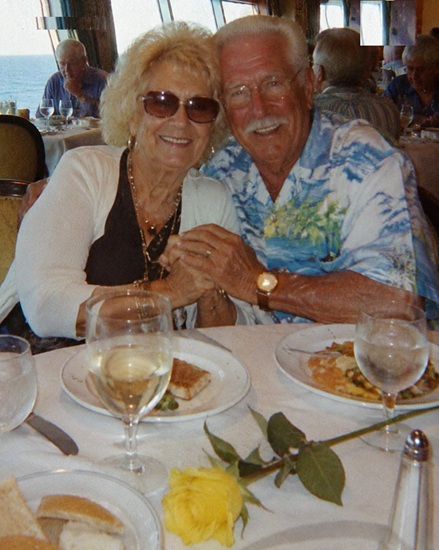
At seventy-one, I took my first cruise alone because I needed to prove something to myself. For nearly four decades, I had traveled with my husband, Peter, and after he died I realized how much of our shared life he had quietly organized. He handled reservations, maps, luggage, documents, and every small complication that came with being away from home. Three years after losing him, I finally decided I was tired of wondering whether I could manage without someone beside me.
So I booked the cruise, packed my own suitcase, and promised myself I would enjoy every moment. Then Richard appeared. He was seventy-four, widowed, observant, and unexpectedly funny. We met at dinner on the first evening when he made a dry comment about how a cruise ship could offer hundreds of dishes and still fail to serve the one thing he wanted. I laughed, and the conversation continued naturally. The next morning, he was nearby at breakfast. By the third day, we were walking along the promenade together.
I told myself not to read too much into it. Then he asked me to dance. Later, he told me about his late wife, Ellen. We talked about grief, aging, family, and how strange it felt to discover that life could still surprise you after seventy. By the final evening, I had started wondering whether Richard might be one of those surprises. We were sharing champagne when his phone buzzed. He read the message and stood abruptly. “I’m sorry. I need to take care of something.” Before I could ask what, he was gone.
Something about his expression unsettled me. Against my better judgment, I followed. The corridor below the main guest areas was quieter than anywhere else on the ship. The walls were plain, the doors unmarked, and I immediately knew I was somewhere passengers were not normally supposed to be. Then I saw my suitcase. It was sitting near an open door. Inside the room, my scarf lay across a bed. And taped to one wall were photographs of me.
Dozens of them.
Me boarding the ship.
Me eating breakfast.
Me standing near elevators.
Me reading alone.
Me walking the deck.
My heart began pounding.
Richard turned and saw me.
“Margaret.”
“What is this?”
His face changed.
“Please let me explain.”
“No.”
An alarm suddenly sounded through the corridor.
I pointed at the wall.
“You have photographs of me from before we even met.”
Richard looked toward the hallway.
Then back at me.
“Someone entered your cabin about twenty minutes ago.”
I stopped.
“What?”
“They used what appears to be a copied keycard.”
“How do you know?”
Instead of answering, Richard looked at the photographs.
That was when I noticed something I had missed.
I was not the only person appearing repeatedly.
In several pictures, the same man stood nearby.
He wore a blue baseball cap.
At embarkation, he was behind me.
At breakfast, he sat several tables away.
Near the elevators, he appeared again.
The more photographs I examined, the more often I found him.
“Who is that?”
Richard hesitated.
The ship’s alarm stopped.
A calm announcement followed, saying that a security situation had been resolved and asking guests to remain in public areas temporarily.
Security.
Not fire.
Not an exercise.
Security.
I folded my arms.
“Start talking.”
Richard stayed near the open doorway.
“My name is really Richard.”
“That is comforting.”
“I really am seventy-four.”
“Excellent.”
“I really am widowed.”
I stared at him.
“And?”
“I used to be a police detective.”
That was not what he had told me.
He had said he worked in insurance.
He explained that he had, but only after retiring from law enforcement following twenty-nine years as a detective.
“That still doesn’t explain why you have pictures of me.”
Richard took a breath.
“Because I was asked to keep an eye on you.”
My anger disappeared for a second.
“By whom?”
“Your daughter contacted the cruise company.”
I almost laughed.
Claire worried constantly.
She sent me articles about travel scams, food poisoning, falls, blood clots, bad weather, and every imaginable risk associated with traveling alone.
But secretly arranging for someone to follow me sounded extreme even for her.
Richard explained that Claire had not hired him personally.
She had reported a series of suspicious phone calls I had received before the trip.
That part was true.
For almost two months, someone claiming to work with the cruise company had repeatedly called me.
He knew details that made him sound legitimate.
My booking number.
My departure date.
My cabin deck.
At first, he offered upgrades and transportation.
Then the questions became personal.
Was I traveling alone?
Did I usually carry expensive jewelry?
Would someone be staying in my home?
Had I arranged for anyone to collect my mail?
I became suspicious and ended the call.
I told Claire.
She became furious when she learned that I had already confirmed my home address.
I blocked the number.
A similar call came from another number days later.
Eventually, I stopped mentioning them because I knew Claire would insist that I cancel the cruise.
Richard knew that too.
“How?”
“Because your name appeared in another investigation.”
That frightened me more than anything else he had said.
He explained that investigators had recovered a list of passengers believed to be potential targets for theft or fraud.
There were twelve names connected to the same sailing.
Most belonged to older travelers.
Many were traveling without spouses.
The man in the blue cap was traveling under the name Jason Miller, although investigators were not certain that was his real identity.
Security believed he might be connected to a group that targeted travelers before and during trips.
The suspected method was simple.
Someone would contact a passenger before departure while pretending to represent a legitimate company.
They would gather personal information.
Then, during the trip, members of the group could attempt to steal cash, cards, passports, identification, keys, or financial information.
In some related investigations, authorities suspected that victims’ homes had been targeted while they were away.
I sat down.
Not because Richard asked me to.
Because my legs suddenly felt weak.
“So you were watching me because I was on that list.”
“Yes.”
“And you sat beside me at dinner on purpose.”
“Yes.”
That answer hurt.
The first conversation I had replayed in my head all week had not happened by chance.
Richard saw my expression.
“Breakfast the next morning was not part of the assignment.”
I looked at him.
“Neither was the champagne.”
He continued.
“Or the dancing. Or telling you about Ellen. Or asking where you’d live if you could choose anywhere.”
I wanted to believe that.
But I still had another question.
“How did my suitcase get here?”
Richard explained that the man in the blue cap had entered my cabin while I was at dinner.
Ship security had been monitoring him.
He removed my suitcase and carried it toward a service area.
Richard and security personnel followed.
The room we were standing in was not Richard’s cabin.
It was a security room.
When the suspect realized he was being followed, he dropped the suitcase and ran.
My scarf had fallen out when the zipper opened.
The photographs on the wall were part of the investigation.
Some came from ship surveillance cameras.
Others had been taken while Richard tracked the suspect’s movements around me.
They were not romantic souvenirs.
They were a timeline.
I looked again.
Me.
The blue cap.
Again.
And again.
“He was following me the entire cruise.”
“Yes.”
My anger returned.
“Why didn’t anyone tell me?”
Richard looked ashamed.
“Security hoped he would lead them to other people involved.”
“So I was bait.”
“No.”
“That is exactly what it sounds like.”
“We were supposed to prevent him from reaching your cabin.”
“But he did.”
“Yes.”
I hated that he admitted it so easily.
It made it harder to argue.
Then Richard opened my suitcase.
Inside, on top of my clothes, was a small electronic device sealed in an evidence bag.
“What is that?”
“A card reader, possibly.”
“It isn’t mine.”
“We know.”
There was also another keycard in a separate bag.
Security believed both items had been placed inside my luggage.
Why remained uncertain.
One theory was that the suspect intended to use my belongings to create a distraction or make unauthorized equipment appear to belong to me.
Richard was careful not to present that theory as a proven fact.
That mattered.
I asked the question I had been avoiding.
“Why me?”
His answer was quiet.
“Because you were traveling alone.”
That sentence stayed with me.
Traveling alone was precisely what I had been proud of.
I had booked the cruise because I wanted to prove that independence was still possible after Peter’s death.
Someone else had apparently looked at that same independence and seen vulnerability.
But what upset me just as much was realizing that Claire had responded by allowing people to make decisions about my safety without telling me.
Richard understood that better than I expected.
He told me more about Ellen.
She had lived with Alzheimer’s disease before she died.
During her final years, Richard had gradually taken control of almost every part of her life.
At first, it was necessary.
Later, he admitted, control became automatic.
“There were times she could still decide for herself,” he said. “And I stopped asking.”
Then he looked at me.
“Fear can make control feel like love.”
That sentence hurt because it described exactly what Claire had done.
A ship security officer named Elena arrived shortly afterward.
She explained the investigation more formally.
Several people had been under observation.
The man using the Jason Miller identity had entered my cabin.
He took my suitcase.
He ran after being confronted and later tried to enter another restricted area, triggering the security alert.
Another passenger was being questioned.
Authorities were also examining how passenger information may have been obtained.
I asked Elena one question.
“Was I in danger?”
She paused.
“We had no specific evidence that he intended physical violence.”
“That wasn’t my question.”
She nodded.
“There was risk.”
At least she said it.
Then I asked whether I should have been told earlier.
She hesitated again.
“Yes.”
That answer mattered more than anything else.
Not that everyone meant well.
Not that they believed they were protecting me.
Just that I should have known.
I gave my statement.
Then I collected my suitcase.
Richard followed me to the elevator.
“Margaret.”
I turned.
He looked exhausted.
“I’m sorry.”
“For what?”
“For meeting you under false pretenses.”
I waited.
“And for not telling you when it stopped feeling like an assignment.”
That one hurt.
Then he added something else.
“And for allowing you to be part of a situation involving real risk without giving you enough information to decide for yourself.”
That was the apology I needed.
The next morning, the ship docked.
Claire was waiting at the terminal.
She ran toward me and hugged me.
I let her.
Then I said, “You and I are going to have a very long argument.”
She started crying.
“I know.”
I asked why she had not told me what she knew.
Her answer came immediately.
“Because I knew you’d still go.”
I stared at her.
“That was the point.”
She looked confused.
“The decision was mine.”
“I was scared.”
“I know.”
“I thought if you understood how serious it was—”
“You thought I might choose something different from what you wanted.”
She lowered her head.
“Yes.”
I was angry.
I also understood her fear.
Those two feelings could exist together.
She apologized.
I believed her.
Twenty minutes later, Richard came through the terminal.
Claire looked at him.
Then at me.
Her expression changed.
“Oh.”
“What?”
“Nothing.”
“Claire.”
“He is not what I imagined.”
I glared at her.
Richard approached carefully.
He handed me an envelope.
Inside was a piece of paper with one thing written on it.
His phone number.
“No secret report?” I asked.
“No.”
“No photographs?”
He winced.
“I deserve that.”
“If I call?”
“I’d like that.”
“And if I don’t?”
“I’ll understand.”
That answer was exactly what I needed.
Choice.
I put the paper in my purse.
I waited two weeks before calling him.
I needed to know whether I missed Richard or simply missed the version of the cruise I had believed in.
Unfortunately for my pride, I missed Richard.
Our first real date took place on land.
I chose the restaurant.
I drove myself.
I told Claire where I was going because I wanted to, not because she demanded it.
Richard arrived early.
He looked nervous.
That made me smile.
We talked for three hours.
I asked questions.
Many questions.
He answered them.
Months later, we were still seeing each other.
Slowly.
Carefully.
Honestly.
Claire changed too.
She stopped tracking my location.
I changed passwords, reviewed my accounts, strengthened the security around my personal information, and became far more skeptical of unsolicited calls.
None of those precautions made me helpless.
Learning from danger is not the same as surrendering to fear.
That difference became one of the most important lessons of the entire experience.
People sometimes say I was lucky Richard happened to be there.
I was.
But I was also glad I asked questions.
Glad I followed when something felt wrong.
Glad I refused to accept secrecy simply because someone claimed it was for my protection.
At seventy-one, I learned something I should have understood much earlier.
Love does not cancel autonomy.
Concern does not erase another person’s right to know.
Protection should not require deception.
Not from your daughter.
Not from someone you may be falling in love with.
Not even from people who sincerely believe they are acting in your best interest.
Richard and I still share champagne occasionally.
Every time he raises his glass, he asks the same question.
“What are we drinking to?”
I always answer the same way.
“Full disclosure.”
And then we drink to that.
