
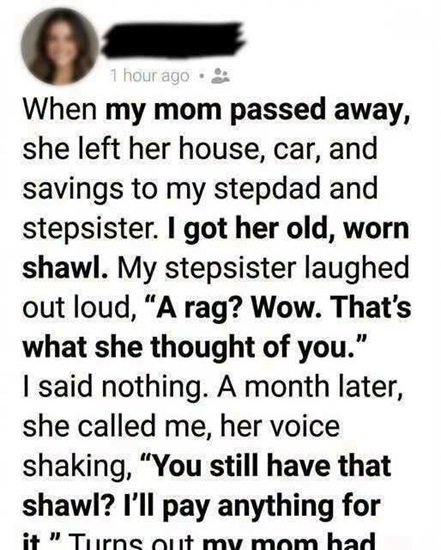
The afternoon my mother’s will was read, I entered the lawyer’s office believing I had prepared myself for whatever happened. Losing Mom had already changed everything, and I kept reminding myself that houses, cars, jewelry, and money could never replace her. Still, sitting beside relatives while a stranger divided the possessions she had collected throughout her life felt uncomfortable. Every item seemed connected to a memory, yet everyone around the table appeared focused on what each inheritance might be worth.
My sister Lila received several things with obvious financial value. Other relatives were assigned furniture, savings, personal belongings, and portions of the property. Nobody said much, but I could feel people quietly calculating what they had received. Then the lawyer reached my name. He looked down at the paperwork, reached beside his chair, and placed a small package in front of me. Inside was a shawl. Not an expensive designer shawl. Not something decorated with precious stones or rare material.
It was old, faded, and visibly worn. Several edges were frayed, and the fabric had become thin in places. I waited for the lawyer to continue. He didn’t. “Is there something else?” I finally asked. He checked the document. “No. Your mother specifically requested that this shawl be given to you.” A small laugh came from across the table. Lila. She quickly looked away, but I had heard her. After the meeting, she followed me into the hallway. “Well,” she said, “at least it’s sentimental.”
I looked at her.
“What is that supposed to mean?”
“Nothing.”
“Then why were you laughing?”
She shrugged.
“I’m just surprised. Mom was always very deliberate about these things.”
The implication was obvious.
According to Lila, Mom had deliberately left me something worthless.
I didn’t argue.
There was no point.
I placed the shawl carefully in my bag and went home.
That evening, I sat alone at my kitchen table and unfolded it.
Without relatives watching me, the shawl no longer looked quite as embarrassing.
I ran my fingers across the fabric.
Then I noticed the smell.
Lavender.
The scent was faint, almost completely gone, but I recognized it immediately.
A memory surfaced.
The shawl had belonged to my grandmother.
Suddenly, I could see her sitting near the living-room window with the fabric wrapped around her shoulders.
Grandma had not been an easy woman.
She was stubborn, demanding, and often painfully critical.
As she became older, those qualities became even more difficult for relatives to handle.
One by one, people stopped visiting as frequently.
Some had legitimate reasons.
Others simply became tired of arguments.
Mom stayed.
She continued visiting Grandma even when their conversations ended badly.
She bought groceries.
She arranged appointments.
She helped with cleaning.
When Grandma became less independent, Mom quietly assumed more responsibility.
She never expected anyone to congratulate her.
That was simply who she was.
Mom rarely expressed love through grand declarations.
She showed it by appearing when people needed her.
The shawl had been present throughout those years.
Grandma wore it constantly.
After she died, Mom kept it.
I remembered seeing it over the back of a chair and occasionally around Mom’s shoulders during cold evenings.
Once, years earlier, I had asked why she kept something so worn.
Her response came back to me.
“Old doesn’t mean worthless.”
At the time, I had barely thought about the sentence.
Now it felt different.
Maybe Mom had not intended the shawl as an insult.
Perhaps she had chosen it because she knew I remembered what it represented.
I folded it carefully and placed it inside my bedroom drawer.
For the next several weeks, life slowly returned to something resembling routine.
Then Lila called.
Her voice sounded strangely tense.
“Do you still have that shawl?”
“Yes.”
“You didn’t throw it away?”
“Why would I?”
“No reason.”
There was a pause.
Then she asked something unexpected.
“Would you sell it to me?”
I laughed.
“You mocked it three weeks ago.”
“I wasn’t mocking it.”
“You laughed.”
“I was surprised.”
“Same difference.”
She became impatient.
“I’ll give you five thousand dollars.”
That got my attention.
“For a faded shawl?”
“Yes.”
“Why?”
“I just want it.”
“No, you don’t.”
She went quiet.
I waited.
Then she increased the offer.
“Ten thousand.”
“Lila.”
“Twenty.”
“Stop.”
“What?”
“Tell me what you know.”
Another long silence.
Finally, she sighed.
“We need to meet.”
The following morning, Lila arrived at a quiet café carrying a folder.
She placed it on the table between us.
“The lawyer found additional documents connected to Grandma’s estate.”
“What documents?”
“Financial records.”
I frowned.
“Grandma died years ago.”
“I know.”
“So why are they appearing now?”
“Apparently some assets were handled separately from the property everyone knew about.”
I stared at her.
“How much?”
She avoided the question.
“Enough that you should consider my offer.”
That answered everything I needed to know.
“What does this have to do with the shawl?”
Lila opened the folder.
Within the fictional framework of this story, the documents described a separate estate arrangement created by Grandma years earlier.
Certain financial assets had been placed under specific inheritance conditions.
The old shawl was explicitly identified in those papers.
Under the fictional terms of the arrangement, legal ownership of that particular family heirloom was connected to the beneficiary entitled to claim those assets.
I read the paragraph twice.
Then a third time.
“This can’t be serious.”
“It is.”
“And Mom knew?”
“She must have.”
Everything suddenly looked different.
Mom had not randomly selected an old piece of clothing for me.
She knew exactly what the shawl represented.
Lila leaned toward me.
“I’ll give you fifty thousand.”
“No.”
“You haven’t even heard what the estate may be worth.”
“I don’t care.”
“You’ll care when you see the number.”
“You’re missing the point.”
Her expression hardened.
“What point?”
“You laughed when I received this.”
“I already told you—”
“You thought Mom had left me nothing.”
She looked away.
“So did I,” I admitted.
That surprised her.
“For weeks, I wondered whether you were right.”
Lila said nothing.
“I thought maybe Mom really had decided I mattered less.”
My voice became quieter.
“Now I understand.”
“Understand what?”
“She trusted me.”
Lila rolled her eyes.
“This isn’t some emotional puzzle. We’re talking about money.”
“No. You’re talking about money.”
I closed the folder.
“Mom was talking about something else.”
The legal situation was not resolved immediately.
Even in this fictional story, possessing an old object would not realistically cause millions of dollars to appear overnight.
Attorneys needed to examine the estate documents.
Ownership had to be established.
Financial records needed verification.
The relevant legal conditions had to be interpreted properly.
I followed that process rather than relying on Lila’s explanation.
Eventually, the fictional estate arrangement was confirmed.
Grandma had left substantial financial assets under conditions tied to the heirloom Mom had later legally passed to me.
The amount was enough to change my life.
But something unexpected happened.
By the time everything was settled, the money was no longer the most important discovery.
The most important discovery had happened that first evening at my kitchen table.
Lavender.
Grandma.
Mom.
Those memories explained why the shawl mattered long before I knew anything about additional assets.
Mom had spent years caring for Grandma.
She understood the history carried by that fabric.
And when she prepared her own will, she chose me to continue carrying it.
I wondered why.
Eventually, I remembered another conversation.
Years earlier, Mom and I had been cleaning Grandma’s home after she died.
Relatives had already taken the obvious valuables.
Jewelry disappeared first.
Then antiques.
Then furniture.
I picked up a small box of photographs that nobody wanted.
Mom watched me.
“You always notice the things everyone else leaves behind,” she said.
I had forgotten that moment.
Apparently, she hadn’t.
Perhaps that was why she gave me the shawl.
She believed I would keep it even when I thought it had no financial value.
And she was right.
I had taken it home.
I had not thrown it away.
I had not tried to sell it.
I had unfolded it and remembered.
That realization mattered more than proving Lila wrong.
The money eventually improved practical parts of my life.
I paid debts.
I created a financial cushion.
I made careful decisions rather than suddenly changing everything.
But I never sold the shawl.
Lila asked again once.
The answer remained no.
Our relationship became strained for a while.
Inheritance can reveal old resentments that families have spent years pretending do not exist.
Eventually, however, we talked.
Not about the money.
About Mom.
Lila admitted that she had laughed because she genuinely believed the shawl meant Mom had valued me less.
“I was cruel,” she said.
“Yes.”
“I’m sorry.”
I accepted her apology.
Then she asked whether I hated her.
“No.”
“Why not?”
“Because Mom spent her life teaching me that difficult relationships aren’t always disposable.”
Lila smiled slightly.
“That sounds like something she’d say.”
“It is.”
Our relationship did not become perfect afterward.
Real family relationships rarely transform because of one conversation.
But something improved.
We became more honest.
I also stopped comparing what Mom had left each of us.
Lila had received things she could use.
I had received something different.
The shawl became the last conversation I would ever have with my mother.
Not literally.
There was no hidden letter sewn into the fabric.
No secret recording.
No mysterious final message.
The meaning came from understanding why she had chosen that particular object.
Mom knew the shawl’s history.
She knew Grandma had worn it during difficult years.
She knew she had preserved it afterward.
And she knew I would recognize its significance eventually.
That was enough.
As the years passed, the fabric became even more fragile.
I learned how to store it properly.
I kept it away from direct sunlight and handled it carefully.
I never tried to make it look new.
The frayed edges belonged there.
They showed that the shawl had lived a life before reaching me.
Those imperfections became part of its value.
Whenever I unfolded it, I remembered three generations.
Grandma sitting beside the window.
Mom helping her despite their difficult relationship.
And myself sitting in a lawyer’s office believing I had received the least valuable inheritance in the room.
I had been wrong.
Everyone else had looked at Mom’s possessions and understood their immediate prices.
A house could be valued.
A car could be sold.
Savings had numbers attached to them.
Jewelry could be appraised.
The shawl seemed to have none of those things.
That was precisely what made it such an effective test of perspective.
Would I value something before knowing its price?
Mom apparently believed I would.
The hidden financial inheritance eventually proved that the shawl had monetary importance within this fictional story.
But that was not the lesson I carried forward.
Money can disappear.
Property can be sold.
Cars eventually wear out.
Even expensive possessions can lose their significance.
Memory works differently.
An ordinary object can become priceless because of what it connects us to.
For me, the shawl connected Grandma’s difficult final years with Mom’s quiet loyalty.
It reminded me that love is not always dramatic.
Sometimes love looks like driving someone to another appointment.
Sometimes it means returning after an argument.
Sometimes it means caring for a person who rarely says thank you.
And sometimes it looks like leaving an old piece of fabric to the one person you believe will understand.
I nearly failed to understand.
At first, I saw exactly what Lila saw.
Old fabric.
Frayed edges.
No obvious value.
Then I smelled lavender.
That changed everything.
The fortune came later.
The meaning came first.
Years afterward, people occasionally asked why I kept the shawl when I could have preserved something more attractive from Mom’s belongings.
I never gave them the complete story.
I simply said it belonged to my family.
That explanation was enough.
I no longer needed anyone else to understand its value.
Mom had understood.
Eventually, I did too.
The day her will was read, I walked out believing everyone else had inherited the important parts of her life.
The house.
The money.
The possessions people could immediately recognize as valuable.
I carried home something nobody wanted.
And that turned out to be precisely the point.
My mother’s final gift reminded me that value is not always announced.
Sometimes it waits quietly inside something ordinary until memory teaches us how to recognize it.
The shawl’s edges are still worn.
Its colors are still faded.
The lavender scent is almost completely gone.
But I would not exchange it for something new.
Its imperfections tell the story.
Grandma wore it.
Mom protected it.
And Mom trusted me to keep it.
The fictional fortune hidden behind the inheritance changed my financial circumstances.
The shawl changed something more important.
It changed the way I understood my mother’s final decision.
She had not forgotten me.
She had not pushed me aside.
She had not decided I deserved less.
She had given me the one possession whose value depended on looking beyond the surface.
And she had trusted that eventually, I would know why.
Sometimes the greatest inheritance is not the thing everyone immediately recognizes as valuable, but the thing that reminds us who truly understood us.

