
For twelve-year-old Daniel, hospital life had gradually become far too familiar. He knew the sound of carts moving through the hallway, the quiet voices of nurses changing shifts, and the routine questions doctors asked every morning. His parents, Laura and Michael, had learned those patterns as well. Their days revolved around appointments, medication schedules, long conversations with medical staff, and trying to make Daniel as comfortable as possible. Because Daniel was dealing with a serious fictional illness, his parents watched him closely almost all the time.
They believed they were protecting him, but Daniel sometimes wished they could stop watching him for a little while and simply be his parents again. Before their family routine changed, weekends had been much simpler. On Saturday afternoons, Michael and Daniel often watched football together while Laura claimed that she was not interested in the game. That claim rarely lasted more than a few minutes. Whenever a referee made a decision she disliked, she immediately complained louder than either of them.
Daniel loved teasing her about it, while Michael usually laughed from the couch. Sometimes Daniel would insist that his father misunderstood a play, and Michael would spend several minutes explaining why he was right. None of those moments had seemed particularly important at the time. They were ordinary family moments, and Daniel did not realize how much he valued them until they became less common. As his fictional treatment continued, football afternoons slowly began to feel different. Michael still turned on the game, but he rarely watched it without looking toward Daniel every few minutes.
If Daniel shifted in his seat, Michael asked whether he was uncomfortable. If he became quiet, his father wondered whether he was tired. Laura developed another habit. She began taking photographs constantly. She photographed Daniel eating breakfast, resting on the couch, laughing at television, and even making faces when he disliked hospital food. She told herself that she was preserving memories. Daniel understood why she did it, but sometimes he felt as though every ordinary moment had suddenly become an event that needed to be saved.
One afternoon, a fictional hospital support worker named Sarah sat beside Daniel and asked him a simple question. If he could plan one special day with his parents, what would he choose? Daniel did not spend much time thinking about it. He did not ask for an expensive vacation, a famous visitor, or an unusual gift. He wanted to attend a football game with his mother and father. Sarah asked whether there was anything else that would make the day perfect. Daniel thought for a few seconds and then shook his head. He did not want a complicated surprise. More than anything, he wanted the three of them to sit together, watch football, argue about bad plays, and laugh the way they used to.
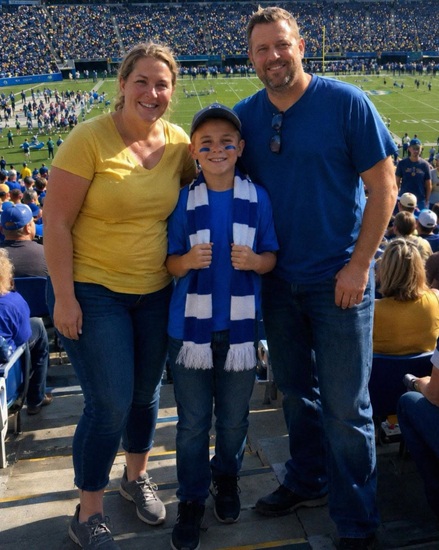
In this fictional story, arrangements were made so Daniel could attend a game safely and comfortably. When the family entered the stadium, the atmosphere immediately caught his attention. Thousands of voices echoed through the building, vendors called out to passing fans, music filled the corridors, and people wearing team jerseys moved in every direction. Michael instinctively asked whether the noise was too much for him. Daniel quickly told him it was fine. When they reached their seats and Daniel saw the field stretching out below them, he became quiet for a moment. After spending so much time surrounded by hospital walls, seeing the wide green field and thousands of excited fans felt almost unbelievable.
Laura immediately reached for her phone. She photographed Daniel looking toward the field, Daniel holding his drink, and Daniel laughing when the crowd reacted to the opening play. Michael, meanwhile, continued checking on him. He asked whether Daniel needed water, whether he was warm enough, and whether he wanted to rest. Daniel answered each question patiently until he finally looked at his father and smiled. “Dad, you’re missing the game,” he said. Michael insisted that he was watching. Daniel shook his head. He told him that he was not really watching football at all. Instead, he was watching Daniel watch football.
The comment surprised Michael because he knew there was some truth in it. For months, he had felt responsible for noticing every possible sign that Daniel needed something. He had become so focused on protecting his son that he sometimes forgot how to simply spend time with him. Laura had developed a similar habit in a different way. She wanted to document every smile because she feared forgetting important moments. Neither parent was trying to make Daniel uncomfortable. Their behavior came from love and worry. Yet Daniel wanted them to understand that constantly observing him made even simple family moments feel different from the way they once had.
During a quieter part of the fictional afternoon, Daniel tried to explain what he meant. He told his parents that he knew they worried about him and that he did not blame them. But he also admitted that he missed ordinary things. He missed Michael yelling at the television without immediately checking whether Daniel was okay. He missed Laura complaining about referees without stopping to take a photograph. He missed sitting on the couch and being treated like a boy watching football rather than someone whose every smile had to become a precious memory. What he wanted from the stadium trip was not a dramatic experience. He wanted a few hours when their family could feel familiar again.
Laura slowly lowered her phone while Daniel was talking. She realized that she had begun looking at many moments through a camera screen rather than experiencing them directly. Michael understood something similar about himself. He had convinced himself that being a good father meant remaining alert every second. Sometimes Daniel genuinely needed that attention, but not every second had to revolve around concern. Daniel was still their son, and being his parents meant more than monitoring him. It also meant laughing at his jokes, disagreeing with him about football, sharing snacks, and allowing an ordinary afternoon to remain ordinary.
When the game resumed, Michael made a deliberate effort to watch the field. A few minutes later, their team made a terrible mistake, and he reacted without thinking. He groaned loudly and complained about the play. Daniel immediately laughed. “That sounds more like you,” he said. Michael smiled. Soon afterward, a referee made a call Laura disliked. She shouted toward the field before remembering that she had been trying to stay quiet. Daniel turned toward her and asked whether she even understood the rule involved. Laura admitted that she probably did not, but she still believed the referee had made a terrible decision. Daniel laughed again, and this time she kept her phone in her pocket.
For the next part of the fictional game, nothing unusual happened to the family. No camera focused on them. Nobody made an announcement about Daniel. No famous athlete appeared beside their seats, and there was no dramatic stadium surprise. The game simply continued. Michael argued about strategy, Daniel insisted that his father was wrong, and Laura occasionally joined the debate despite knowing less about the rules than either of them. Daniel stole part of Michael’s snack after saying he was not hungry. Michael complained about it and then handed him more. The entire scene was completely ordinary, which was exactly why Daniel enjoyed it.
Late in the game, their team finally scored. Almost everyone around them jumped to their feet, and Michael stood up immediately. Daniel grabbed his father’s arm and laughed while Laura shouted along with the crowd. For several seconds, none of them thought about whether the moment should be photographed. They were simply reacting together. When they sat down, Daniel noticed that Laura had not reached for her phone. He asked why she had not taken a picture. Laura looked at him and smiled. She told him she wanted to watch the moment instead. Daniel studied her briefly and then nodded as though he understood exactly what she meant.
Michael soon began predicting what would happen during the next play. Daniel disagreed with him almost immediately. The two of them argued back and forth while Laura listened. She eventually added her own opinion, even though both of them reminded her that she barely understood the rule they were discussing. Laura responded that understanding every rule was not required to have an opinion. Daniel laughed so loudly that a few nearby fans turned toward them. Michael laughed too. It was the kind of ridiculous family argument they had once taken for granted. For Daniel, that familiar feeling mattered more than anything elaborate that could have been arranged for him.
The fictional story is not intended to suggest that families facing serious medical situations should ignore health concerns or professional medical advice. Daniel’s parents still needed to be attentive when he required help, and his fictional care remained important. What Daniel helped them understand was something more personal. Concern did not have to occupy every second they spent together. A family could take necessary precautions while still making room for ordinary conversation, humor, frustration, and fun. Love could appear through careful attention, but it could also appear through sharing food, laughing at the same joke, or simply watching a football game together.
When the fictional game ended, Laura realized that she had taken far fewer photographs than she expected. Surprisingly, she did not regret it. She still valued the pictures she had taken, but she understood that not every memory needed photographic evidence. Michael had also spent a long stretch of the afternoon without repeatedly asking Daniel whether he needed something. Daniel had received exactly what he had wanted. It was not a perfect day and it was not free from the reality his fictional family was facing. But for several hours, they had been able to behave like themselves again.
On the ride home, Daniel leaned against the window and listened while Michael continued talking about the final score. Laura noticed how tired Daniel looked and almost reached for her phone. Then she remembered their conversation and left it where it was. Daniel opened his eyes and noticed her looking at him. “What?” he asked with a small smile. Laura shook her head and told him it was nothing. She was simply enjoying the ride. Daniel smiled, closed his eyes again, and rested quietly while his parents sat beside him. No photograph captured that moment, but Laura knew she would remember it anyway.
The lesson within this fictional story is simple. Extraordinary circumstances can make people feel that every moment must become extraordinary too, but sometimes the moments people value most are the ones that feel completely normal. Daniel did not need every minute to become a ceremony or every smile to become a photograph. He wanted his parents beside him, laughing, arguing about football, and participating in the same afternoon. For Laura and Michael, learning to be present did not mean caring less. It meant understanding that being together and documenting being together were not always the same thing. And for one fictional afternoon, the three of them simply watched the game.

