
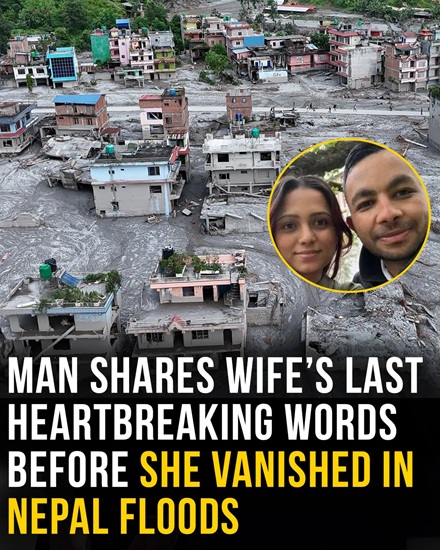
An ordinary early-morning telephone conversation became especially significant for Pramod Poudel after catastrophic flooding struck communities along the Nepal-Tibet border on August 26, 2026. Poudel, who lives in Uckfield in East Sussex, had spoken with his recently married wife, Sumitra, shortly before the disaster. Hours later, a devastating surge of water, ice, rock and sediment swept through Himalayan valleys and caused widespread destruction.
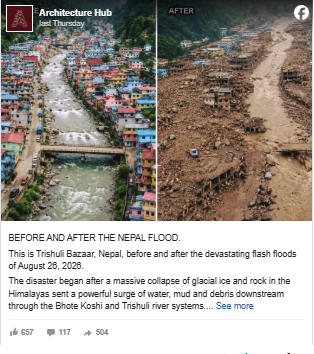
Roads, bridges and buildings were damaged or destroyed, while communications with some communities were interrupted. Poudel subsequently lost contact with Sumitra and three other members of his family. He later travelled from Britain to Nepal as he sought reliable information about what had happened to them. The disaster struck Nepal’s Rasuwa district and areas across the border in China’s Tibet Autonomous Region. A huge volume of water and debris travelled rapidly through mountain valleys, damaging settlements and critical infrastructure along its path.
Bridges were destroyed, roads became impassable and some communities were effectively isolated from surrounding areas. These conditions created major difficulties for rescue personnel attempting to reach people who might have survived. Communication and electricity disruptions added another layer of uncertainty for families trying to contact relatives. In the days after the disaster, emergency personnel continued searching difficult terrain while authorities worked to determine the full extent of the destruction.

Scientific analysis indicated that the destructive event was associated with a major glacial collapse in the Himalayas rather than an ordinary tectonic earthquake. Seismic activity associated with the event was initially detected, but subsequent analysis pointed toward the movement of an enormous quantity of ice and mountain debris. The collapsing material generated a fast-moving mixture of water, ice, rock and sediment that travelled downstream at extraordinary speed. Reports indicated that the destructive flow covered more than 14 miles in less than seven minutes.
Communities situated along the affected valleys therefore had extremely little time to respond once the event began. Scientists have continued examining the disaster to better understand how the collapse developed and why its downstream effects became so severe. The number of casualties and missing people increased as authorities obtained information from previously inaccessible areas. By August 31, Nepalese authorities reported that hundreds of bodies had been recovered in Nepal while approximately 4,200 people remained unaccounted for.
The situation continued changing as rescue teams expanded their searches and additional victims were identified. By September 2, reporting indicated that at least 1,050 people had died across the wider disaster zone and nearly 4,000 remained missing. These figures were not necessarily final because search, rescue and identification operations were continuing. In disasters of this scale, authorities may revise totals as missing individuals are located or additional information reaches emergency coordination centers.
For Pramod Poudel, those enormous numbers represented a deeply personal crisis. Poudel was born and raised in Nepal before moving to the United Kingdom when he was young, and he now lives in East Sussex. Following the flood, he reported that four members of his family could not be located: his wife Sumitra, his mother Tulasa, his brother Pradip and his uncle Madhav Prasad Poudel. His father, who was elsewhere when the disaster occurred, survived. Poudel tried to establish contact with relatives after learning what had happened but faced the same communication difficulties affecting many families in the disaster zone. With little reliable information available from a distance, he decided to return to Nepal.
The disappearance of Sumitra was particularly painful because she and Poudel had married only a short time before the disaster. After their marriage, Poudel returned to Britain for work while Sumitra remained in Nepal. They continued communicating by telephone despite being thousands of miles apart. According to Poudel’s account reported by news organizations, he spoke with his wife shortly before the flood struck and remembered her expressing her love for him during that conversation. He did not know at the time that communication between them would soon be interrupted. After news of the flood emerged, repeated attempts to reach her were unsuccessful, leaving him without confirmation of what had happened.
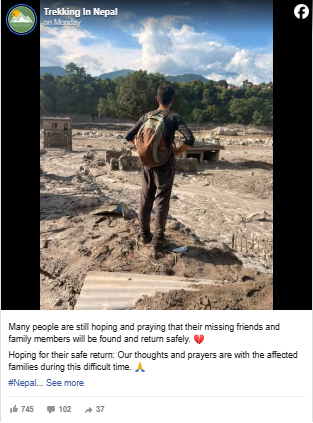
Poudel travelled to Nepal as the search operation continued, but simply reaching the affected region presented major difficulties. Floodwaters and debris had destroyed important bridges and damaged roads throughout the area. Some routes could not be crossed by ordinary vehicles, while other locations remained dangerous because of unstable ground and accumulated debris. Electricity and telecommunications were also disrupted in several communities, preventing families from easily contacting one another. These conditions meant that a lack of communication did not automatically provide information about whether someone had survived. For Poudel and many other relatives of missing people, waiting for verified information became one of the most difficult aspects of the disaster.
When Poudel reached Nepal, he encountered extensive destruction in the area connected to his childhood and family. Buildings and infrastructure had been damaged, while access problems continued to complicate attempts to search affected locations. He publicly described the situation as emotionally devastating and explained that his priority was reaching places where information about his relatives might be available. His wife, mother, brother and uncle continued to be reported as missing in the available reporting at that stage. Their status therefore should not be changed from missing to confirmed dead without reliable confirmation. That distinction remains especially important when reporting on disasters in which thousands of people have not yet been accounted for.
Poudel’s experience was one among thousands of similar situations created by the flood. Families throughout affected parts of Nepal and Tibet were searching for relatives while emergency workers examined damaged settlements, debris fields and infrastructure. Particular concern surrounded hydroelectric facilities and associated tunnel systems where workers were feared to have been trapped. Deep mud, unstable debris, destroyed transportation links and challenging Himalayan terrain complicated rescue efforts. Emergency personnel continued working despite these obstacles, and specialized resources were deployed where access was possible. The enormous geographic scale of the damage meant that obtaining a complete picture of the disaster required time.
Authorities also faced the difficult task of identifying people who had died. In some cases, traditional identification became challenging because of the condition in which victims were recovered or because relatives themselves were missing or unable to reach identification centers. Officials collected photographs, personal information and DNA samples to help establish identities. Families travelled to hospitals and temporary facilities seeking information about loved ones. Some recovered remains had to be transferred away from severely affected locations because local facilities lacked sufficient capacity. These identification efforts continued alongside searches for survivors, demonstrating that the consequences of the disaster extended far beyond the initial hours of flooding.
The catastrophe has also drawn renewed scientific attention to risks associated with glaciers and unstable mountain environments across the Himalayas. Organizations studying the region have repeatedly emphasized that hazards originating at high elevations can produce destructive effects far downstream. Rivers and glacial systems can also cross national borders, meaning that environmental monitoring and early-warning strategies may require cooperation between neighboring countries. Researchers are studying the August event to understand the sequence that transformed a high-altitude collapse into a catastrophic downstream flow. Accurate scientific analysis can help authorities assess future hazards, although no monitoring system can eliminate every risk associated with extreme mountain events.
For Poudel, however, the scientific explanation does not reduce the personal uncertainty surrounding his missing relatives. His immediate concern has remained his wife and family members, along with obtaining trustworthy information about their whereabouts. He travelled thousands of miles because he believed being in Nepal would give him a better opportunity to understand what had happened and support surviving relatives. Like many families affected by the disaster, he has had to balance hope with the reality of widespread destruction. Until authorities or relatives provide definitive information, responsible reporting should continue describing Sumitra, Tulasa, Pradip and Madhav as missing rather than assigning them an unconfirmed fate.
The disaster also illustrates why casualty figures during major emergencies need to be presented with dates and appropriate context. A number published shortly after a flood can quickly become outdated as rescuers reach previously isolated locations or missing people are located. Figures reported on August 27, for example, may differ significantly from figures available several days later. By September 2, the reported death toll had exceeded one thousand while thousands of people remained unaccounted for. Search and identification operations were still underway, meaning further revisions remained possible. Readers following developments should therefore rely on updated information from responsible authorities and established news organizations rather than assuming earlier numbers remain current.
The final telephone conversation between Poudel and Sumitra has understandably become one of the most personal elements of his account. Poudel recalled speaking with his wife shortly before the catastrophe and hearing her tell him that she loved him. At the time, it was simply communication between a married couple living temporarily in different countries. Only after the flood and the subsequent loss of contact did those words take on a different meaning for him. His account should be understood as his publicly reported recollection rather than as an independently witnessed conversation. It reflects the painful uncertainty experienced by a husband searching for information about his missing wife.
As rescue operations continue, thousands of families remain affected by the consequences of the Nepal-Tibet disaster. Some have received confirmation about relatives, while others are still waiting for answers. Damaged infrastructure, difficult terrain and communication failures have complicated efforts to establish exactly what happened in every affected community. Poudel’s search represents one family’s experience within that much larger emergency. Reporting on his situation responsibly means avoiding speculation, respecting the distinction between missing and confirmed dead, and updating information when authorities provide new findings. It also means avoiding exaggeration of either the scale of the disaster or the circumstances of individual families.
This account is based on publicly reported information and is written from an outside, third-person perspective. It does not claim that the publisher witnessed the flood, lives in the affected communities, represents Nepalese residents, or speaks on behalf of Poudel and his family. It also does not attempt to influence a local or domestic political issue or present the writer as a local voice.
Because searches and identification efforts remain ongoing, individual statuses and casualty figures may change as authorities release verified information. Any future confirmation concerning Poudel’s missing relatives should therefore come from reliable authorities, the family or established reporting rather than speculation. For now, their documented status should remain exactly what available reporting supports: missing following a devastating Himalayan disaster.

