
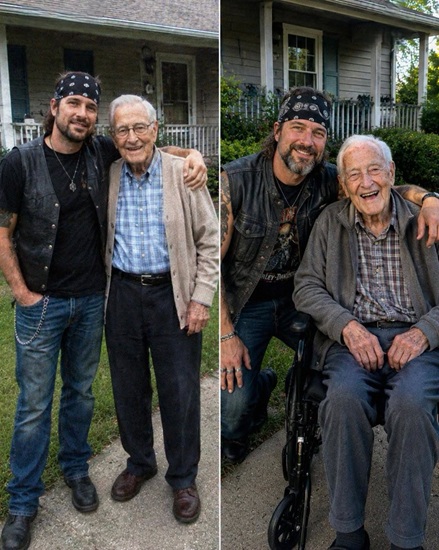
Some gifts cannot be measured by their financial value. They arrive quietly, carrying memories, gratitude, and lessons that stay with us long after the people who gave them are gone. I discovered that truth on a quiet Sunday afternoon after saying goodbye to my elderly neighbor, Ezra Harrison. As I left the small cemetery believing the hardest part was over, his longtime attorney approached me with an old leather suitcase and a simple instruction. Ezra had wanted me—and only me—to receive it after the funeral.
At that moment I assumed it contained personal keepsakes, but I had no idea it would completely change the way I viewed kindness, friendship, and the lasting impact of ordinary moments. I first moved into the neighborhood when I was twenty-eight years old. Like many young professionals, I imagined the house would simply be a temporary stop before moving somewhere larger. My attention was focused almost entirely on work, deadlines, and future ambitions.
Ezra had already spent decades living on the same quiet street. He was a retired widower whose daily routine rarely changed. Most mornings he watered flowers in his front yard, read newspapers on his porch, or waved politely to neighbors passing by. At first, our relationship extended no further than friendly greetings and brief conversations across our driveways.
Everything changed one autumn afternoon when I noticed him struggling with several grocery bags outside his car. One paper bag suddenly split open, sending vegetables and canned goods rolling across the driveway. I hurried over to help gather everything before it was damaged. Ezra thanked me warmly and insisted I come inside for coffee before leaving. Although I originally planned to continue with my own errands, something about his sincere appreciation convinced me to accept the invitation. Looking back, that simple decision became one of the most meaningful choices I ever made.
Over steaming cups of coffee, Ezra began sharing stories about his life. He described growing up in a much smaller community, remembered local landmarks that had long since disappeared, and spoke lovingly about his late wife, Margaret. Even after many years, it was obvious how deeply he still missed her. Before leaving that afternoon, I casually mentioned that if he ever needed groceries again, I would be happy to help. Neither of us realized that what sounded like a simple favor would eventually grow into a tradition lasting more than a decade.
Every Sunday morning afterward became remarkably consistent. I stopped at the grocery store before arriving at Ezra’s house. Together we unpacked food, organized the kitchen, shared coffee, and talked about life. Sometimes we discussed books, family memories, or local events. Other times we simply enjoyed peaceful silence while watching birds gather near the feeder outside his kitchen window. Those weekly visits gradually became something both of us looked forward to. They offered companionship for Ezra and a welcome reminder for me that genuine human connection often grows from the smallest acts of kindness.
As the years passed, Ezra’s mobility slowly declined. Driving became increasingly difficult, carrying groceries required more effort, and everyday household tasks occasionally presented challenges. Even so, he remained remarkably independent and always tried to contribute in whatever ways he could. More than once he attempted to pay me for helping, slipping folded bills across the kitchen table. I always returned the money with a smile, explaining that friendship should never be measured by financial transactions. Spending time together had become valuable in ways neither of us could calculate.
Meanwhile, my own life continued changing. I married my wife, Claire, accepted new professional opportunities, and gradually settled into the neighborhood I had once planned to leave. Claire quickly became fond of Ezra as well, often joining our Sunday visits with homemade bread or fresh desserts. She treated him like family, and he welcomed her with genuine warmth every time she visited. Looking back now, I realize those simple Sunday afternoons became an important tradition not only for Ezra but also for our own growing family.
One crisp October morning, however, something felt different. As I left my house, I noticed Ezra’s porch light was still on well after sunrise. He had always been careful about every household expense and never wasted electricity. A feeling of concern settled in almost immediately. After receiving no response to repeated knocks on his front door, I contacted emergency services. Later that day, I learned that Ezra had passed away peacefully in his sleep. Although his passing had been gentle, the loss felt enormous. The neighborhood suddenly seemed much quieter without the familiar sight of him tending his flowers or waving from the porch.
The funeral reflected the quiet life Ezra had lived. Friends, neighbors, and a handful of relatives gathered to celebrate his memory. During the service, stories were shared about his generosity, patience, and kindness. Among those attending was his nephew, Marcus, whom Ezra had mentioned only occasionally during our conversations. After the ceremony, Marcus questioned why I had spent so many years helping his uncle, suggesting there must have been another reason beyond simple friendship. Rather than becoming defensive, I calmly explained that Ezra had become an important part of my life and that kindness never required a reward.
Just as Claire and I prepared to leave, Ezra’s longtime attorney approached carrying an old leather suitcase with worn brass corners. He explained that Ezra had left written instructions requesting that the suitcase be given directly to me after the funeral. According to the attorney, it was separate from the formal estate and represented a personal gift. Curious but emotional, Claire and I carried it home before carefully opening it together that evening.
Inside we found hundreds of handwritten letters, carefully arranged by date, several family photo albums, and a personal journal. Resting on top was an envelope addressed to me. Ezra had written a letter after nearly every Sunday we spent together. Each one described our conversations, celebrated small moments, and expressed gratitude for the companionship that had filled the loneliness left by losing his wife. Reading his words, we realized that those weekly visits had meant even more to him than we had ever understood.
Near the end of the journal, Ezra explained that after losing his only son many years earlier, he had gradually come to think of me as the family he never expected to find again. He also revealed that he had quietly established a modest charitable fund intended to support older adults living alone in the community. Rather than keeping the gift for ourselves, Claire and I decided to honor Ezra’s wishes by creating a neighborhood volunteer program that delivers groceries, assists with household chores, and provides regular companionship to seniors who might otherwise spend weekends alone.
Even today, before leaving each Sunday morning, I still open Ezra’s weathered suitcase and read one of his letters. Every page reminds me that the greatest legacies are rarely built through wealth or recognition. Instead, they are created through simple acts of consistency, compassion, and genuine friendship. Ezra never considered himself extraordinary, yet his kindness continues touching lives years after his passing—a lasting reminder that even the smallest gestures can leave an impact that reaches far beyond our own lifetime.

