
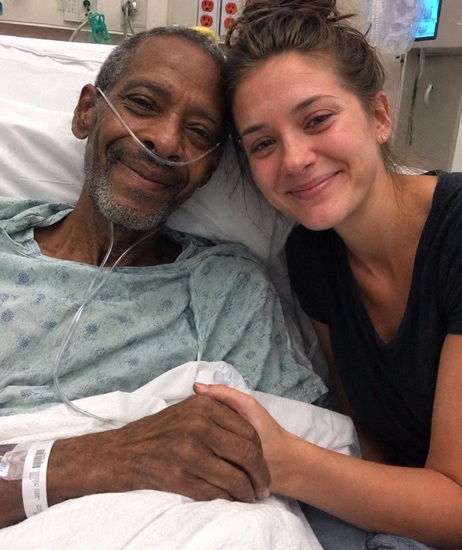
Frank had been the only father I had ever truly known. He came into my life when I was four, married my mother, and patiently figured out how to care for a child who did not trust adults easily. He never demanded affection from me and never insisted that I call him Dad. Instead, he learned the small details that mattered: how much strawberry jam I wanted on toast, which bedtime stories calmed me down, and how frightened I became when thunderstorms shook the windows.
Every Sunday morning, he made apple pancakes with an old metal cutter shaped like a star. I thought it was just one of his little traditions. I had no idea those pancakes belonged to a story that began long before me. Years later, I was sitting beside his hospital bed talking about those breakfasts. Frank was 78, and illness had reduced the strong man I remembered to someone fragile and exhausted. Tubes ran beneath his hospital gown, oxygen helped him breathe, and even opening his eyes seemed to require effort.
I told the nurse that his star pancakes had never actually been very good because he always burned the edges. Frank opened his eyes at the sound of my voice and looked directly at me. “You still ate them,” he whispered. “Of course,” I said. “I was afraid you’d make oatmeal if I complained.” For a moment, there was a trace of the familiar crooked smile. Then his expression changed. His eyes filled with tears, and I leaned closer, suddenly worried.
“Dad?”
His lips moved before any sound came out.
I asked whether he was hurting.
He slowly shook his head.
The nurse checked the monitor, adjusted his blanket, and quietly left us alone.
Frank had married my mother when I was four years old. At first, I barely acknowledged him. My biological father had disappeared before I could form a real memory of him, but somehow I already understood that adults could leave. When Frank asked if I wanted toast, I would point at the bread instead of answering. When he offered to read to me, I sometimes pulled the blanket over my face. He never became impatient.
He simply stayed.
During storms, he sat outside my bedroom because I would not let him come inside. He remembered that I hated jam in the center of my toast unless it reached all the way to the crust. And every Sunday morning, he made star-shaped pancakes.
One morning, a few months after he married my mother, I walked into the kitchen and casually called him Dad.
Frank dropped the spatula.
I thought I had done something wrong.
He said nothing about it.
He simply gave me the least-burned pancake on the plate.
Five months later, my mother died suddenly from a brain aneurysm.
There had been no long illness and no time to prepare. The last ordinary conversation I remembered having with her was about whether I had put my shoes away. Then suddenly relatives filled the house, casseroles arrived at the door, and adults whispered in hallways.
I heard things they probably thought I was too young to understand.
“He isn’t really her father.”
“Maybe her aunt should take her.”
“He might want to start over.”
The night after the funeral, I crawled beneath the kitchen table and stayed there with my knees pressed against my chest.
Frank found me shortly before sunrise.
He lowered himself onto the floor without asking me to come out.
For several minutes, neither of us spoke.
Then I asked, “Are you leaving too?”
His face changed instantly.
“No.”
“Everybody leaves.”
“I won’t.”
“Promise?”
Frank held out his little finger beneath the table.
“I promise.”
He kept that promise.
He was there for school concerts, bad report cards, my first heartbreak, graduation, and the day I finally learned to drive without terrifying him. He walked me down the aisle when I got married. Years later, when my daughter was born, he hovered beside me as if I might accidentally drop her even though I was a grown woman.
Whenever I asked about his life before my mother, however, he became vague.
“The important part started when you came along, sweetheart,” he would say.
I always heard love in those words.
I never noticed the sadness underneath them.
His health began to fail shortly after his 78th birthday. First came the exhaustion. Then weight loss. Then appointments with specialists, tests, medications, and conversations that gradually became less hopeful.
During his final week, I practically lived beside his hospital bed.
I slept in a vinyl chair and woke whenever his breathing changed.
Every sound from the monitors became familiar.
As long as those machines continued beeping, some irrational part of me believed we still had time.
On his last evening, a doctor asked me to step into the hallway.
“It may only be a few hours, Rosalie.”
I nodded because speaking felt impossible.
When I returned, Frank appeared to be asleep.
I sat down beside him and slipped my hand into his.
His fingers suddenly tightened around my wrist.
“Promise you’ll listen before you hate me,” he said.
I stared at him.
“I could never hate you.”
His hand felt cold against mine.
“I’ve lied to you your whole life.”
At first, I thought medication had confused him.
“Dad, you’re exhausted. Let me call the nurse.”
“My mind is clear.”
His voice was weak, but his expression was not.
“Everything you believe about your childhood, and about who I was before you, is incomplete.”
My heart began to race.
For a moment, every possible secret entered my mind.
Maybe my biological father had tried to contact me.
Maybe Frank had hidden letters.
Maybe there had been another marriage.
Another family.
Another version of him that I had never known.
Frank reached beneath his blanket and pulled out a folded piece of paper.
He pressed it into my hand.
“Go there.”
I unfolded it.
There was an address written in his shaking handwriting.
“I’m not leaving you.”
“You have to.”
Tears slid down his face.
“Please, Rosalie.”
He had not called me by my full name in years.
I leaned closer.
“Tell me yourself.”
Frank closed his eyes.
“Some truths need another voice.”
Those were the last words he ever said to me.
A nurse came in when one of the machines changed rhythm. She checked him and told me that he was still alive, but he might not wake again.
I stood in the hallway holding the folded paper.
The address was less than twenty minutes away.
I nearly threw it away.
Whatever secret was waiting there could not possibly matter more than the man dying behind me.
Then I remembered his expression.
Frank had not looked afraid of death.
He had looked afraid that I would never understand him.
So I went.
I drove through nearly empty streets, gripping the steering wheel until my hands hurt. During that short drive, I invented every possible betrayal.
A secret wife.
Children I had never met.
A past filled with lies.
By the time I reached the address, I was afraid to knock.
An elderly woman answered.
She had silver hair, pale blue eyes, and a look of shock the moment she saw me.
“Rosalie,” she whispered.
I stepped backward.
“How do you know my name?”
“My name is Caroline.”
She looked toward the road behind me.
“Frank called me last month.”
My stomach tightened.
“What did he say?”
“That you might come.”
“Might?”
“He hoped he would find the courage to send you.”
She opened the door.
“I think you should come inside.”
Every instinct told me to return to the hospital.
Instead, I followed her into the kitchen.
“Tell me what Frank lied about.”
Caroline did not answer immediately.
She opened a drawer near the stove.
Inside were old metal cutters shaped like hearts, flowers, animals, apples, and stars.
One small star caught my attention immediately.
It looked almost identical to the one Frank had used every Sunday throughout my childhood.
I picked it up.
“Where did you get this?”
“It belonged to Frank.”
“No. His is at my house.”
Caroline gave me a sad smile.
“He had two.”
Then she removed a photograph from the drawer.
A little girl stood beside a kitchen table holding a plate of star-shaped pancakes. Frank stood behind her, younger and thinner than the man I remembered.
But he was unmistakably Frank.
“Who is she?”
Caroline sat down.
“Her name was Miley.”
I waited.
“She was Frank’s daughter.”
For a moment, I thought I had misunderstood.
“His daughter?”
“Frank was married before he met your mother.”
I stared at the photograph.
“Where is she?”
Caroline lowered her eyes.
“Miley died when she was five.”
The words were quiet.
That somehow made them hurt more.
Caroline explained that there had been an accident at a lake. It happened quickly. Frank blamed himself afterward, even though there was apparently nothing he could have done to prevent it.
His first marriage eventually collapsed under the weight of their grief.
“He disappeared from almost everyone,” Caroline said. “He stopped returning calls. He packed away photographs. He stopped saying Miley’s name.”
I looked back at the metal star.
“The pancakes.”
Caroline nodded.
“He made those for Miley.”
Something inside me tightened.
A tradition I thought belonged to my childhood had existed before I was born.
Then Caroline told me more.
One morning, shortly after Frank married my mother, I apparently climbed into his lap and asked whether he could make pancakes shaped like stars.
I did not remember it.
I was only four.
“He called me afterward,” Caroline said. “He was crying so hard I could barely understand him.”
“What did he say?”
“That he made them for you.”
She paused.
“And that he had said Miley’s name aloud for the first time in years.”
I covered my mouth.
Caroline placed the cutter on the table between us.
“You didn’t replace his daughter, Rosalie. You reminded him that remembering her didn’t have to destroy him.”
The kitchen blurred through my tears.
“Then what was the lie?”
Caroline became quiet again.
“After your mother died, Frank packed his truck.”
I stared at her.
“He was going to leave me?”
“Yes.”
The answer hit harder than anything else she had said.
“He came here after the funeral. He thought your aunt should raise you.”
“But he promised me he would stay.”
“He made that promise after he came here.”
Caroline explained that Frank had sat in her kitchen for most of the night, terrified of loving another child.
“He told me, ‘Every time Rosalie runs too close to the road, I stop breathing. Every time she gets sick, I imagine another hospital. Every time she laughs, I hear Miley.’”
My chest hurt.
“He thought staying would destroy him if something happened to you.”
“What did you tell him?”
Caroline reached across the table and held my hand.
“I told him not to leave because he was afraid of loving you. I told him to stay because he already did.”
Frank drove home before sunrise.
He unpacked the truck.
He found me hiding beneath the kitchen table.
And then he promised me he would never leave.
For my entire life, I had believed that promise came without hesitation.
Now I understood that it came after the hardest decision he had ever made.
“He almost left,” I whispered.
“Yes.”
Caroline did not try to soften it.
“But he turned around.”
I asked why Frank had kept Miley and that night secret for so many years.
“Because he never wanted you to believe you were responsible for saving him,” Caroline said. “He knew what it was like for a child to carry an adult’s grief. He would not put that on you.”
Suddenly, so many things Frank had said throughout my life sounded different.
“You gave me a reason to keep going.”
“I’m lucky you found me.”
“The important part started when you came along.”
I had always assumed those were simply affectionate things parents said.
Now I understood that he had meant them literally.
“He let me think he rescued me.”
Caroline squeezed my hand.
“He did rescue you.”
Then she smiled through her tears.
“And you rescued him too.”
I drove back to the hospital with Miley’s photograph on the passenger seat.
Every red light felt unbearable.
I needed to tell Frank that I understood.
I needed him to hear that the truth did not make me love him less.
I needed to tell him that knowing he had almost left did not erase the thousands of days he had chosen to stay.
When I reached the hospital floor, the nurse was waiting outside the room.
One look at her face stopped me.
“I’m sorry,” she said softly.
I walked past her.
Frank lay exactly where I had left him.
But the room had changed.
The machines were quiet.
There was no strained breathing.
No oxygen hiss.
I sat beside him and took his hand.
“You should have told me,” I whispered.
Tears fell onto his fingers.
“You should have let me thank you.”
Later, the nurse brought me a small bag containing his belongings.
His watch.
His keys.
And the old brown wallet he had carried for as long as I could remember.
I opened it.
Behind his driver’s license was a worn photograph.
Miley stood beside a plate of star-shaped pancakes.
The corners were soft from being touched.
Behind it was another photograph.
Me, around five years old, smiling while holding a crooked pancake with one burned point.
Frank had carried both photographs every day.
That was when everything finally made sense.
He had never replaced Miley with me.
He had never needed to forget her in order to love me.
He had loved me while remembering exactly how painful love could become when someone was lost.
And he chose to love again anyway.
That evening, I returned home.
My daughter was sitting at the kitchen table.
“Is Grandpa coming back?”
I sat beside her.
“No, sweetheart.”
Her face crumpled.
I held her until the crying became quiet.
Eventually, I opened the drawer beside the stove.
Frank’s old metal star cutter lay near the back.
Scratched.
Darkened.
Slightly bent from years of Sunday mornings.
I mixed flour, eggs, milk, cinnamon, and chopped apples.
My daughter watched me.
“Why did Grandpa always make them shaped like stars?”
I looked at the two photographs resting beside the stove.
“Because he learned something important.”
“What?”
“That loving someone new doesn’t mean you stop loving someone who came before.”
She thought about that.
Then she nodded.
The first pancake burned at one point.
Exactly like Frank’s always had.
My daughter took one bite and laughed.
For a moment, I understood the fear Frank had carried.
That kind of laughter had once reminded him of everything he lost.
Eventually, it also reminded him that love could survive grief.
When breakfast was finished, I washed the metal cutter and placed it beside the stove.
It would be there the following Sunday.
And the Sunday after that.
Not because grief disappears.
Not because one person can replace another.
But because love can remember the people who are gone while still making room for those who remain.
Frank spent decades believing the truth might change how I saw him.
In the end, it did.
But not in the way he feared.
I had always believed my father stayed because staying was easy for him.
Now I understood that he stayed even though it terrified him.
And somehow, that made the promise he kept mean even more.
This is a fictional narrative created for storytelling purposes. It should not be presented as a verified real-life account or local news report.

