
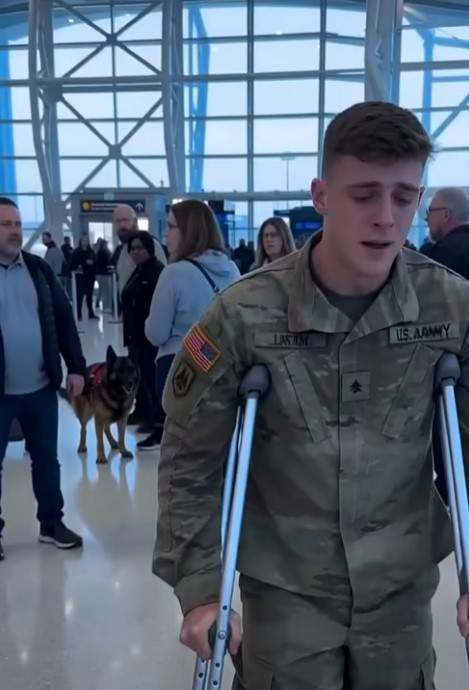
A wounded soldier returned to the United States after months of rehabilitation abroad, expecting silence, exhaustion, and a quiet transition back into civilian life after a long and painful recovery period. Following nearly a year of medical treatment in Germany, including multiple surgeries and physical therapy sessions, he was finally cleared to travel home after learning to walk again with a prosthetic leg. The journey marked a major turning point in his recovery.
Each step through the airport reflected months of rehabilitation, determination, and the emotional struggle of adapting to a completely changed body and life. He arrived at Gate 12 after a long international flight, visibly tired and moving carefully on crutches, preparing himself mentally for a return that felt uncertain and emotionally overwhelming. There was no family waiting for him, no welcoming signs, and no messages of arrival. He expected to leave the airport quietly and return to an empty and unfamiliar home.
The Sound He Never Forgot
As he moved slowly through the busy terminal, the background noise of announcements and travelers suddenly broke when a deep, familiar bark echoed across the entire airport space. The sound immediately stood out. It was sharp, emotional, and powerful enough to cause nearby passengers to turn their heads and pause in confusion at its intensity.
Across the terminal, a German Shepherd wearing a red service vest began pulling aggressively against his handler, completely ignoring commands as he locked his attention toward a single direction. The soldier stopped walking instantly. The bark was not just noise to him—it carried recognition, memory, and emotional weight that he had not expected to encounter in that moment.
The dog turned and locked eyes with him from a distance, suddenly becoming still and silent, as if recognizing the person he had been searching for all along. The soldier’s breath caught when he noticed familiar details: the scar near the muzzle and the slightly torn ear, signs of past missions they had shared together.
“Rex?” he said quietly, almost unsure whether the moment was real or a memory returning unexpectedly after months of separation and recovery.
A Reunion in the Middle of the Terminal
The German Shepherd suddenly broke free from his handler and ran across the terminal with full force, ignoring commands and obstacles as he closed the distance between them. The soldier tried to steady himself, but one crutch slipped as Rex reached him quickly, preventing him from falling completely and immediately pressing against his body.
Rex leaned into him, trembling and whining softly, overwhelmed with emotion after months of separation that neither training nor time had been able to erase. The soldier dropped his crutches and wrapped his arms tightly around the dog’s neck, holding him close as tears filled his eyes after months of emotional restraint and isolation.
The entire terminal seemed to pause. Travelers, airport staff, and security personnel stopped what they were doing, witnessing a reunion filled with silence, emotion, and recognition.
Rex Had Refused to Move On
A volunteer named Clara, who worked with military K9 retirement programs, later explained that Rex had struggled significantly after being separated from the soldier he had served alongside. Although he was reassigned to new handlers, Rex refused to fully accept the transition, showing signs of distress, disobedience, and emotional withdrawal during training and daily routines.
He stopped responding properly to commands, ate poorly at times, and frequently searched his environment, as if expecting to find the soldier he had bonded with during service. Eventually, Rex was placed into a retirement and rehabilitation program designed for military working dogs transitioning out of active duty and operational environments.
Even in retirement care, however, Rex remained unsettled and restless, reacting strongly to travel sounds and environments similar to airports or deployment-related settings. According to Clara, Rex eventually managed to leave his supervised environment and made his way to the airport, where he began waiting near the international arrivals area.
For approximately three months, he returned regularly to the same location, observing passengers and reacting every time soldiers or travelers arrived from international flights.
A New Beginning for Both of Them
The soldier slowly understood that Rex had not been waiting for the version of him that left for service, but for the person he had become after everything he endured. Clara gently offered the leash, but the soldier looked down at Rex and quietly refused, recognizing that the connection between them no longer needed control or formal structure.
“He doesn’t need a leash,” he said softly. “He already knows exactly where I am, and I know where he is.”
Together, they walked out of the airport side by side, the soldier’s crutches tapping the floor in steady rhythm while Rex walked calmly beside him without hesitation. For the first time since his injury, movement no longer felt like struggle. Instead, it felt shared, steady, and quietly supported by the presence of someone he trusted completely.
The Meaning of Home
When they arrived at the soldier’s apartment, the space felt quiet and unfamiliar, as if it had been frozen in time during his long absence overseas. Rex walked in first, carefully inspecting each room before settling in the living room, as though confirming that the environment was safe and familiar once again.
The soldier lowered himself to the floor beside the dog, leaning against him in silence, finally allowing months of exhaustion, pain, and emotion to surface without restraint. That night, the apartment no longer felt empty or cold. It felt filled with presence, connection, and something deeper than words—something that resembled home in its truest form.
Rex lay beside him quietly, breathing steadily, as if no time had passed at all. And in that moment, both of them were finally where they belonged.

