
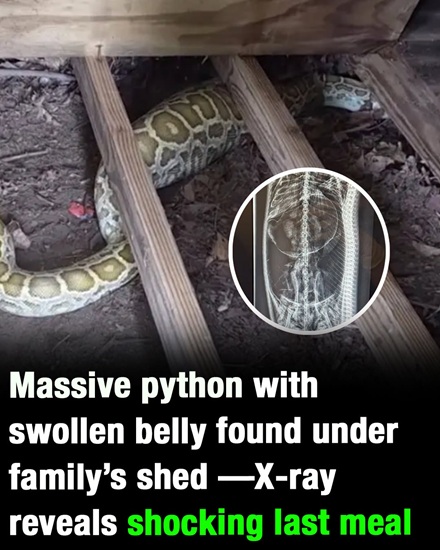
A family in Freehold, New Jersey, experienced an unusual backyard discovery after a large snake was found hiding underneath their shed. The reptile was identified as an approximately eight-foot-long Burmese python, a species that is not native to New Jersey. What made the discovery even more striking was the noticeable swelling around the middle of the snake’s body. Rather than attempting to capture such a powerful reptile themselves, the residents contacted professionals for assistance.
The Monmouth County SPCA became involved, and trained animal-control personnel responded to the property to safely remove the python. According to the family’s account, resident Leslie Daley first noticed the unexpected visitor while she was outside watering flowers. Her husband, Ed Daley, later described how the snake was spotted moving through their Freehold backyard. Discovering an animal of that size was understandably surprising, particularly because Burmese pythons are associated with much warmer regions and are not naturally found in New Jersey.
The family contacted the Monmouth County SPCA rather than approaching or handling the reptile. By the time assistance arrived, the python had positioned itself underneath the floor of a backyard shed, making the rescue more complicated. Getting to the animal required careful planning because sections of the shed were blocking access to its hiding place. A local contractor assisted with removing boards so that animal-control personnel could safely reach the python.
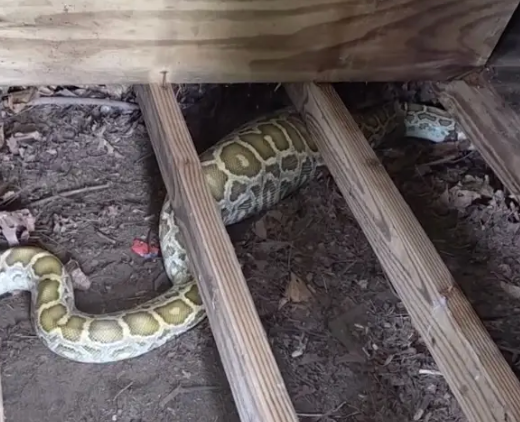
Video of the rescue showed trained officers gradually working to free the large snake from underneath the structure. The process required patience because pulling or handling a large constrictor incorrectly could injure either the reptile or the people involved. Eventually, rescuers were able to carefully unwind the python and remove it from beneath the shed without intentionally harming it.
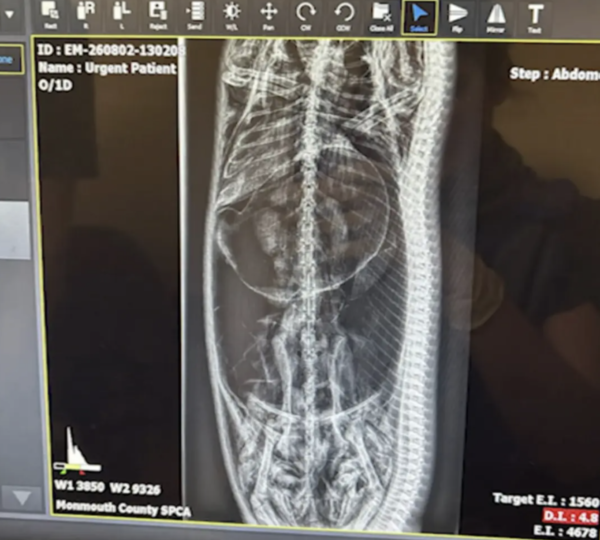
Once the animal was visible, one physical feature immediately attracted attention. The python had a substantial bulge around the center of its body, suggesting that it had recently swallowed something relatively large. Snakes consume their prey whole, meaning a sizable meal can remain clearly visible from the outside during digestion. Still, rescuers could not determine exactly what the python had eaten simply by looking at the swelling. After the animal was safely transported away from the property, medical imaging provided the answer.
According to information released by the Monmouth County SPCA, X-rays showed that the Burmese python had consumed a large opossum. The discovery explained the unusual shape that had been visible during the rescue. Rather than relying on speculation about the contents of the snake’s stomach, the X-ray allowed those caring for the reptile to identify its recent meal. The finding also demonstrated that the python had apparently been capable of hunting local wildlife while it was outside captivity.
Following the rescue, the python was taken into the care of the Monmouth County SPCA. Staff cleaned the animal and placed it inside a secure enclosure while arrangements were made for appropriate temporary housing. Because Burmese pythons require specialized care and secure facilities, the organization contacted people experienced with reptiles. The SPCA said it also reached out to Fins & Feathers in Red Bank for assistance in finding an appropriate placement for the animal.
Plans called for the python to remain with an experienced reptile keeper who had the necessary permits while officials determined whether a properly permitted owner would come forward. If an eligible owner could not be located, the snake would need another suitable permanent home. The goal was to ensure that such a large exotic reptile remained under the supervision of someone equipped to provide appropriate housing and long-term care.
The discovery naturally raised another question: how could an eight-foot Burmese python end up underneath a residential shed in New Jersey? Burmese pythons originate in parts of Southeast Asia and are not a native component of New Jersey’s wildlife. The species is nevertheless kept in captivity in various places, subject to applicable laws and permit requirements. Reporting surrounding the Freehold case noted that exotic snakes can be legally kept in New Jersey when the necessary requirements are satisfied.
The presence of this individual snake should not be confused with evidence that Burmese pythons have established a wild population in the Freehold area. The incident involved one animal discovered on private residential property. Burmese pythons are well known as an invasive species in parts of southern Florida, where an established population has created serious ecological concerns. The circumstances in New Jersey are different, and nothing reported about this incident establishes a comparable population there.
That distinction is important when sharing stories involving unusual animals. A single escaped or released exotic pet does not automatically mean an invasive population exists in an area. In the Freehold incident, authorities focused on safely recovering the individual python and determining appropriate placement. The available information does not establish exactly how the animal came to be beneath the shed, so speculation about whether it escaped, was abandoned, or had another history should not be presented as confirmed fact.
The Monmouth County SPCA used the case to emphasize responsible exotic-animal ownership. Keeping reptiles can involve responsibilities that are significantly different from caring for more common household pets. Large snakes may require carefully controlled temperatures, specialized feeding, secure enclosures and access to knowledgeable veterinary care. Prospective owners also need to consider the eventual adult size of an animal rather than making decisions based only on how manageable it appears when young.
Burmese pythons are particularly significant in that regard because they can grow into very large and powerful animals. Housing requirements can change substantially as a python develops, and an enclosure appropriate for a juvenile may eventually become inadequate. Preventing escapes is equally important. Secure containment protects the snake itself while reducing the possibility of encounters involving neighbors, domestic animals or native wildlife.
The SPCA specifically reminded people that exotic pets should not be released outdoors. Releasing a captive animal can expose it to unsuitable weather, lack of appropriate shelter and other conditions it may not be equipped to survive. At the same time, a non-native predator that successfully adapts to its surroundings may prey on local wildlife. The opossum discovered inside the Freehold python provides a direct example of an interaction between a non-native captive species and a naturally occurring animal.
The organization encouraged anyone who can no longer care for an exotic reptile to contact an appropriate rescue, shelter or qualified professional. Seeking assistance gives specialists an opportunity to find secure placement for an animal instead of leaving it to survive outside. This approach protects the exotic pet while also reducing potential consequences for the surrounding environment.
The incident also illustrates why people who encounter a large unfamiliar snake should avoid attempting a risky capture without suitable experience. An eight-foot constrictor is a powerful animal even when it is not behaving aggressively. Improper handling can result in injuries to the reptile as well as the person trying to move it. In this case, trained animal-control personnel used a patient approach and carefully removed the python from its difficult hiding location.
Despite the dramatic appearance of the animal, the rescue did not need to become a confrontation between people and wildlife. The family recognized that professional assistance was appropriate, access to the shed was carefully created, and experienced personnel removed the snake. The python was then transported to a controlled environment where it could be examined and securely housed. The prominent swelling that initially created so much curiosity was subsequently explained through an X-ray rather than guesswork.
The story is remarkable without adding exaggerated details. An approximately eight-foot Burmese python was found underneath a family’s shed in Freehold, trained animal-control officers responded, and rescuers noticed a significant bulge in its body. After the animal was safely removed, X-rays revealed that it had swallowed a large opossum. Those confirmed details alone explain why the unusual backyard encounter attracted so much attention.
For the residents, what began as an ordinary day at home unexpectedly turned into an encounter with an exotic reptile rarely associated with New Jersey backyards. For the animal-control personnel, it became a rescue requiring specialized handling and patience. For the python, intervention meant being moved away from the residential property and into secure care while officials worked to determine an appropriate long-term solution.
The Freehold discovery ultimately carries a broader message about responsible pet ownership. Exotic animals can be fascinating, but some species require substantial knowledge, resources and long-term commitment. When circumstances change and an owner can no longer provide proper care, contacting experienced professionals is a safer option than abandoning or releasing the animal. In this case, the python was successfully recovered, placed in appropriate care, and the mystery surrounding its swollen abdomen was solved: the large snake had recently eaten an opossum.

