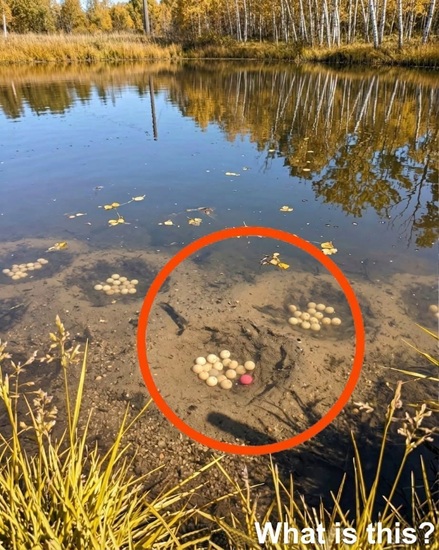
I stood at the edge of an old, forgotten lake, watching its unusually clear surface reflect the pale afternoon sky. The water was so still that it looked almost like glass, broken only occasionally by faint ripples moving across its surface. The entire area felt quiet and isolated, surrounded by dense trees that blocked out most of the outside world. There was a strange sense of calm in the environment, but also something slightly unsettling. The lake had a reputation among locals for being rarely visited, tucked away from main roads and hidden deep within woodland.
On that day, I had not expected to find anything unusual, yet something beneath the surface immediately caught my attention. Strange Shapes Beneath the Water. As I looked more closely into the clear water, I noticed several round objects scattered across the lakebed. They were arranged in small clusters, almost as if they had been placed intentionally. From a distance, they appeared smooth, identical, and slightly reflective under the sunlight filtering through the water.
At first glance, the shapes did not resemble anything natural. They stood out clearly against the mud and scattered debris on the bottom of the lake. Because of their uniform appearance, my mind immediately began searching for explanations that could match such an unusual sight.

Curiosity Turning Into Imagination
The longer I observed them, the more my thoughts began to drift into speculation. I considered whether these objects could be remnants of something old, perhaps buried over time or left behind for reasons unknown. The isolated setting and complete silence around me only strengthened the feeling that I was witnessing something unusual.
In moments like this, the human mind tends to create stories to fill gaps in understanding. I found myself imagining different scenarios, each more uncertain than the last. The stillness of the lake made everything feel more intense, as if even the smallest detail carried hidden meaning.
Moving Closer to Understand What It Was
Eventually, I decided to move closer to the shoreline to get a better look. The ground beneath me became softer and wetter, making each step slightly more difficult. I focused on one section where the objects were more visible, partially uncovered by the shallow water.
From this closer distance, the shapes still looked strange, but subtle details began to appear. Their surfaces were not perfectly smooth as I first believed, and faint textures could be seen when the light hit them at the right angle. Still, I could not immediately identify what they were, and the mystery remained.
The Moment Everything Became Clear
When the sunlight shifted and illuminated one of the objects directly, the truth suddenly became obvious. The surface revealed a pattern of small indentations, evenly spaced and familiar in design. In that instant, the mystery I had been building in my mind disappeared completely.
What I had imagined to be something unusual or unexplained turned out to be far simpler. The objects were golf balls, resting at the bottom of the lake, covered in mud and discolored by time and water. Their appearance from a distance had created the illusion of something far more mysterious.
Understanding the Real Explanation
The realization quickly replaced curiosity with relief and a sense of humor. It became clear that the lake was likely located near a golf course or practice area, where balls had been lost over time and gradually accumulated underwater. What looked strange and organized was simply the result of many individual objects settling naturally into the soft lakebed.
There was no hidden meaning or unusual event behind what I saw. Instead, it was a simple example of how everyday objects can appear very different when placed in unfamiliar conditions. Distance, lighting, and environment had combined to create a misleading impression.
Reflection on How Easily We Misinterpret Things
Standing there, I began to reflect on how quickly the mind can create assumptions based on limited information. In unfamiliar surroundings, even simple objects can appear mysterious when viewed without context. The brain naturally tries to explain what it cannot immediately identify, often building ideas that feel real in the moment.
This experience showed how perception can easily be influenced by setting and expectation. When something is unclear, imagination often fills in the missing details, sometimes turning ordinary scenes into something far more dramatic than they actually are.
Leaving the Lake Behind
After spending a while observing the lakebed, I eventually turned away and walked back through the trees. The water behind me returned to its calm, unremarkable state, reflecting the sky just as it had before I arrived. Nothing about the lake itself had changed—only my understanding of what I had seen.
The golf balls remained beneath the surface, quietly resting in the mud, no longer appearing mysterious at all. What had once felt like a discovery of something unusual had become a simple reminder of how easily perception can be misleading.
A Lasting Lesson From a Simple Moment
Even though the experience was based on something ordinary, it left a lasting impression. It highlighted how quickly curiosity can transform into assumption, and how assumption can build entire narratives that feel convincing in the moment. The emotional intensity of discovery does not always match the reality behind it.
In the end, the lake held no secret or hidden story—only everyday objects seen from the wrong perspective. Yet the experience itself remained meaningful, serving as a reminder that not everything strange is extraordinary, and sometimes the truth is much simpler than the story we create in our minds.
