
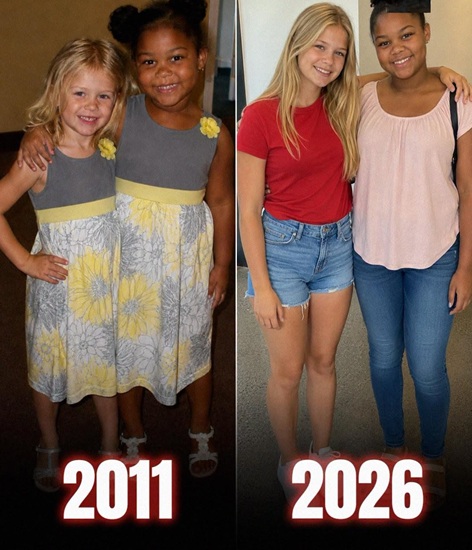
At first, I believed my daughter was simply going through one of those painful teenage friendship problems that feel enormous when you are sixteen. Emma and Sophie had known each other since kindergarten and had spent nearly their entire childhoods side by side. They had shared birthdays, sleepovers, school projects, Halloween costumes, family barbecues, and long summer afternoons that seemed endless when they were younger. Because of that history, nobody in our family thought twice when Sophie began planning her Sweet 16 and naturally included Emma in almost every part of it.
Emma had even gone shopping with Sophie to choose a dress for the celebration. They found a pale-pink one that Sophie insisted looked perfect on her. Standing in the fitting room, Sophie had laughed and told Emma she would be right beside her in every photograph. Emma came home excited and spent the next several weeks working on a scrapbook she had been secretly making as a birthday gift. She included photographs from nearly every year of their friendship and filled the pages with small memories only the two of them would understand.
Then the invitations were handed out at school, and Emma did not receive one. At first, she thought it was funny. She assumed Sophie had accidentally left hers at home or forgotten to give it to her. But several days passed, and more classmates began talking about the party. Girls Sophie barely knew had been invited, along with students she rarely spent time with. Emma slowly realized that the missing invitation was not an accident.
She tried texting Sophie and received no response. She called twice and went straight to voicemail. At school, Sophie began avoiding her altogether. One afternoon, Emma spotted her near the cafeteria and called her name, only to watch Sophie turn around and walk in the opposite direction. That moment broke something in my daughter. Until then, she had been searching for an innocent explanation. After that, she began wondering what she had done wrong.
I found her sitting on the floor of her bedroom with the pale-pink dress hanging from the closet door. The scrapbook was beside her, still wrapped in tissue paper. Emma stared at the dress for a long moment before quietly asking whether we could return it. She did not need to explain why. The dress had become a reminder of a night she had believed she would spend beside the person she trusted most.
I sat down next to her and asked whether there had been an argument. Emma shook her head. She said nothing had happened that she could remember. That was what made the situation so difficult for her. If she had said something cruel, forgotten an important promise, or hurt Sophie somehow, she could at least understand the anger. Instead, she was being punished without knowing what she had done.
Mark, my husband, appeared in the doorway while Emma was talking. He had always been affectionate and patient with her, especially when she was upset. He sat down beside her, wrapped an arm around her shoulders, and told her not to blame herself. When Emma asked why Sophie would suddenly throw away eleven years of friendship, Mark answered much faster than I expected.
He said sometimes people disappoint us and that Emma could not force someone to treat her properly. He told her that anyone willing to end such a long friendship without an explanation was probably the person behaving badly. The words sounded supportive, but something about the certainty in his voice bothered me. He did not seem surprised by Sophie’s behavior. He sounded as though he had already decided there was no point asking questions.
When I said I was going to call Sophie, Mark immediately told me not to. That was the moment my uneasiness became suspicion. He said the girls were sixteen and needed to work it out themselves. Emma quickly added that she did not want me demanding an invitation, and I promised her I would never do that. I only wanted to know whether she had unknowingly done something that could be repaired.
I stepped into the hallway and called Sophie. Mark followed me to the doorway and quietly said my name, almost like a warning. I held up my hand and continued with the call. Sophie answered after several rings, and the moment she realized who was calling, her voice became tense.
I told her I was not asking her to invite Emma anywhere. I just wanted to know whether Emma had hurt her. Sophie answered immediately and said Emma had done absolutely nothing wrong. That response came so quickly that I knew there was more to the story. I asked why she was avoiding Emma if she was innocent.
There was a long silence. Then Sophie quietly told me I should ask my husband. At first, I thought I had misheard her. I asked what Mark had to do with any of this. Sophie repeated that I needed to ask him and warned me that he might not tell me everything.
My stomach tightened. I asked what had happened between Mark and her family. Sophie hesitated, then said the problem involved something he had done with her mother, Helena. For a few seconds, my mind jumped to the worst possible explanation. Sophie must have heard the panic in my voice because she quickly told me it was nothing romantic.
Instead, she said Mark had been giving Helena money. He had helped them during a difficult period, but according to Sophie, the help eventually came with expectations. She said he had made them feel grateful at first and uncomfortable later. Before I could ask for a full explanation, Sophie apologized for what had happened to Emma and ended the call.
When I turned around, Mark was no longer standing behind me. I found him downstairs beside Emma, giving her a mug of hot chocolate and telling her that anyone who treated her this way did not deserve her friendship. I stopped on the stairs and watched him. At that moment, I understood that he had known something from the beginning.
I waited until Emma went to bed before confronting him. I found Mark cleaning the kitchen and asked directly how much money he had given Helena. He froze. Before answering, he immediately told me there had been no affair. I pointed out that I had never accused him of having one.
Eventually, he admitted that Helena had struggled financially after separating from Sophie’s father. She had needed money for a security deposit, then for car repairs, and later for another household expense. Mark described the payments as temporary help to someone we had known for years.
The financial assistance itself was not automatically the problem. Mark and I had always given each other freedom with money. I had grown up watching my parents argue about every purchase, so when I married, I wanted my home to feel different. We shared accounts, trusted each other, and rarely demanded explanations for every dollar.
That arrangement only worked, however, if both people used that trust honestly. I asked Mark why he had never told me Helena was the person he was helping. He said she had been embarrassed and that he wanted to protect her privacy. I told him protecting her privacy did not require keeping his wife completely in the dark.
Mark became defensive. He said Helena had accepted his help more than once and later started treating him as though he had done something wrong. When I asked what had changed between them, he mentioned arguments about Sophie. He had been helping her with school planning, college ideas, and conversations about her future.
I asked what happened when Helena stopped wanting his advice. Mark’s expression changed. Instead of giving me a direct answer, he told me to go ask Helena myself. Then he added that I should remember one thing before deciding he was the villain: Helena had asked him for money several times.
That detail complicated the story, but it did not clear him. The next morning, I drove to Helena’s house because I wanted to hear her version directly. She opened the door looking nervous but not surprised to see me. I asked how many times she had gone to Mark for financial help.
Helena admitted there had been four significant payments. The first was for the security deposit after her separation. The second helped repair her car. Another covered a utility bill. The last involved a summer program Sophie wanted to attend. Helena said she had requested the first three payments herself, while Mark had offered the final one.
I asked why she had never told me. Helena said she had been ashamed the first time. After accepting the second payment, telling me became harder. By the third, she felt trapped by her own silence. I understood how embarrassment could grow, but that did not make the secrecy acceptable.
I reminded her that Emma had been crying for days because Sophie had suddenly abandoned her. Helena looked down. I asked why the consequences of an adult financial arrangement had fallen on our daughters. That was when she told me the problem had not really begun with money.
According to Helena, Mark had started spending time helping Sophie think about college. He helped her make lists of schools, talked through classes, and encouraged her to imagine what she might want to study. During an unstable period in Sophie’s life, that support meant a great deal to her.
Mark had even told Sophie that if she was accepted to a school she truly loved, he would help with the enrollment deposit so money would not immediately eliminate the opportunity. Sophie had taken that promise seriously. Her father was no longer consistently involved after the separation, so Mark’s attention made her feel as though another adult believed in her future.
Then, Helena said, the relationship changed. Mark began offering increasingly strong opinions about which classes Sophie should take, where she should apply, and what she should study. Helena eventually told him that she appreciated the help but that helping financially did not give him parental authority over Sophie.
After that conversation, Mark began stepping back. He canceled a college-planning afternoon he had arranged with Sophie. Then he canceled another. Helena showed me messages that made the situation even more uncomfortable. In one, Mark said perhaps Helena should handle Sophie’s college planning from then on. In another, he said that after everything he had done, he had expected more trust.
The messages did not tell me everything about his intentions, but I could understand why Helena felt that his generosity had become connected to influence. Once she stopped following his advice, some of his involvement disappeared.
Then I asked why Emma had not been invited to Sophie’s birthday. Helena’s face changed immediately. She admitted that she had been the one who told Sophie not to invite her.
I was furious. Helena said she had been afraid Mark would attend if Emma came to the party. She did not want a confrontation with him and decided that keeping Emma away would solve the problem. Sophie had argued against the decision, but Helena refused to change her mind.
I told her she had punished two teenagers because she was afraid to have a difficult conversation with an adult. Helena admitted that was exactly what she had done. She said she had panicked and made a terrible decision. I told her that being uncomfortable with Mark did not justify allowing Emma to believe her best friend hated her.
That conversation helped me understand something important. There was no simple villain and no perfectly innocent adult. Helena had accepted money in secret and later hurt my daughter because she wanted to avoid Mark. Mark may have started from a place of genuine generosity, but his messages suggested that he expected his assistance to give his opinions greater weight. Both had made decisions that pushed the consequences onto Sophie and Emma.
Before leaving, I asked Helena to send me the messages. I wanted to read them myself instead of relying on anyone else’s interpretation. Back home, I opened our financial accounts and found the payments. They had been made months apart with vague labels such as temporary help or helping a friend.
Nothing about them had seemed suspicious when I first saw them. I even remembered telling Mark how kind he was after one of the payments. At the time, I thought I understood what he was doing. Now I realized how little I had actually known.
Emma came into the kitchen while I was looking at the accounts. She had overheard enough of our argument the night before to know Helena was involved. She asked whether her father had really been giving Sophie and her mother money.
Before I could answer fully, Mark walked into the room. He said he had planned to explain everything. Emma looked at both of us and asked whether Sophie had excluded her because Helena had taken money from Mark. He tried to say that Helena simply needed help and that Emma did not need to know the rest.
I stopped him. Too much damage had already been caused by adults deciding that silence was easier. I told Emma that Helena needing money was not the central issue. I explained that Mark had begun giving Sophie advice about school and college and that the conflict started when Helena no longer wanted him involved in those decisions.
Emma turned toward her father and asked whether he had really promised Sophie help with college. Mark hesitated before saying he had only told her he would do what he could.
Emma’s expression changed. She quietly reminded him that he had never made the same promise to her. That moment was painful for everyone in the kitchen. Whatever Mark intended when he spoke to Sophie, his own daughter now felt as though another girl had received reassurance about her future that she had never heard from her father.
Then Emma finally understood that Sophie had not stopped caring about her because of something she had done. She looked at me and said Sophie never actually hated her. I told her no. She had been caught in an adult conflict that was never hers to begin with.
Emma went upstairs, and I turned toward Mark. I told him that after Sophie’s phone call, I had briefly feared something romantic had happened between him and Helena. Mark immediately insisted that he had never touched her.
I told him that was no longer what disturbed me most. What bothered me was the possibility that he had used generosity as a way of gaining influence. Helping someone during a crisis was one thing. Expecting greater authority because of that help was something completely different.
Mark said I was twisting his intentions. He insisted he had been trying to guide Sophie because he cared about her future. I asked why that guidance suddenly became less available after Helena stopped accepting his advice.
He had no quick answer.
Then I asked the question that frightened me more than anything else. If Mark sometimes confused helping with having a right to decide, had he ever done that in our marriage? Had there been situations where I believed I was freely making a choice when he had already decided which answer he wanted?
Mark told me he had never controlled me. I said I was not claiming he had treated me exactly the way Helena believed he treated her. I was saying I needed to examine our marriage more carefully because something I had always interpreted as care now looked different.
I told him we would go through our finances together and that there would be no more private loans, major favors, or financial promises involving shared money without both of us knowing about them. Mark said it felt like punishment.
I told him it was not punishment. It was transparency.
Later that afternoon, Helena called. Sophie had apparently told one classmate why Emma had not been invited, and the story was beginning to spread. Helena said she was thinking about canceling the birthday celebration entirely.
I could hear Sophie protesting in the background. She told her mother she had already lost Emma because of decisions she had not made and begged her not to lose the party as well. Helena became quiet and eventually admitted that everything she had done to avoid conflict had created even more of it.
I told her the next decision needed to belong to Sophie and Emma. If Sophie wanted Emma there, she should ask her directly. If Emma refused, Sophie needed to hear that from Emma rather than having another adult decide for them.
That evening, Emma came downstairs wearing the pale-pink dress. She was carrying the scrapbook against her chest. She told me she was still angry. I said she was allowed to be.
Going to the party did not mean pretending nothing had happened. It only meant she was willing to have the conversation Sophie had avoided.
When we arrived, Sophie came outside before we even reached the entrance. The moment she saw Emma, she began crying. Emma stopped a few feet away and waited.
Sophie apologized. Emma told her that the worst part had been believing her best friend suddenly hated her. Sophie admitted she should have told Emma immediately that none of it was her fault.
She explained that after her parents separated, everything in her home had felt unstable. There were bills, car problems, arguments, and uncertainty about the future. When Mark began helping, she felt safer. He gave her attention when she desperately needed reassurance from an adult.
Sophie said she had been grateful to him and then confused when the relationship between Mark and Helena became tense. She did not know how to explain what was happening without exposing her mother’s financial problems or discussing private conversations involving Mark.
Emma told her she still should have said something. Even one sentence telling her that the problem was not her fault would have saved days of pain. Sophie agreed.
Then Emma admitted she had also made assumptions. After first learning about the money, she wondered whether Helena had simply taken advantage of Mark. Once she understood more, she realized that the situation was far more complicated.
Sophie opened the scrapbook. The first page contained a picture of both girls when they were five years old, smiling with missing front teeth. She began crying again and told Emma she had missed her.
Emma said she had missed her too.
Sophie asked whether everything between them could be fixed. Emma thought for several seconds. Then she said not immediately. Eleven years of friendship mattered, but so did what had happened.
She reached for Sophie’s hand and told her they could begin again.
The girls walked into the party together.
Seeing them side by side did not magically solve the problems between the adults. Helena still had to live with the fact that she had allowed fear to hurt Emma. Mark still had questions to answer about his secrecy and his expectations. And I still needed time to decide what those discoveries meant for my marriage.
Helena came outside afterward and apologized to me again. I told her I believed she regretted what she had done, but forgiveness would take time. She had made my daughter responsible for a conflict Emma had never created.
As I stood there, I realized how much of my adult life had been built around avoiding conflict. I had always believed that keeping things calm meant protecting my family. I was beginning to understand that silence can sometimes protect a problem rather than the people affected by it.
I did not know exactly what would happen between Mark and me. Perhaps what I had discovered was one serious failure in judgment. Perhaps it exposed a larger pattern I had never recognized. I was not ready to decide that night.
But I was ready to stop being afraid of asking questions.
Emma had spent days blaming herself because several adults believed secrecy was easier than honesty. Sophie had been forced to carry information she was too young to manage alone. Helena had allowed fear to dictate her decisions, while Mark had kept financial and emotional boundaries far less clear than they should have been.
None of those problems could be solved by pretending everything had been a misunderstanding.
Helping someone does not automatically make a person controlling. Accepting help does not automatically make someone manipulative. But generosity becomes dangerous when it creates an unspoken expectation that the recipient now owes obedience, loyalty, or influence in return.
Trust also requires information. A marriage cannot depend on one person quietly making major decisions while assuming the other person would understand if they ever discovered them.
And children should never become collateral damage in disputes between adults.
Emma and Sophie’s friendship might survive. They had eleven years of memories and enough love for each other to begin trying. Whether it became exactly what it had been before was up to them.
For me, the lesson was different. I had spent years believing that asking difficult questions threatened the peace in my family.
That week taught me that sometimes the questions are the only way to discover whether the peace was genuine at all.
I drove away knowing I still had difficult conversations ahead of me. I did not know where my marriage would end up or how long it would take for Emma to trust Sophie completely again.
But for the first time, uncertainty did not scare me as much as silence.
I would rather face an uncomfortable truth than protect another comfortable lie.

