
Her First Day Back at Work Ended in Tragedy Near Times Square
For Erin Piacenti, August 31 was supposed to mark a return to routine.
The 32-year-old attorney and Bank of America vice president had recently spent months away from work after becoming a mother.
Her daughter was only five months old.
That Monday was Erin’s first day back from maternity leave.
By the end of the afternoon, however, her family was facing an unimaginable loss.
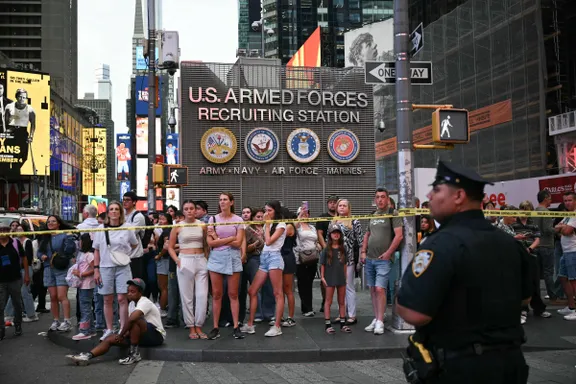
Erin was fatally stabbed near Times Square during what police described as a random and unprovoked attack.
And the violence had begun only moments earlier.
The First Attack Happened Nearby
Shortly after 4:20 p.m., a 68-year-old man was near West 41st Street and Seventh Avenue.
He had recently exited the subway and was with his wife.
According to police, a woman carrying two knives approached him.
Authorities later identified her as Pamela Cisneros, 49.
Police said the man had no known connection to Cisneros.
There was no reported argument between them.
The attack appeared to come without warning.
Cisneros stabbed the man and continued walking north.
What happened next unfolded extremely quickly.
About 20 Seconds Later, Erin Crossed Her Path
Erin was walking near Seventh Avenue and West 42nd Street.
She was roughly one block from the location of the first stabbing.
Police said Cisneros approached her and stabbed her in the abdomen.
Investigators found no known relationship between Erin and her attacker.
NYPD Commissioner Jessica Tisch later described both attacks as random and unprovoked.
Police also said investigators had found no evidence suggesting terrorism.
Two strangers had been attacked within roughly 20 seconds.
One would survive.
The other would not.
But the confrontation was still unfolding.
Cisneros Continued Toward 43rd Street
After the second stabbing, police said Cisneros continued north while still holding the knives.
Officers encountered her between West 42nd and West 43rd streets.

They repeatedly ordered her to drop the weapons.
According to the NYPD, she refused.
The confrontation continued for several minutes.
Police said Cisneros threatened the officers.
Officers then attempted to stop her using stun guns.
Those attempts did not end the confrontation.
Then the situation escalated again.
Two Officers Opened Fire
Police said Cisneros advanced toward officers while still armed.
Two officers fired their weapons.
She was struck and taken to Bellevue Hospital.
Cisneros was later pronounced dead.
Both stabbing victims were also transported to Bellevue.
The 68-year-old man survived.
Erin died from her injuries.
Within minutes, an ordinary afternoon in Midtown Manhattan had left two people dead and another seriously injured.

The shooting by police triggered a separate investigation.
The Police Response Is Being Reviewed
Officer-involved shootings resulting in death are investigated through formal procedures.
The NYPD’s Force Investigation Division began reviewing the confrontation.
The New York Attorney General’s Office of Special Investigation also opened an inquiry into Cisneros’ death.
Investigators have access to body-camera footage and other video from the area.
Those reviews are intended to establish what happened based on evidence.
They do not automatically mean that officers acted improperly.
The circumstances of the stabbing attacks themselves are also still part of the broader investigation.
And one detail has required particular care in public discussion.
Police Reported Previous Mental-Health Contacts
Authorities said Cisneros had previous mental-health-related encounters with the NYPD dating back several years.
She reportedly had no criminal record.
Police described her as emotionally disturbed during their initial account of the incident.
But that information should not be treated as a simple explanation for the violence.
Most people who experience mental-health conditions are not violent.
A past mental-health history cannot establish motive by itself.
Investigators still have to determine what can actually be supported by evidence.
For now, police have described the attacks as apparently random.
For Erin’s family, however, the unanswered motive changes little.
Their loss was immediate.
Erin Had Just Become a Mother
Initial reports focused heavily on Erin’s professional title.
She was a vice president at Bank of America.
That was true.
But it was only one part of her life.
After her death, family members revealed that Erin had welcomed a daughter only months earlier.
Her baby, Madison, was about five months old.
Erin had been on maternity leave.
August 31 was her first day back at work.
That detail made the timing of her death especially painful.
A day that represented a return to professional life became the final day of her life.
Her Family Wanted Her Remembered for More Than the Attack
Violent deaths can quickly become defined by headlines.
The location.
The attacker.
The police response.
The final minutes.
But Erin’s relatives wanted people to know there had been 32 years before those minutes.
She had built a career.
She had married.
She had become a mother.
She had friends, colleagues and relatives who knew her outside the context of a crime report.
A family fundraising effort established after her death focused on supporting her daughter.
It also emphasized the person Erin had been.
That story begins long before Times Square.
Her Career Had Been Years in the Making
Erin worked in Bank of America’s Business Selection and Conflicts team.
She had joined the bank in 2025.
Before moving to Bank of America, she worked as an associate at Davis Polk & Wardwell.
Her legal experience included corporate and transactional work.
During her time at Davis Polk, she also completed a secondment at Morgan Stanley in its Legal & Compliance Division.
Her connection with Davis Polk began while she was still studying law.
She worked there as a summer associate.
Even earlier, Erin had completed an internship with Major League Baseball.
The progression showed a career built step by step.
And her academic achievements were equally significant.
Fordham Law Played a Major Role
Erin graduated from Fordham University School of Law in 2021.
She completed her degree magna cum laude.
Her activities included the Fordham Law Review and Moot Court.
She also received recognition for legal writing.
Before Fordham, Erin attended the University of Pennsylvania.
She earned her undergraduate degree in political science.
After law school, she entered professional practice.
Davis Polk followed.
Then Morgan Stanley through her secondment.
Then Bank of America.
By 32, she had already created an impressive professional path.
But Fordham also connected her with someone who became central to her personal life.
Her Husband Was a Fellow Fordham Law Graduate
Erin was married to attorney Frank Piacenti.
Frank also graduated from Fordham Law in 2021.
He later built his own legal career in complex commercial litigation.
The couple had recently celebrated their second wedding anniversary.
They had also purchased their first home in Chester, New Jersey.
Then came another milestone.
Their daughter.
Within a relatively short period, Erin and Frank had married, established a home and become parents.
Those were the developments shaping their life before August 31.
The attack interrupted a future that was still being built.
Fordham Mourned Two Members of Its Community
After Erin’s death, Fordham University issued a public statement.
The university expressed grief over the loss of its alumna.
It also recognized Frank as a member of the same law-school community.
The school extended sympathy to him and both families.
That response reflected the fact that Erin had remained connected to the institution after graduation.
She was not merely another name on an alumni list.
She had been part of a professional and academic network that knew both her and her husband.
Bank of America would issue its own tribute.
Her Colleagues Described Her as a Valued Teammate
Bank of America said it was shocked and deeply saddened by Erin’s death.
The company described her as a valued colleague who would be greatly missed.
An internal message from senior executive Matthew Koder also remembered Erin as a cherished teammate and friend.
The memo noted that she had been with the bank for about 18 months.
Her loss, it said, was being felt across the organization.
Security teams at Bank of America also worked with authorities following the attack.
The bank’s One Bryant Park offices are located close to Times Square.
Erin had returned to the workplace only hours before the attack.
That timing made the tragedy even harder for colleagues to process.
The First Victim Was Able to Go Home
The 68-year-old man attacked shortly before Erin survived.
He was visiting from Rhode Island.
He was hospitalized at Bellevue after being stabbed.
Later reports indicated that he was doing well enough to be released.
His family received the news that so many other families hope for after an emergency.
He was alive.
That outcome stood in painful contrast to Erin’s.
Two strangers were attacked within seconds.
The difference between their outcomes was enormous.
The Entire Sequence Happened in Minutes
The speed of the incident is difficult to overstate.
Police said the first stabbing occurred near 41st Street.
Cisneros moved north.
Around 20 seconds later, Erin was stabbed near 42nd Street.
Cisneros then continued toward 43rd Street.
Police confronted her.
Within minutes, officers had fired their weapons.
What began with one pedestrian being attacked had become a fatal stabbing and an officer-involved shooting.
The entire episode took place in a heavily traveled part of Manhattan.
Yet being in a crowded location did not give Erin enough time to escape the randomness of what was happening.
She Was Simply Walking
There is no evidence Erin had been involved in a dispute with Cisneros.
Police did not identify any previous relationship between them.
She was simply moving through the area.
That detail matters.
Random violence can be especially difficult for families to understand because there is no clear sequence of personal decisions leading to it.
No conflict to reconstruct.
No relationship to examine.
No obvious warning.
Just two strangers crossing paths at precisely the wrong moment.
And for Erin, that moment arrived on a day already filled with change.
Returning From Maternity Leave Was Supposed to Be a Beginning
For many parents, returning to work after maternity or parental leave is emotionally complicated.
It can mean adjusting routines.
Leaving a baby for part of the day.
Reconnecting with coworkers.
Resuming professional responsibilities.
Erin had reached that transition.
She had spent the first months of Madison’s life away from work.
Then she returned.
There was every reason to expect the day to end normally.
She would finish work.
Return home.
See her husband.
See her daughter.
Instead, the family received devastating news.
Madison Will Know Her Mother Through Other People’s Memories
Erin’s daughter was too young to understand what had happened.
She was only months old.
As Madison grows, much of what she knows about her mother will come from people who loved Erin.
Frank.
Grandparents.
Other relatives.
Friends.
Former classmates.
Colleagues.
They will be the ones who preserve stories about her personality and accomplishments.
Her daughter will see photographs.
Hear family memories.
Learn about her mother’s education and career.
And eventually understand why so many people responded to the family after her death.
That legacy became one reason relatives emphasized Erin’s life rather than only the crime.
A Résumé Cannot Capture an Entire Person
Erin’s academic and professional record was impressive.
Penn.
Fordham.
Davis Polk.
Morgan Stanley.
Bank of America.
But those institutions still describe only one part of her.
The roles that mattered privately were different.
Wife.
Mother.
Daughter.
Friend.
For the public, her career provided a way to understand what she had accomplished.
For her family, the personal roles are likely the ones that matter most.
That distinction is easy to lose when someone becomes the subject of breaking news.
The Case Also Raised Questions About Public Safety
A violent attack in Times Square naturally produces discussion about safety, policing and emergency response.
Those conversations can be important.
But they should remain grounded in verified facts.
One incident does not, by itself, establish the overall direction of crime across an entire city.
Nor does an individual suspect’s history establish broad conclusions about people with mental illness.
The investigation should answer questions about this event.
Broader claims require broader evidence.
That is especially important when reporting on a tragedy involving real victims and families.
Erin’s death should not become a vehicle for unsupported generalizations.
What Authorities Have Established So Far
The basic timeline is clear.
Police say Cisneros stabbed a 68-year-old man.
She then moved north.
About 20 seconds later, she stabbed Erin.
She continued walking while armed.
Officers confronted her.
Police attempted to use stun guns.
They say she advanced while still carrying knives.
Two officers fired.
Cisneros died.
The older stabbing victim survived.
Erin did not.
The remaining investigations concern the finer details of that sequence and the police use of force.
But the central tragedy is already known.
One Afternoon Changed Several Families
The surviving victim and his wife experienced a violent attack during what had been an ordinary visit.
The officers involved faced an armed confrontation in a crowded area.
Cisneros died during that confrontation.
And Erin’s family lost a daughter, wife and new mother.
The event lasted minutes.
Its effects will extend far beyond them.
For Frank and Madison, August 31 became a permanent dividing line.
Life before the phone call.
And life after it.
The Most Painful Detail Came Later
At first, news reports identified Erin by her age and job.
32 years old.
Bank of America vice president.
Attorney.
Fordham graduate.
Those details established who the victim was.
Then her family revealed something much more personal.
She had a five-month-old daughter.
And Monday had been her first day back after maternity leave.
Suddenly, the timeline looked different.
Erin had just returned to one part of her life after beginning another.
She was balancing a legal and financial career with the newest role in her family.
Motherhood.
That chapter had barely begun.
Her Story Did Not Begin on Seventh Avenue
That may be the most important point.
Erin Piacenti should not be remembered only as the woman killed near Times Square.
Her story began long before August 31.
It included years of education.
A demanding legal career.
Marriage.
A first home.
A newborn daughter.
Friends and colleagues who valued her.
And family members who expected decades more time with her.
The violence that ended her life lasted only seconds.
The life before it lasted 32 years.
And for the people who loved Erin, that is the part of the story they will carry forward.
