
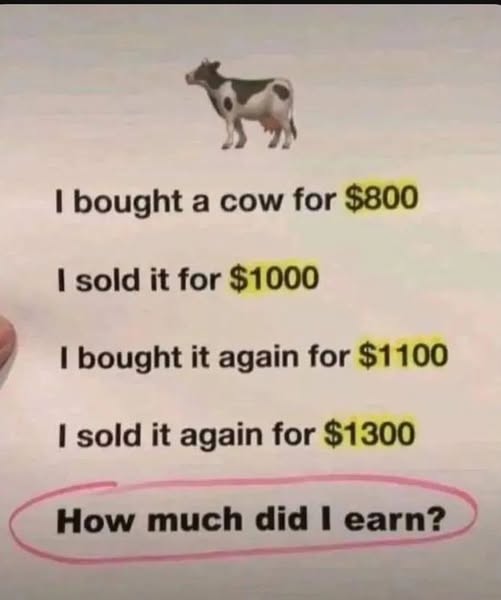
In recent weeks, a simple yet tricky math puzzle involving a cow has been circulating widely across social media platforms. Many users have described it as surprisingly confusing at first glance, even though the solution relies on basic arithmetic and careful tracking of transactions. The puzzle is often presented in a storytelling format, which makes it feel more complex than it actually is. Because of this, it has sparked discussion, debate, and curiosity among people trying to verify their answers.
At the center of the puzzle is a sequence of buying and selling actions involving a cow and a series of prices. While the numbers themselves are not difficult to understand, the challenge lies in keeping track of profit across multiple transactions. Many people make mistakes by double-counting profit or misunderstanding how net gain works over repeated purchases and sales. This is what makes the puzzle both engaging and slightly misleading at first reading.
Step 1: First Purchase and Sale
The scenario begins with a simple transaction. A cow is purchased for $800. Later, it is sold for $1,000. At this stage, the calculation is straightforward: the difference between the selling price and the purchase price results in a profit of $200. This part is easy to understand and serves as the foundation for the rest of the puzzle.
However, this initial profit is often where confusion begins. Some people assume that this $200 must be added repeatedly later, but in reality, each transaction must be tracked separately. The key is to treat each buy-and-sell cycle independently before combining results at the end. This ensures accuracy when calculating total profit.
Step 2: Buying the Cow Again
After the first sale, the cow is purchased again, this time for $1,100. At this point, the financial position changes because the money spent is higher than the previous purchase price. This creates a new starting point for the second transaction cycle.
It is important to note that the previous profit of $200 does not disappear, but it is already realized. The second purchase simply begins a new calculation cycle. Many people mistakenly combine all numbers at once, which leads to incorrect answers. The correct approach is to separate each stage clearly.
Step 3: Second Sale of the Cow
The cow is then sold again, this time for $1,300. This creates another profit calculation: $1,300 minus $1,100, resulting in a second profit of $200. Just like the first cycle, this is an independent gain that must be recorded separately.
At this stage, both transactions have produced identical profits of $200 each. This symmetry is part of what makes the puzzle visually simple but mentally tricky. People often overthink the structure, assuming hidden logic is involved when in reality it is basic subtraction repeated twice.
Final Profit Calculation Explained
When combining both transactions, the total profit is calculated by adding the results of each cycle. The first transaction produced a profit of $200, and the second transaction also produced a profit of $200. Adding them together results in a total profit of $400.
200+200=400200 + 200 = 400
This confirms that the final answer is $400. The key insight is that profit should be tracked per transaction, not mixed across steps. Once this is understood, the puzzle becomes much easier to solve and no longer feels misleading or complicated.

Why People Get Confused
One reason this puzzle went viral is because it plays on how people mentally track money. When multiple buying and selling steps are involved, it is easy to lose track of what is profit, what is cost, and what is already accounted for. The story format also encourages overthinking, which leads many people to incorrect conclusions.
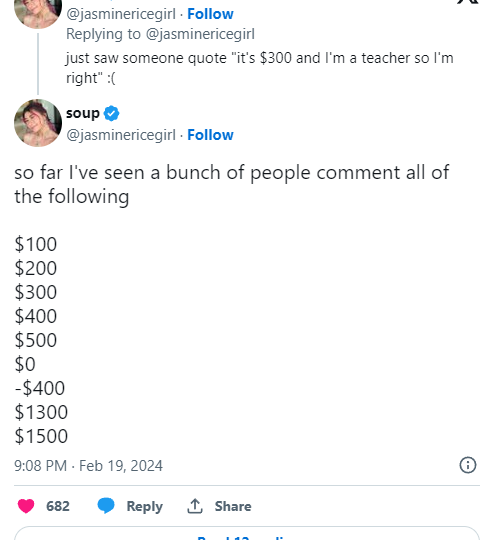
Another factor is that people often try to calculate everything in one combined equation instead of breaking it into stages. This creates confusion and sometimes leads to answers like $200, $300, or even incorrect net loss interpretations. In reality, structured step-by-step thinking eliminates the confusion entirely.
More Brain Teasers Like This
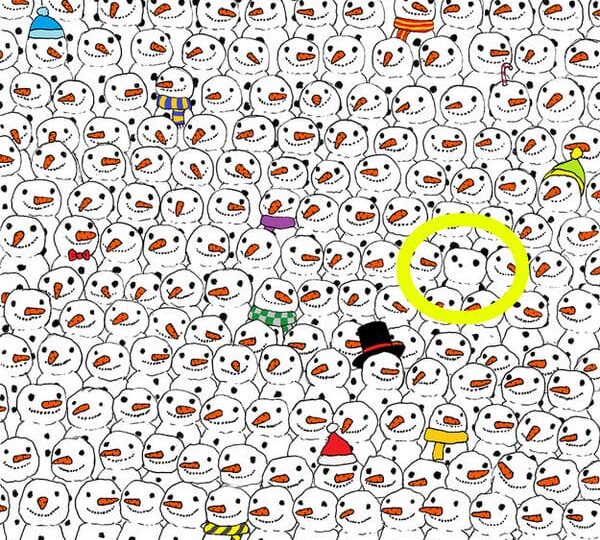
Puzzles like this cow math problem are popular because they challenge attention to detail rather than advanced mathematical knowledge. They are designed to test logical thinking, not complex formulas. Similar puzzles often include hidden objects, pattern recognition challenges, or visual trick questions that rely on perception.
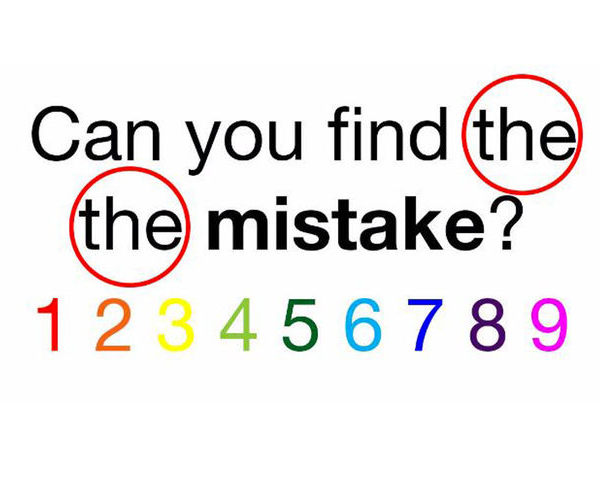
For example, “odd one out” puzzles test how quickly the brain can detect differences in a group. Hidden object puzzles challenge visual focus and patience. Meanwhile, mistake-spotting puzzles require careful reading and attention to detail. All of these types of challenges are widely shared online because they are quick, engaging, and satisfying to solve.
Final Thoughts
The cow math puzzle is a good example of how simple arithmetic can become confusing when presented in a story format. While the numbers themselves are straightforward, the mental challenge comes from tracking multiple steps correctly. Once broken down properly, the solution is clear and logical.
The correct final answer remains $400 total profit across both transactions. This type of puzzle is a reminder that careful step-by-step reasoning is often more important than speed when solving logical problems. It also shows why such challenges continue to spread widely across social media, attracting people who enjoy testing their thinking skills.

