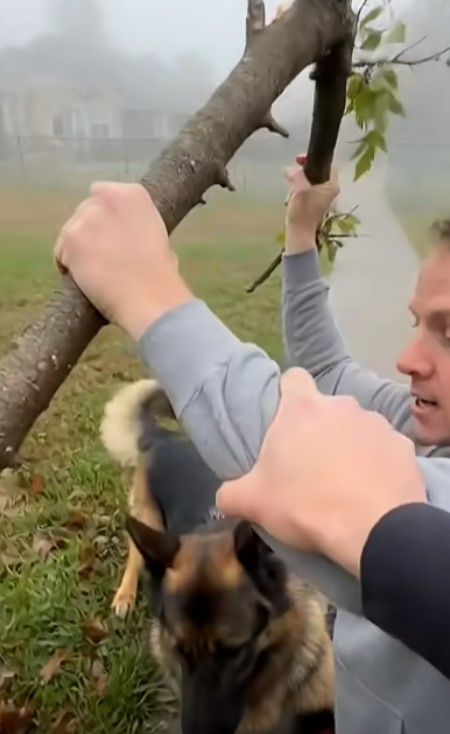
For seven years, Officer Daniel Carter had built his entire professional identity around discipline, routine, and trust in his K9 partner. His German Shepherd, Max, was not just a trained police dog but a highly experienced working partner who had been involved in countless operations. Together, they had cleared buildings, assisted in suspect apprehensions, and worked in crowded urban environments where focus and obedience were essential.
Over time, Carter came to believe that he understood Max’s behavior completely, as if the dog’s reactions were always predictable and precise. Despite their demanding work, the bond between them had grown stronger through years of shared experience. Max responded instantly to commands, maintained calm under pressure, and demonstrated a level of awareness that made him highly reliable in unpredictable situations.
For Officer Carter, Max represented stability in a profession often filled with uncertainty. Nothing in their past suggested that an ordinary day could ever turn into something unexpected. That sense of routine remained unchanged until a quiet morning at Miller Park, when everything took a different turn. It was early, around 6:30 a.m., and the air was cold and still. A thick layer of fog covered the ground, reducing visibility and giving the entire park a muted, almost silent appearance. Most of the walking paths were empty, with only occasional movement from early joggers or park maintenance staff in the distance.
Officer Carter was off duty that morning, walking Max along one of the paved paths that curved through the park. The environment felt peaceful and uneventful, and there was no indication that anything unusual was about to happen. As they moved forward, Carter noticed a father and his young son nearby. The child was playing close to a pile of damp leaves that had gathered beside the walkway, while the father stood a short distance away, watching casually.
At first glance, the scene appeared completely normal. There was nothing about the surroundings or the behavior of the people that suggested danger or concern. Max also seemed relaxed as they passed, maintaining his usual pace beside Officer Carter. The atmosphere remained calm, and the morning continued without disruption for several moments.
Then, suddenly, Max stopped walking.
His posture changed immediately. The relaxed movement disappeared, replaced by a rigid and focused stance. His ears shifted backward slightly, and his attention locked onto a specific point ahead. Officer Carter noticed the change instantly, recognizing it as a sign that Max had detected something unusual. However, there was nothing visible that could explain the reaction.
Carter gave a command, expecting Max to return to position and continue walking. Under normal circumstances, Max would have obeyed without hesitation. But this time, there was no response. The dog remained completely still, intensely focused on the child near the leaves. His body language had shifted from calm awareness to high alert, something Carter had only seen in training scenarios involving potential threats.
Within seconds, Max broke forward.
The movement was sudden and forceful, catching both Officer Carter and the father off guard. Carter immediately shouted a warning, urging the father to move his child away from the area. But the situation unfolded too quickly for immediate reaction. Max reached the child first and pulled him backward by the hoodie, dragging him away from the edge of the leaf-covered ground.
The boy fell onto the concrete surface and began crying in shock, while the father rushed forward, initially believing the dog had attacked his son. Confusion and panic spread through the scene in seconds. Officer Carter sprinted toward them, equally alarmed by what he was witnessing.
But as he reached Max, he realized something was wrong with the assumption of an attack. Max was not focused on the child at all anymore. Instead, his attention had shifted to the ground near where the boy had been standing moments earlier. His posture remained tense, but his behavior was controlled and deliberate, not aggressive.
Carter followed Max’s gaze and noticed subtle movement in the pile of wet leaves. At first, it appeared to be nothing more than wind or shifting debris. However, the ground beneath the leaves began to sink slightly, forming an uneven depression that was not there before. The movement became more noticeable with each passing second.
Recognition set in quickly. Max had not been reacting to the child—he had been responding to instability beneath the surface. The officer’s training immediately took over as he realized that a structural collapse or hidden void could be forming underground. Before he could fully warn the others, the situation escalated.
The ground suddenly gave way.
A large section of soil and pavement collapsed inward, revealing a deep cavity beneath the walking path. Had the child remained in that position, he would have fallen directly into the opening. The father stood frozen, realizing how narrowly his son had avoided serious injury or worse.
But the danger was not over.
As Officer Carter attempted to secure the area, additional cracks began forming along the edge of the pathway. The unstable ground extended farther than initially visible. In the chaos, Carter lost his footing and nearly fell into the collapsing section himself. The father reacted quickly, grabbing his arm and pulling him backward to safety.
Max also responded instinctively. Moving beside them, he positioned himself in a way that helped stabilize their retreat, using his strength to assist in pulling them away from the unstable edge. His actions contributed to preventing further injuries as the ground continued to shift behind them.
After several tense moments, the immediate collapse stopped, leaving a large exposed hole in the ground. Dust and debris filled the air, and silence returned briefly to the park. Max remained alert, standing near the edge as if still assessing the environment.
It was then that a faint sound emerged from below.
At first, Officer Carter was unsure if he had heard correctly. But after focusing his attention, he heard a weak voice coming from inside the collapsed area. Realizing the seriousness of the situation, he immediately called for emergency services and began assessing the source of the sound more carefully.
With the help of a flashlight, Carter looked into the exposed underground space. What he saw confirmed the urgency of the situation—a young girl was trapped beneath debris and broken structural material. She appeared conscious but frightened and unable to move freely.
The child was identified as Chloe, a young girl who had been reported missing two days earlier. The discovery immediately shifted the situation from a structural collapse to a critical rescue operation. Emergency services were dispatched urgently, including firefighters and specialized rescue teams trained for confined-space recovery.
While waiting for assistance, Max remained calm but alert, staying near Carter and the edge of the collapse. His behavior suggested continued awareness of potential danger in the surrounding area. Officer Carter later reflected that Max had been responding to subtle environmental signals long before any visible signs of collapse appeared.
When rescue teams arrived, they carefully stabilized the area and began the process of extracting the trapped child. The operation required precision due to the instability of the surrounding ground. After a coordinated effort, Chloe was safely brought to the surface. She was injured but alive and immediately transported for medical evaluation.
The young boy involved in the incident was also confirmed to be safe, with no serious injuries reported. The father, overwhelmed with emotion, expressed gratitude and regret for initially misunderstanding the situation. He later acknowledged that without Max’s intervention, the outcome could have been far more tragic.
In the aftermath of the event, Officer Carter reflected deeply on what had occurred that morning. What began as a routine walk had transformed into a life-saving intervention driven by instinct, training, and environmental awareness. Max’s actions demonstrated not only obedience but an extraordinary ability to detect danger beyond human perception.
By the end of the day, Max was recognized not just as a trained police K9, but as a critical factor in preventing multiple tragedies. His actions saved a child from falling into a hidden collapse, helped protect his handler, and ultimately contributed to the rescue of a missing child underground.
The incident at Miller Park became a reminder of how unpredictable real-world situations can be, and how highly trained K9 units often perceive danger long before humans are aware of it. For Officer Carter, the event permanently changed the way he viewed his partner—not simply as a working dog, but as an irreplaceable member of every operation.
