
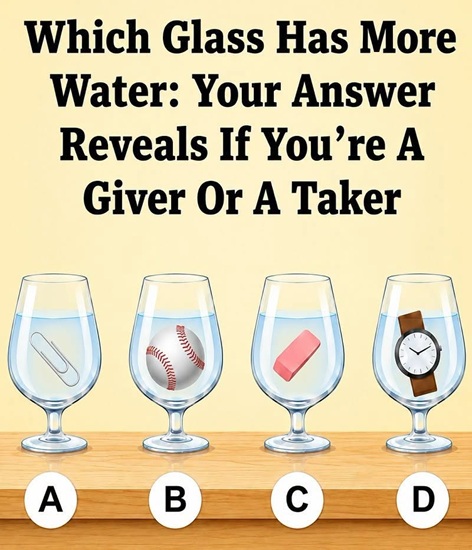
At first glance, the puzzle appears surprisingly simple. Four identical drinking glasses are placed side by side, each seemingly filled to exactly the same water level. Inside each glass rests a different object: a small paperclip, a baseball, an eraser, and a wristwatch. The challenge asks only one question: Which glass contains the greatest amount of water? Because every glass appears equally full, many people instinctively assume they all contain the same amount of water.
Others immediately select the largest object, believing it somehow indicates the correct answer. Yet the puzzle is carefully designed to demonstrate how easily our first impressions can mislead us when we rely only on visual appearance rather than scientific reasoning. This type of visual puzzle has become popular because it encourages people to slow down and think analytically instead of relying solely on intuition.
Human beings process enormous amounts of visual information every day, allowing the brain to make quick decisions based on patterns and previous experience. Most of the time this ability is extremely useful, but it can occasionally produce incorrect conclusions when important information is hidden beneath the surface. The glass puzzle is a simple example of how critical thinking often requires looking beyond what appears obvious at first glance.
The key scientific concept behind the puzzle is displacement, a principle that has been understood for centuries. When any object is placed into water, it occupies physical space. As a result, the object pushes water aside equal to the volume of the portion of the object submerged beneath the surface. This principle was famously described by the ancient Greek mathematician and inventor Archimedes, whose discoveries continue to be taught in physics classrooms around the world. Although the puzzle looks like a visual challenge, the correct solution depends entirely on this physical law rather than on eyesight alone.
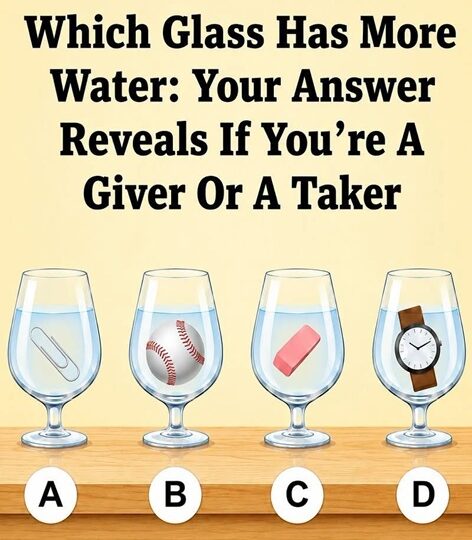
Imagine that all four glasses are exactly the same size and that each one is filled to precisely the same level. If a very large object is placed inside one of the glasses, that object occupies a significant amount of space within the container. Because the glass has a fixed volume, less space remains available for water. Conversely, if the object is extremely small, it occupies very little internal volume, allowing more water to remain inside the glass. Once this principle is understood, the puzzle becomes much easier to solve through logical reasoning rather than guesswork.
Applying this reasoning to the four objects provides the answer. The baseball occupies the greatest volume, meaning it displaces the largest amount of water. The wristwatch and eraser also take up noticeably more space than a small paperclip. The paperclip, by contrast, occupies only a tiny fraction of the glass’s interior. Assuming the glasses are identical and the objects are fully submerged, the glass containing the paperclip has the greatest remaining volume available for water. Therefore, Glass A, containing the paperclip, holds the most water.
Although the answer is straightforward once explained, the puzzle remains fascinating because of what it teaches about human perception. Our brains naturally focus on the visible water level rather than the invisible volume occupied by the submerged objects. This shortcut allows us to make rapid judgments in everyday situations, but it can also lead us to overlook important details. Scientists who study perception often explain that the human brain continuously simplifies information in order to process it efficiently, which sometimes results in visual or cognitive illusions.
The popularity of puzzles like this extends beyond science classrooms because they encourage habits that are valuable in many areas of life. Engineers, researchers, physicians, accountants, investigators, and many other professionals regularly solve problems by identifying hidden variables rather than accepting first impressions. A successful solution often depends on asking additional questions, testing assumptions, and considering information that may not be immediately visible. The glass puzzle demonstrates these skills using an example that almost anyone can understand within a few moments.
Many versions of this puzzle shared on social media also include personality descriptions based on the answer someone chooses. These descriptions often claim that selecting a particular glass means a person is highly analytical, intuitive, creative, or detail-oriented. While these interpretations may be enjoyable to read, psychologists emphasize that there is no scientific evidence showing that choosing one answer to a visual puzzle accurately reveals personality traits. Such descriptions should therefore be regarded as entertainment rather than psychological assessment.
Perhaps the greatest value of the puzzle lies not in identifying the correct glass but in encouraging careful observation. It reminds us that appearances alone do not always provide complete information. In science, mathematics, engineering, and everyday decision-making, people frequently achieve better results by slowing down, examining the evidence carefully, and remaining willing to question their initial assumptions. That habit of thoughtful analysis is one of the most important skills this seemingly simple puzzle can teach.
By combining an everyday object with a basic law of physics, the glass puzzle transforms an ordinary question into an engaging lesson about reasoning. It demonstrates that even the simplest problems sometimes contain hidden variables that are easy to overlook. Instead of rewarding quick guesses, it rewards careful thinking, scientific understanding, and the willingness to look beyond first impressions—qualities that remain valuable long after the puzzle itself has been solved.
One of the reasons the glass puzzle continues to capture people’s attention is that it demonstrates how easily the human mind can be influenced by first impressions. In everyday life, people constantly make rapid judgments based on visual information because doing so allows the brain to process enormous amounts of data efficiently. Most of the time these quick decisions are accurate enough for ordinary situations. However, puzzles like this remind us that when a problem involves hidden variables, relying only on what we immediately see may lead to an incorrect conclusion. Careful observation and logical analysis often reveal information that is not obvious at first glance.
Psychologists who study human perception explain that the brain naturally looks for familiar patterns. Rather than calculating every detail individually, it simplifies information using previous experience. This mental shortcut is extremely useful because it helps people react quickly to everyday situations. At the same time, it also explains why visual puzzles, optical illusions, and scientific demonstrations can sometimes surprise us. They are specifically designed to encourage assumptions that seem reasonable initially but become inaccurate once additional information is considered.
The glass puzzle also serves as an excellent introduction to one of the most important concepts taught in basic physics: volume displacement. Students around the world learn that an object placed into a liquid occupies space, forcing the liquid to move aside. This principle forms the foundation for understanding why ships float, how scientists measure the volume of irregular objects, and how engineers design countless devices involving fluids. Although the puzzle appears simple, it illustrates a scientific idea that has practical applications across engineering, medicine, manufacturing, environmental science, and many other fields.
Teachers frequently use puzzles similar to this one because they encourage students to explain why an answer is correct rather than simply identifying the answer itself. Developing the ability to justify conclusions with evidence is an important part of scientific thinking. Instead of memorizing facts, students learn to connect observations with established principles and logical reasoning. This approach strengthens problem-solving skills that remain valuable throughout education and professional life.
Another interesting aspect of the puzzle is how differently people approach the same question. Some individuals immediately focus on the visible water level, while others begin comparing the size of the submerged objects. Still others mentally imagine what would happen if each object were removed from its glass. These different approaches illustrate that people often use multiple reasoning strategies when solving unfamiliar problems. None of these strategies necessarily reflects intelligence on its own; rather, they demonstrate the variety of ways the human mind analyzes information.
Many online versions of the puzzle encourage friendly discussion because people enjoy comparing their reasoning with that of others. Conversations often become less about who answered correctly and more about how different individuals reached their conclusions. This exchange of ideas mirrors an important aspect of scientific inquiry itself. Researchers regularly propose explanations, evaluate evidence, question assumptions, and refine conclusions as new information becomes available. The puzzle therefore offers a simple example of how collaborative reasoning can improve understanding.
It is also worth remembering that scientific puzzles are designed to teach principles rather than measure personal ability. Answering incorrectly does not indicate a lack of intelligence, just as answering correctly does not automatically demonstrate advanced scientific knowledge. Instead, such puzzles provide opportunities to learn something new while encouraging curiosity about the underlying concepts. Many educators view this process of questioning, discovering, and understanding as more valuable than simply arriving at the correct answer.
Social media has played an important role in increasing the popularity of visual puzzles over the past decade. Images that appear easy to solve often encourage large numbers of people to participate, compare answers, and discuss the reasoning behind them. When accompanied by accurate explanations grounded in science, these puzzles can serve as enjoyable educational tools that introduce complex concepts in an accessible way. They demonstrate that learning does not always require lengthy textbooks; sometimes a simple illustration can inspire meaningful curiosity.
The broader lesson extends well beyond physics. In everyday life, people frequently encounter situations where the most obvious explanation is not necessarily the most accurate one. Whether evaluating information, solving workplace problems, conducting research, or making important personal decisions, careful observation and evidence-based reasoning often produce more reliable conclusions than quick assumptions. Taking time to ask additional questions and consider information that may not be immediately visible is a valuable habit across many areas of life.
Ultimately, the glass puzzle reminds us that knowledge grows when curiosity is combined with careful thinking. A tiny paperclip, almost invisible compared with the larger objects, ultimately provides the correct solution because of a fundamental law of physics rather than appearance alone. That simple realization encourages a broader mindset: look carefully, question first impressions, and allow evidence to guide conclusions. These habits form the foundation of scientific thinking and remain valuable whether solving classroom puzzles, addressing real-world challenges, or simply seeking a deeper understanding of the world around us.

