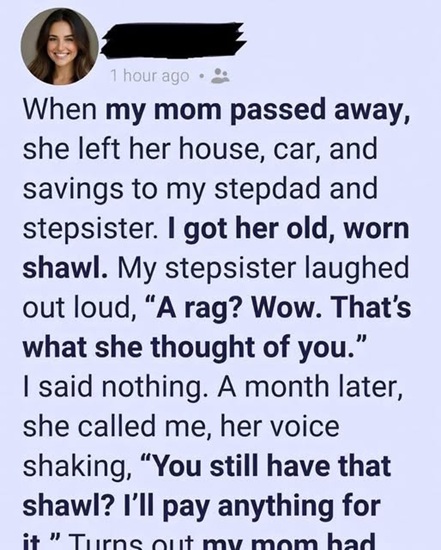
When my mother passed away, it felt as if the world had shifted in a way I couldn’t fully describe. Everything around me continued normally, yet I felt disconnected from it, as though I was observing life rather than participating in it. Even simple routines, like walking into a room or hearing familiar voices, felt slightly distant. Grief does not arrive all at once; it slowly changes how reality feels, until even ordinary moments seem unfamiliar. The reading of the will became one of the most emotionally difficult moments of that period.
I sat in a quiet room surrounded by people who were connected to my mother in different ways, yet none of it felt comforting. My stepfather and stepsister were present, along with a lawyer who read through the document in a calm and professional tone. The distribution of assets was straightforward: the house, the car, and financial savings went to my stepfamily.
When my name was finally mentioned, there was no property or financial inheritance attached. Instead, I was handed a single item—my mother’s old shawl. It was folded neatly, worn from years of use, and carried a softness that only comes with time. In that moment, I noticed my stepsister’s reaction. She laughed briefly, as if the gesture itself was meaningless or even insulting. I did not respond. I simply took the shawl and placed it carefully with me.
At the time, I understood why it might appear insignificant to others. It was not valuable in a financial sense, and it did not represent wealth or status. However, to me, it carried a different kind of meaning. I remembered my mother wearing it during quiet evenings at home, especially during moments of rest or reflection. It was something she used when she felt safe and at ease, and those memories made it far more meaningful than anything else in that room.
In the weeks that followed, life slowly began to settle into a new rhythm. It was not the same as before, but it was stable enough for daily routines to resume. Emotional adjustment took time, and there were days when everything felt heavier than expected. Then, unexpectedly, I received a phone call from my stepsister. Her tone was noticeably different from before—less confident, more uncertain.
She asked about the shawl directly. At first, I assumed it was a casual question, but it quickly became clear that it was not. When I confirmed that I still had it, she paused for a moment and then asked if she could have it back. There was urgency in her voice that I had never heard before. She did not fully explain her reason, but it was obvious that her perspective on the item had changed.
That moment stayed with me because it revealed something important about how people assign value. What once seemed irrelevant to her had suddenly become significant. It made me reflect on how often people overlook things simply because they do not immediately appear valuable or important. Sometimes, meaning is not visible until much later.
Around the same period, other experiences in my life also began to reshape my understanding of relationships and support. My relationship with my father, for example, had been strained for years. After he refused to attend my wedding, communication between us gradually stopped. There was no formal ending to our relationship—just silence that grew over time until it became normal.
Years later, I experienced a serious medical emergency while at work. It was sudden and disorienting, leaving me unable to make clear decisions in the moment. Without thinking, I listed my father as an emergency contact, not expecting much to come from it. To my surprise, he arrived quickly and took responsibility for authorizing medical care.
During my recovery, he stayed present and involved. He coordinated with medical staff and remained nearby throughout the process. We did not immediately discuss past conflicts or unresolved issues. Instead, he simply focused on ensuring I received proper care. At one point, he said that regardless of everything that had happened between us, losing me would have been the worst outcome. It was one of the few emotionally direct statements he had ever made.
That experience did not resolve all our differences, but it changed the way I viewed our relationship. It reminded me that people are often more complex than a single decision or moment. Actions taken during crisis situations sometimes reveal emotions that are otherwise difficult to express.
A similar realization came through my relationship with my younger brother. For a long time, he believed I had everything under control. I did not correct that assumption, even when it became untrue. When I later developed a severe anxiety condition, I withdrew from many daily activities and avoided social interaction.
Instead of distancing himself, my brother became more involved. He helped me attend therapy sessions consistently and learned techniques to support me during difficult moments. He did not treat the situation as something to fix quickly, but rather as a process that required patience. His presence became a stabilizing factor during a time when I struggled to maintain structure in my life.
In a separate situation at work, I was once wrongly blamed for an error made by someone in a supervisory position. The consequences affected my job and reputation, and I was removed from my position without a clear public explanation. The experience was isolating, and for a time, I considered leaving my field entirely.
However, a former colleague I had not been close to reached out privately. She had access to internal information that showed I was not responsible. Sharing that information placed her in a difficult position professionally, but she chose to do it anyway. Her actions helped me challenge the situation and eventually rebuild my career path.
Across these different experiences, a pattern began to emerge. Support often came from unexpected places, and not always from those I assumed would be closest. Sometimes strangers or distant connections played more meaningful roles than immediate family or authority figures. These moments highlighted how unpredictable human behavior can be in times of difficulty.
Eventually, the situation with the shawl became less about conflict and more about understanding perception. What one person dismisses, another may hold onto for emotional reasons that are not immediately visible. The value of objects is often shaped not by appearance, but by memory and association.
In the end, what remained most important was not ownership or inheritance, but what each experience revealed about people and relationships. Life has a way of showing intentions more clearly during moments of loss, stress, and uncertainty. Some individuals act quietly but meaningfully, while others only recognize value when circumstances change.
The shawl, ultimately, remained with me—not as a symbol of wealth or possession, but as a reminder of memory, connection, and the complexity of human perception. Over time, I learned that meaning is not always immediate, and value is not always visible at first glance. Sometimes, the smallest things carry the deepest significance.
