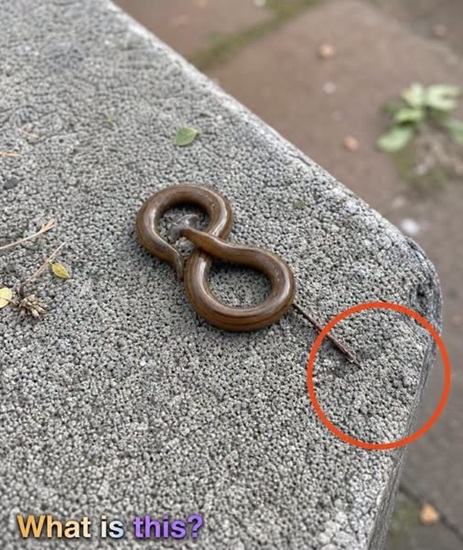
A long, smooth animal moving across damp soil can easily be mistaken for an unusual earthworm. From a short distance, its body may look familiar enough that many people would not immediately recognize anything unusual. The major clue appears when the head becomes visible. Instead of the rounded end associated with a common earthworm, the animal may have a broad, flattened head that resembles a small shovel, crescent, or hammer.
This distinctive appearance is the reason these terrestrial flatworms are commonly known as hammerhead worms or hammerhead flatworms. Although their bodies may look wormlike, they are not earthworms and belong to a completely different group of animals. Hammerhead flatworms are land planarians that belong to the family Geoplanidae. Several species associated with genera such as Bipalium can develop the characteristic widened head that gives the group its familiar name.
Different species can vary in length, color, stripe pattern, head shape, and feeding behavior, so the presence of a broad head alone does not necessarily identify the exact species. Some are dark and relatively uniform in color, while others display visible longitudinal stripes. Accurate identification may require a combination of body markings, size, head pattern, location, and specialist knowledge. For this reason, it is better to describe an unfamiliar specimen cautiously rather than assume that every hammerhead-shaped flatworm is biologically identical.
Their movement provides another obvious difference from ordinary earthworms. Earthworms generally move through muscular contractions while using tiny bristles on their bodies to gain traction. Terrestrial flatworms move across surfaces in a smoother manner, assisted by microscopic cilia, muscular activity, and mucus produced beneath the body. To a person watching one on wet pavement, mulch, or soil, the animal can appear to glide rather than wriggle. This unusual motion is often what attracts attention before the head is even noticed. It may look deliberate, but it is simply part of the flatworm’s normal way of moving through its environment.
Moist conditions are particularly important for terrestrial flatworms. Many are associated with damp soil, leaf litter, mulch, stones, logs, plant pots, and other protected places where moisture is retained. After rain, they may become much more visible because wet surfaces allow them to move into areas that would otherwise be too dry. This is why sightings can sometimes appear sudden. A flatworm that was previously hidden beneath vegetation or landscaping material may cross an exposed surface when conditions become suitable. Its appearance after rainfall does not necessarily mean that it has just arrived in the area.
The flattened head is more than an unusual shape. Land planarians possess sensory structures that help them detect information in their surroundings. Chemical cues are especially important as the animal navigates through soil and other moist environments. The broad head therefore belongs to an animal adapted to a very different way of life from an earthworm. The similarity between a hammerhead flatworm and an earthworm is mostly superficial. Once their anatomy and behavior are considered, the two animals become much easier to distinguish.
One of the most surprising facts about many hammerhead flatworms is that they are predators. Common earthworms are often associated with decomposing organic material and soil processes, but many terrestrial planarians actively feed on other small invertebrates. Depending on the species, their prey may include earthworms, slugs, snails, other worms, small arthropods, or related organisms. Several widely discussed Bipalium species are especially well known for feeding on earthworms. This means that a creature resembling a simple soil worm may actually be moving through the environment in search of prey.
The hunting process can be highly specialized. Research on hammerhead flatworms has documented behavior in which they locate and make contact with earthworm prey before restraining it. Mucus and body movements can play a role during capture. The flatworm does not need claws, teeth, or a rapid attack in order to function as a predator. Instead, it uses the biological tools available to a soft-bodied land planarian. This makes its slow movement particularly interesting. A predator does not always need to be fast or dramatic to be effective.
Feeding is also very different from what people normally imagine when they think about predators. Hammerhead flatworms do not possess jaws comparable to those of mammals, reptiles, or fish. Planarians have a muscular pharynx that can extend from the underside of the body and participate in feeding. Once suitable prey has been subdued, the feeding process begins through this specialized structure. The mechanism is unusual compared with familiar larger animals, but it is well adapted to the flatworm’s body plan. Nature contains many different solutions to the same basic challenge of obtaining food.
Another remarkable part of hammerhead flatworm biology involves chemical defenses. Scientific research has confirmed tetrodotoxin in at least two species, Bipalium kewense and Bipalium adventitium. Tetrodotoxin is a powerful neurotoxin also known from several unrelated groups of animals. Researchers have suggested that in these flatworms it may contribute to predation and possibly defense. However, this finding should not be generalized to every terrestrial flatworm in every location. The fact that a compound is known from particular studied species does not automatically mean all hammerhead flatworms contain the same amount or even the same toxin.
This scientific detail can easily become exaggerated when shared online. The presence of tetrodotoxin does not mean that hammerhead flatworms actively attack humans or inject venom into people. They are not adapted to hunt humans and do not possess a stinger or fang designed to deliver toxin. Nevertheless, sensible handling precautions are appropriate. If a person needs to move an unfamiliar flatworm, gloves can reduce unnecessary contact with mucus, and washing the hands afterward is reasonable. Avoiding contact with the eyes or mouth is also a sensible precaution when handling unknown wildlife.
For most people, direct handling is unnecessary. A clear photograph can usually provide more useful information than picking up the animal. Images of the entire body, head shape, coloration, and stripe pattern can help with identification. Recording the general location can also be useful because different species have different distributions. If a person believes the animal may be an introduced or invasive species, the relevant agricultural, environmental, or university extension authority in that region can provide more specific guidance. This avoids pretending that one universal rule applies everywhere.
The difference between hammerhead flatworms and earthworms is especially important when discussing ecological effects. Earthworms belong to the annelids and have segmented bodies, while hammerhead flatworms belong to the flatworms and lack the same segmentation. They also differ in internal anatomy, movement, feeding behavior, and reproductive biology. Describing a hammerhead flatworm simply as an unusual earthworm therefore overlooks most of its defining characteristics. The two animals may share a long body shape, but biologically they are far apart.
Earthworms themselves also deserve careful treatment when discussing ecology. Many people associate them with healthy garden soil because some earthworm species can influence decomposition and soil structure. However, their ecological role depends on the species and region. In some ecosystems, certain earthworms are introduced rather than native and can significantly alter soil conditions. This means that statements claiming every earthworm is universally beneficial or every hammerhead flatworm is universally harmful are too simple. Ecological effects need to be considered according to species and location.
The same caution applies to the word “invasive.” Several hammerhead flatworm species have been introduced into areas outside their original ranges, often through the movement of soil, plants, greenhouse material, or horticultural products. A small flatworm hidden beneath a pot or inside moist soil can travel long distances without being noticed. Over time, some introduced species have established populations in new regions. However, the ecological impact of a particular species can vary. Responsible reporting should distinguish between being non-native, being established, and causing demonstrated ecological harm.
Gardens and landscaped environments can provide suitable habitat because mulch, plant pots, stones, and dense vegetation often retain moisture. These same environments can also contain earthworms and other small invertebrates that may serve as prey. This combination makes gardens one of the places where people are likely to notice terrestrial flatworms. Their presence does not automatically mean a property is dirty or poorly maintained. They are outdoor organisms responding to habitat conditions, moisture, and available food.
Their connection with transported plants also explains why sightings may occur far from a species’ original range. International and regional trade in ornamental plants can unintentionally move soil-dwelling organisms. Insects, snails, flatworms, fungi, and many other small organisms can be carried with roots, soil, pots, or packing material. This process is one reason biosecurity programs pay attention to the movement of plant material. Hammerhead flatworms are only one example of how human transportation can reshape the distribution of small terrestrial species.
Reproduction makes some land planarians particularly interesting. Certain species can reproduce asexually through fragmentation or fission, with separated body portions regenerating missing structures. This remarkable ability is one reason cutting a hammerhead flatworm is not considered a reliable control method. Depending on the species and the condition of the fragments, pieces may survive and regenerate. Some species can also reproduce sexually. Because these reproductive strategies vary, broad claims such as “every piece always becomes another worm” should be avoided.
Planarians have attracted scientific interest for many years because of their impressive regenerative abilities. Their biology has contributed to research on tissue regeneration, cell organization, and developmental processes. That does not mean every land planarian has identical regenerative capacity, but the group is well known for its ability to rebuild missing structures. This feature makes them scientifically interesting far beyond their appearance. An animal found moving across a garden path can belong to a group that has helped researchers investigate fundamental biological questions.
If management is considered necessary, local guidance matters. Different regions may have different species, different reporting rules, and different recommendations. One authority may ask residents to document a sighting, while another may provide specific disposal advice. An international article should therefore avoid telling readers everywhere to contact a particular state or local office. The most accurate recommendation is to consult the appropriate agricultural, environmental, invasive-species, or extension authority where the animal was actually found.
Handling advice also needs to remain proportionate. There is no reason for panic if a hammerhead flatworm is seen outdoors. The animal is not seeking people as prey and does not behave like an aggressive animal. At the same time, unnecessary direct contact with unfamiliar wildlife is rarely useful. Gloves, tools, or simple observation can minimize contact. This is a balanced response that acknowledges the animal’s biology without turning the encounter into a frightening story.
The mucus produced by land planarians is one of their most important adaptations. It helps them move across surfaces and can also play roles in interactions with prey and environmental protection. A flatworm may therefore leave a visible slimy trail behind it. This is normal for the animal and should not be interpreted as evidence of disease. The same mucus contributes to the gliding appearance that makes these creatures so visually distinctive. What initially looks strange is closely connected to how the animal survives.
The animal’s dependence on moisture also explains why dry conditions can limit its activity. A land planarian exposed to hot, dry air faces a greater risk of losing moisture, so protected habitats become important. Beneath logs, stones, mulch, and plant containers, humidity can remain higher than on exposed ground. Rain temporarily expands the amount of surface area suitable for movement. A person who notices a hammerhead flatworm crossing pavement after rain may therefore be seeing it during a short period when conditions allow greater surface activity.
The small-scale world of predators and prey beneath our feet is far more complex than many people realize. Soil, leaf litter, and mulch can contain earthworms, insects, mites, centipedes, slugs, snails, nematodes, microorganisms, spiders, flatworms, and countless other organisms. Some feed on dead material, some consume living plants, and others hunt nearby animals. These interactions form food webs that are largely invisible to casual observers. A hammerhead flatworm offers one unusually visible example of that hidden ecological activity.
Predators are often imagined as animals with obvious weapons. Large cats have claws and teeth, birds of prey have talons, and snakes may use fangs or constriction. A hammerhead flatworm does not resemble any of these examples. Its body is soft, its movement is quiet, and its hunting behavior can occur slowly. Yet it is still capable of successfully capturing prey. This is a useful reminder that predation is defined by feeding relationships rather than by dramatic appearance.
The unusual appearance can also lead to inaccurate online descriptions. A photograph of a hammerhead flatworm may be shared with statements claiming that it is deadly to touch, deliberately follows people, infects humans, or destroys every earthworm population it encounters. Claims like these should be treated cautiously unless supported by reliable evidence. The verified biology is already interesting enough. Some species are predators, some are introduced in regions outside their native ranges, and certain studied species contain tetrodotoxin.
Accurate information is especially important because unusual wildlife images can spread rapidly on social media. When a photograph loses its original location or identification, readers may assume that the same species occurs everywhere. A caption written for one region can then be copied into posts aimed at people in completely different countries. This creates confusion about both distribution and risk. The responsible approach is to identify the organism first and separate general biological facts from local management information.
A broad head, for example, can strongly suggest a hammerhead flatworm, but exact identification may still require more detail. Some species have several dark stripes running lengthwise down the body. Others have different color combinations or head markings. Body length can also vary greatly. A photograph with a ruler or another harmless scale reference can sometimes help, provided the animal does not need to be handled. Details like these are much more useful than a dramatic description alone.
Curiosity is valuable when it is combined with restraint. Finding an unfamiliar creature can create a strong desire to touch it, move it, or examine it closely. In many cases, however, those actions are unnecessary. Watching from a short distance may reveal movement patterns, habitat preferences, and body shape without disturbing the animal. Taking a photograph can preserve the encounter for later identification. Learning does not require direct physical contact.
This principle applies to wildlife far beyond hammerhead flatworms. Many animals that seem frightening at first become less mysterious after accurate identification. Others that appear harmless may deserve greater caution than expected. Appearance alone is therefore not a reliable guide to risk. A person who observes first and researches second is less likely to spread misinformation or make an unnecessary intervention. This approach encourages both safety and respect for wildlife.
The hammerhead flatworm is especially memorable because its first impression can be misleading. It looks wormlike, yet it is not an earthworm. It moves slowly, yet it can be an active predator. It appears structurally simple, yet it has specialized sensory abilities, feeding adaptations, mucus production, regenerative capacity, and in certain species unusual chemical defenses. Each new detail changes the way the animal is understood. What first seems like an odd garden worm becomes an example of complex evolutionary adaptation.
It is also important not to treat every predator as harmful simply because it kills other animals. Predation is a normal ecological relationship. The question of whether a particular hammerhead flatworm creates an ecological problem depends on factors such as whether it is native or introduced, what it eats, how abundant it becomes, and what ecosystem it enters. Those questions require evidence. The word “predator” describes feeding behavior; it does not by itself establish environmental damage.
Where introduced populations occur, scientists and environmental agencies may be interested because new predators can affect existing food webs. Earthworms and other invertebrates can contribute to many ecological processes, and changes in their abundance may have consequences. However, the size and importance of those effects are not identical in every location. This is another reason dramatic universal claims should be avoided. Ecology becomes more accurate when uncertainty is acknowledged rather than hidden.
The relationship with earthworms remains one of the most interesting parts of hammerhead flatworm biology. Earthworms spend much of their time in or near soil, which places them within reach of terrestrial predators adapted to the same moist environments. A hammerhead flatworm can use sensory cues to locate suitable prey. Once contact occurs, the interaction can involve mucus, muscular movement, and feeding structures specialized for soft-bodied animals. This quiet process may happen completely unnoticed beneath vegetation or leaf litter.
The apparent simplicity of the flatworm can therefore be deceptive. Humans often judge biological complexity according to size or visible anatomy. A small animal without legs, claws, or a recognizable face may seem primitive at first. Yet survival does not require the same structures in every species. The flatworm possesses adaptations appropriate to its environment and evolutionary history. Its success comes from those specialized traits rather than from resembling larger predators.
Even the head shape has a functional context. The widened anterior region contains sensory structures useful for detecting environmental information. This helps the animal navigate and respond to chemical cues. The broad shape is therefore not merely decorative. It is part of a body adapted to life on damp terrestrial surfaces. The feature that makes the animal easy for humans to recognize also belongs to the sensory system that helps it survive.
Another misconception is that a “worm” must live underground. Hammerhead flatworms may indeed hide in soil or protected spaces, but they can also move across the surface when conditions are moist enough. This makes patios, driveways, garden paths, and plant beds possible places for sightings after rainfall. Their visibility above ground is not necessarily abnormal. It may simply reflect temporary environmental conditions that reduce the danger of drying out.
Homeowners sometimes become concerned that seeing one means a major infestation is present. A single sighting does not provide enough information to determine population size. The animal may have emerged from nearby landscaping material, or there may be additional individuals hidden in suitable habitat. Determining abundance requires more than one observation. It is better to document what is actually seen than to assume the worst from a single encounter.
The same principle applies to claims about danger to pets. An unusual animal should not automatically be treated as a severe poisoning threat without evidence. Avoiding deliberate ingestion and keeping pets from chewing unfamiliar wildlife is sensible general practice. If an animal is suspected of ingesting an unknown organism and develops symptoms, professional veterinary advice is appropriate. But alarmist statements about inevitable poisoning should not replace evidence-based guidance.
For children, the safest lesson is similarly straightforward. Unfamiliar outdoor animals should be observed rather than handled. Adults can use the encounter as an opportunity to teach identification, biology, and respect for wildlife. There is no need to create fear. A photograph, a safe viewing distance, and reliable educational material can turn an unusual sighting into a useful learning experience.
This educational value is one reason hammerhead flatworms attract so much attention. They challenge common assumptions about what worms are and how they live. They demonstrate that soil animals can be predators. They show how introduced species can travel through horticultural trade. They illustrate unusual regeneration and, in some species, chemical defense. All of these topics can emerge from observing one small animal moving slowly across damp ground.
The broader lesson is that familiar environments often contain unfamiliar life. A garden may look ordinary from human height while supporting countless interactions beneath leaves and within soil. Many of those organisms are active at night or during wet conditions and remain hidden most of the time. Others are so small that they are overlooked entirely. Stopping to notice one unusual animal can reveal an entire ecological world that normally remains invisible.
The most responsible way to describe such an encounter is therefore neither to dismiss it nor sensationalize it. The animal deserves accurate identification and context. Calling it “just a strange worm” misses its biology. Calling it a deadly monster exaggerates what is known. The interesting reality lies between those extremes. It is a specialized terrestrial flatworm with a distinctive body, unusual movement, predatory behavior, and a fascinating evolutionary history.
For anyone who finds one, the practical response can remain simple. Observe it without unnecessary handling. Photograph identifiable features if possible. Note the general location and habitat. If local authorities track introduced flatworms, follow the guidance appropriate to that region. Avoid cutting the animal in an attempt to control it because some land planarians can regenerate from fragments.
The encounter can then become an opportunity to learn rather than a reason for panic. What initially seems unfamiliar often becomes understandable once reliable information is available. The broad head explains the common name. The gliding motion reflects flatworm locomotion. Predation explains why some species search for earthworms and other small animals. Chemical defenses and regenerative abilities reveal an organism far more specialized than its simple appearance suggests.
In the end, hammerhead flatworms are memorable precisely because they challenge first impressions. A creature that looks like an unusual earthworm turns out to belong to a very different branch of animal life. Its quiet movement hides a predatory lifestyle, and its flattened body contains adaptations that have allowed land planarians to survive in moist terrestrial habitats around the world. There is no need to make the animal more frightening than it is. Its verified biology is already remarkable.
Sometimes the most interesting discoveries do not require a remote wilderness or a dramatic encounter. They can happen in a garden, beside a plant pot, under a piece of wood, or on a wet path after rain. The important step is noticing something unusual and resisting the temptation to make assumptions too quickly. Careful observation followed by reliable research can turn confusion into understanding. In the case of the hammerhead flatworm, what appears to be a strange worm is actually a small predator with a complex and fascinating place in the natural world.
