
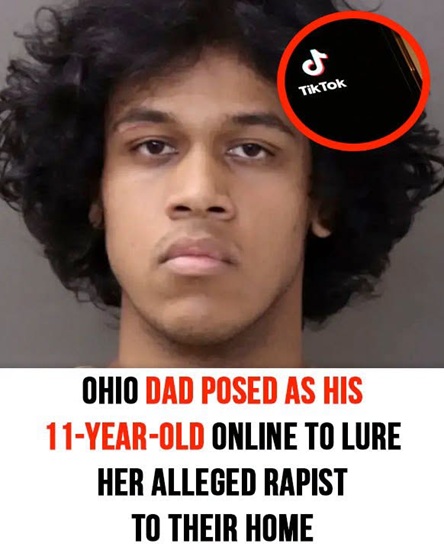
A deeply troubling case in Ohio has drawn widespread attention after allegations involving an 11-year-old girl were followed by a confrontation that ended in gunfire. Malik Chandler, a 31-year-old father from Grove City, is accused of arranging a meeting with 20-year-old Diego Montoya Gonzalez after learning of allegations concerning his daughter. According to authorities and court records reported by multiple outlets, Chandler allegedly used his daughter’s TikTok account to communicate with Montoya Gonzalez before a confrontation at Chandler’s home ended with Montoya Gonzalez being shot. Both men now face separate criminal cases.
The events reportedly began on July 15, 2026, when the girl’s mother discovered disturbing material on her daughter’s phone and contacted law enforcement. Authorities subsequently began investigating allegations of sexual abuse involving the child. Because the alleged victim is a minor, her identity should remain protected, and unnecessary details about the alleged abuse should not be repeated. What can responsibly be reported is that investigators considered the material serious enough to pursue a criminal investigation involving Montoya Gonzalez.
According to court records cited in news reports, Chandler learned about the situation involving his daughter and decided to confront the man accused in connection with it. The following day, July 16, Chandler allegedly used his daughter’s phone and TikTok account to communicate with Montoya Gonzalez while posing as the child. Authorities say those communications were used to persuade Montoya Gonzalez to come to the family’s home in Grove City.
Chandler later told investigators that his original intention was to confront Montoya Gonzalez physically and detain him until police arrived. That description comes from Chandler’s reported statements to law enforcement and should not be interpreted as a judicial finding about exactly what occurred. His decision to arrange the encounter rather than leave the matter entirely to investigators would soon become central to the separate criminal case against him.
When Montoya Gonzalez arrived, the confrontation escalated rapidly. According to Chandler’s account to investigators, he believed Montoya Gonzalez reached toward a pocket and feared that he might be reaching for a firearm. Chandler reportedly knew of social-media material in which Montoya Gonzalez had appeared with a weapon. Chandler then obtained his own firearm and fired several shots.
Reports based on court documents state that Montoya Gonzalez was struck twice. His injuries were not considered life-threatening, and he was transported to Grant Medical Center in Columbus for treatment. Police responding to the scene began investigating not only the circumstances that brought Montoya Gonzalez to the property but also whether Chandler’s decision to use a firearm was legally justified.
Chandler was subsequently taken into custody and charged with felonious assault. His bond was initially reported as $100,000. The existence of serious allegations against Montoya Gonzalez does not automatically resolve Chandler’s legal responsibility for the shooting. Prosecutors and defense attorneys must separately address the circumstances surrounding Chandler’s conduct and determine how Ohio law applies to the evidence.
Additional information about Chandler’s criminal history also emerged as the case developed. Early accounts highlighted a 2017 misdemeanor conviction for attempted breaking and entering and suggested that it did not prohibit him from possessing a firearm. More recent reporting, however, cited the Franklin County Prosecuting Attorney’s Office as saying Chandler had an earlier felony burglary conviction from 2010.
That earlier conviction resulted in an additional legal issue. Recent reporting indicates Chandler was also charged with having a weapon while under disability, meaning prosecutors allege he was legally prohibited from possessing a firearm because of the prior felony conviction. This is an important correction to claims circulating online that Chandler was unquestionably permitted to possess the weapon involved in the July confrontation.
Reports have also mentioned that Chandler previously faced a domestic-violence-related case stemming from allegations involving a girlfriend in 2021. That case was later dismissed. A dismissed allegation should not be described as though it resulted in a criminal conviction, and it does not establish that the alleged conduct occurred. Its existence is part of the reported court history, but it should be presented with that legal distinction clearly stated.
Meanwhile, Montoya Gonzalez faces a separate and extremely serious criminal prosecution. According to published court information, a Franklin County grand jury indicted him on five counts related to pandering sexually oriented material involving minors, two rape counts and one count of obstructing official business. He has pleaded not guilty, meaning the allegations against him have not yet resulted in a conviction.
Investigators have also alleged that additional material depicting the sexual abuse of children was discovered on Montoya Gonzalez’s phone. Prosecutors reportedly said some material involved very young children. Because such allegations concern child sexual abuse material, there is no legitimate reason to reproduce graphic descriptions. The relevant fact is that prosecutors say investigators recovered material that became part of the criminal case against him.
The allegations are exceptionally serious, but the presumption of innocence remains applicable. An indictment means a grand jury determined there was sufficient basis for criminal charges to proceed; it does not establish guilt beyond a reasonable doubt. Montoya Gonzalez will have the opportunity to challenge the prosecution’s evidence through the legal process unless the case is resolved through another lawful procedure.
A court has also imposed restrictions concerning Montoya Gonzalez’s potential pretrial release. Reports indicate that the conditions include having no contact with the alleged victim or her family and significant restrictions on internet use, with an exception connected to employment. These conditions should not be confused with a sentence following conviction.
That distinction corrects an important detail sometimes included in retellings of the case. It is premature to state that Montoya Gonzalez will face these restrictions “when released from prison.” At this stage, he has been charged and pleaded not guilty. The restrictions reported by news organizations concern conditions associated with release while the current criminal proceedings are pending, not a confirmed future prison release.
The two criminal cases also need to remain separate when discussing what happened. The allegations against Montoya Gonzalez do not automatically justify every action Chandler is accused of taking. Similarly, Chandler’s alleged actions during the confrontation do not determine whether Montoya Gonzalez is guilty of the offenses for which he has been indicted. Each man’s conduct must be evaluated according to the evidence relevant to his own case.
The circumstances have understandably generated intense emotional reactions, particularly because a child is at the center of the original allegations. A parent’s anger after learning that a child may have been harmed can be easy to understand on a human level. But understanding an emotional reaction is different from determining whether subsequent violence was lawful. That determination belongs to the courts after the relevant evidence and arguments have been considered.
Chandler reportedly told investigators that he believed Montoya Gonzalez might be reaching for a weapon immediately before the shooting. That assertion could become significant as the case proceeds. At the same time, prosecutors can examine the events preceding the confrontation, including the allegation that Chandler deliberately used his daughter’s account to arrange the meeting and had already intended to confront Montoya Gonzalez.
Those competing facts demonstrate why describing the shooting simply as either “justice” or an unquestionably criminal attack would be premature. Self-defense and other legal defenses depend heavily on specific circumstances. News reports can describe what Chandler says happened and what prosecutors allege, but the ultimate legal conclusions must come through the judicial process.
The privacy of the 11-year-old girl should remain another priority. Public interest in criminal proceedings does not require identifying a child or circulating unnecessary information about alleged sexual abuse. Responsible coverage can explain the charges against the adults while minimizing additional harm to the alleged victim.
The case also demonstrates the importance of distinguishing allegations from established facts when stories spread through social media. Headlines can easily simplify a complicated criminal proceeding into a story about a father taking revenge on someone accused of harming his daughter. The actual legal situation is more complicated: Chandler himself faces felony allegations, while Montoya Gonzalez faces a separate prosecution involving multiple serious charges.
As the cases continue, additional evidence could emerge and charges or court conditions could change. Information available shortly after an arrest is often incomplete, as demonstrated by the later reporting concerning Chandler’s earlier felony conviction and the additional firearm charge. Updates should therefore be based on court records, statements from authorities and other reliable reporting rather than unsupported social-media claims.
For now, several central facts can be stated carefully. Authorities say an investigation began after disturbing material involving Chandler’s minor daughter was discovered. Chandler allegedly used the child’s TikTok account to arrange a meeting with Montoya Gonzalez, and that encounter ended with Montoya Gonzalez suffering two gunshot wounds. Chandler was subsequently charged, while Montoya Gonzalez was separately indicted on multiple serious offenses involving allegations of rape and sexually oriented material involving minors.
Neither prosecution has been resolved simply because the allegations have attracted widespread attention. Chandler is entitled to have the charges against him evaluated through the courts, and Montoya Gonzalez retains the presumption of innocence on his pending charges. The legal system must determine what can actually be proved rather than relying on assumptions created by an emotionally powerful story.
Ultimately, this Ohio case involves several difficult issues at once: allegations of harm to a child, a father’s alleged attempt to confront the accused man, a shooting and two separate criminal prosecutions. The seriousness of those circumstances makes accuracy especially important. The allegations concerning the child deserve a thorough investigation, the shooting requires its own legal examination, and the people charged must have their cases decided through evidence and due process rather than through online speculation.

