
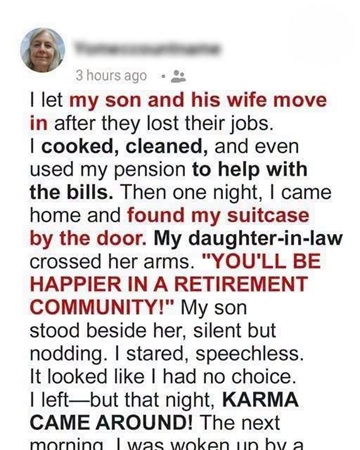
The morning I stood on the front porch with a single suitcase beside me felt strangely quiet. Birds continued singing from the maple tree in the yard, neighbors drove past as they always had, and the breeze carried the familiar scent of freshly cut grass. To anyone passing by, it looked like an ordinary day. Yet for me, everything I had spent decades building seemed to disappear in a matter of minutes. The house behind me had been my home for most of my adult life, the place where birthdays were celebrated, holidays were shared, and countless family memories were made.
Now I found myself looking at the front door as though I no longer belonged there. Standing inside the doorway were my son, Ethan, and his wife, Claire. Their expressions were distant, almost unreadable, making the moment feel even more painful. There were no raised voices or dramatic arguments. Instead, their calm words carried a weight that was far harder to bear. They told me they believed it was time for me to move on and begin a different chapter of my life. Hearing those words from the child I had raised left me stunned. For several moments I could not even respond because I struggled to understand how our relationship had reached such a heartbreaking point.
For years I had believed that family meant standing together through every challenge. Whenever Ethan needed help growing up, I tried to provide it without hesitation. I worked long hours to ensure he had opportunities I never enjoyed myself. I attended school events, celebrated his achievements, comforted him after disappointments, and reminded him that home would always be a place where he was welcome. Those memories remained vivid in my mind as I stood on the porch wondering how the same family could now feel so unfamiliar.
Months earlier, Ethan and Claire had encountered financial difficulties after both unexpectedly lost their jobs. Like many parents, my first instinct was not to calculate the inconvenience but to offer support. I invited them to stay with me until they regained financial stability. It seemed like the natural thing to do. My home had enough space, and I believed difficult seasons eventually passed when people worked together. I never imagined that opening my doors would eventually change the relationship we shared.
During those first weeks, life appeared manageable. We prepared meals together, discussed job opportunities, and encouraged one another to remain optimistic. Ethan often thanked me for helping them through a stressful period, and Claire spoke about how grateful she felt to have family support. Their appreciation seemed genuine, and I looked forward to the day they would find stable employment and move confidently into the next stage of their lives. At that time, I had no reason to question their intentions.
As time passed, however, the atmosphere inside the house slowly began to change. Conversations became shorter, shared meals became less frequent, and ordinary discussions often ended in awkward silence. Small disagreements over household responsibilities gradually became more common. Rather than speaking openly about frustrations, everyone seemed to avoid difficult conversations altogether. I convinced myself that unemployment and financial pressure explained the growing tension. After all, uncertainty can affect even close families in unexpected ways.
One evening Ethan approached me with paperwork that he said would simplify certain financial matters connected to the property. He explained that placing the house in his name could make future planning easier and help protect the family’s long-term interests. His explanation sounded organized and carefully prepared. Because I trusted my son completely, I listened without imagining that I should seek independent legal advice. Looking back, I realized how easily trust can sometimes replace caution when important decisions involve those we love most.
Although I carefully read parts of the documents, I relied primarily on Ethan’s explanation instead of asking detailed questions. My decision was based on confidence in my son rather than on legal knowledge. In this fictional story, that choice would later become one of the most significant mistakes of my life. It was not made out of carelessness but out of the belief that the bond between parent and child was stronger than any written agreement.
Following the paperwork, subtle changes became increasingly noticeable throughout the home. Ethan and Claire gradually started making decisions without consulting me. Rooms that had once felt shared suddenly seemed divided. My opinions were acknowledged less often, and ordinary conversations became unusually formal. I tried to dismiss those changes as temporary adjustments, hoping that once their circumstances improved, the warmth we had once shared would naturally return. Instead, the emotional distance continued growing.
Some evenings I would sit quietly in the living room surrounded by family photographs taken over many years. Pictures of birthdays, graduations, vacations, and holiday gatherings reminded me of happier times when laughter filled every corner of the house. Those memories made the silence feel even heavier. I found myself wondering whether relationships can slowly drift apart without anyone recognizing the warning signs until it is too late.
The uncertainty became emotionally exhausting. Every day I searched for opportunities to rebuild the closeness we once enjoyed, believing honest conversations might resolve the growing distance between us. Yet every attempt seemed to end with polite but brief responses. It was as though invisible walls had appeared inside the home, separating people who had once considered one another inseparable. I still believed reconciliation was possible, even though I could no longer ignore that something fundamental had changed.
Looking back, the greatest source of pain was not financial uncertainty or disagreement over property. It was the realization that trust, once damaged, can alter the way familiar places feel. The same house that had represented security for decades gradually became a place filled with uncertainty. Every room carried memories of happier years while also reminding me that relationships require honesty, communication, and mutual respect to survive difficult seasons.
The turning point came after a long night spent reflecting on everything that had happened. Instead of allowing fear and disappointment to control my decisions, I reminded myself that difficult situations are best handled with patience and careful judgment. Rather than responding emotionally, I decided to understand my legal position before making any assumptions. Whatever the outcome might be, I wanted every step to be guided by facts instead of anger.
The following morning, I contacted an experienced real estate attorney named Richard. During our meeting, I explained the sequence of events as accurately as I could remember, bringing every document related to the property that I had kept over the years. Richard carefully reviewed each page without rushing. He asked detailed questions about dates, signatures, and the circumstances surrounding the paperwork. His methodical approach reassured me that the situation deserved careful legal examination rather than emotional conclusions.
After comparing the documents with the county property records, Richard noticed an important inconsistency. In this fictional story, the paperwork that I believed had transferred ownership had not been fully completed according to the applicable filing requirements. Because certain legal steps had never been finalized, the public records continued to identify me as the lawful owner of the property. Richard emphasized that legal matters often depend on properly completed procedures and official documentation rather than assumptions or verbal understandings.
Although I felt relieved, Richard encouraged me to remain calm and professional. He explained that the goal should not be revenge but a lawful resolution based on verified records. He prepared the necessary documents confirming my legal ownership and advised me to communicate clearly, respectfully, and without confrontation. His guidance reminded me that even deeply personal conflicts should be handled through appropriate legal processes whenever possible.
When I returned to the house, Ethan and Claire appeared surprised to see me. The conversation that followed was quiet but serious. I placed the legal documents on the table and explained that, according to the official records reviewed by my attorney, ownership of the property had not changed. I also informed them that I intended to regain possession of my home through lawful procedures. There were no dramatic accusations or raised voices. Instead, the discussion centered on the legal facts established by the documentation.
At first, Ethan struggled to understand how the situation had unfolded differently from what he expected. Claire remained silent while reviewing the paperwork. As the conversation continued, it became clear that emotions alone could not change the legal status of the property. Rather than arguing further, everyone recognized that the matter required cooperation and respect for the applicable legal process. Although the atmosphere remained tense, the discussion avoided unnecessary hostility.
Following additional conversations and legal guidance, Ethan and Claire agreed to move out within the timeframe established through the formal process. Their departure was emotional, but it occurred peacefully. As they packed their belongings, I reflected on how easily misunderstandings, poor communication, and damaged trust can reshape family relationships. The quiet that followed their departure felt unfamiliar, yet it also provided an opportunity to begin rebuilding my life.
During the weeks that followed, I focused on restoring not only the house but also my own confidence. I reorganized rooms that had become neglected, repaired small things I had postponed for years, and gradually transformed the house into a place of comfort once again. Each completed project reminded me that healing often happens through small, consistent steps rather than dramatic moments.
The experience also changed how I approached trust. I did not become unwilling to help others, but I learned that kindness and healthy boundaries can exist together. Offering support to family members remains an important act of love, yet major financial or legal decisions deserve independent advice and careful review. Seeking professional guidance does not reflect a lack of trust; it reflects responsible decision-making.
Over time, the anger that initially accompanied the experience slowly faded. While the disappointment remained, I understood that carrying resentment indefinitely would only prolong my own pain. Forgiveness, I realized, does not always mean restoring a relationship exactly as it once was. Sometimes it simply means choosing not to let painful memories determine every future decision. Rebuilding trust, however, requires honesty, accountability, and time.
As the seasons changed, the house gradually became filled with new memories instead of old regrets. Friends visited more often, family photographs once again decorated the shelves, and the garden that had been neglected began to bloom. Watching flowers return each spring reminded me that renewal is possible even after difficult chapters. The home once again represented safety, stability, and hope rather than uncertainty.
Looking back, the most valuable lesson was not about property ownership or legal documents. It was about recognizing the importance of communication, transparency, and mutual respect within families. Trust is strengthened through honesty and weakened when important decisions are hidden or misunderstood. Although every family faces challenges differently, open conversations and responsible choices often prevent conflicts from becoming far more painful than they need to be.
In the end, this fictional story is not intended to celebrate conflict but to highlight resilience. Difficult experiences may leave lasting memories, yet they can also encourage wisdom, patience, and personal growth. The house remained standing, but its greatest value no longer came from walls or ownership papers. Instead, it became a symbol of resilience, reminding me that while circumstances can change unexpectedly, dignity, integrity, and hope are qualities that can always be rebuilt.

