
Morning light slipped quietly through the dusty blinds of Noah’s nursery, creating pale golden lines across a crib that had never been used. Kate stood in the doorway with one hand resting against the wooden frame, unable to step farther inside and equally unable to walk away. Three weeks had passed since her newborn son died in the hospital, yet every object in the room still seemed to be waiting for him. The folded blankets, unopened diapers, tiny clothes, and carefully arranged toys remained exactly where she and her husband had placed them.
The room had once represented possibility. During the final months of her pregnancy, Kate had spent hours imagining ordinary moments that now seemed impossibly precious. She pictured lifting Noah from the crib in the early morning, rocking him in the chair while the neighborhood remained asleep, and watching him grow into clothes that still carried their store tags. She had imagined exhaustion, laughter, first smiles, and the quiet rhythm of family life. Instead, the nursery became a place where time appeared to have stopped.
On the changing table sat several outfits arranged by size. Kate had washed and folded each one before Noah’s birth, following the instructions on their delicate labels with almost ceremonial care. Beside them was a package of newborn diapers that had never been opened. A small giraffe blanket rested across the back of the rocking chair, and a musical mobile hung above the crib. Whenever the heating system came on, the mobile shifted gently, creating the illusion that someone had just touched it.
Near the closet waited the stroller that Kate and Thomas had chosen together. They had spent weeks comparing models, reading reviews, and debating which features might matter most once Noah arrived. One evening, they assembled it in the living room and pushed it down the hallway, laughing at how seriously they were treating their practice. When everything appeared to work properly, Thomas folded it again and returned it to its box. Neither of them could have imagined that it would remain unused.
The hospital had allowed Kate only a brief period with her son. Those hours later blended in her memory into a collection of fragments: the soft sound of machines, the careful voices of medical workers, Thomas standing near the window, and Noah’s impossibly small hand resting against her finger. She remembered trying to memorize every detail because some part of her already understood that memory might become all she had. Nothing in her life had prepared her for leaving the hospital without the baby she had expected to bring home.
Since the funeral, Kate had moved through each day without feeling fully present. She woke because morning arrived, drank water because she knew she should, and sometimes ate because someone reminded her. Friends left messages offering help, but she rarely answered. Her mother called several times a day, alternating between gentle concern and determined insistence. Kate understood that everyone cared, yet ordinary conversation felt exhausting when her entire world had been reduced to one irreversible absence.
Thomas grieved differently. At first, he remained close to Kate, performing practical tasks when she could not. He spoke to funeral staff, accepted meals from neighbors, and responded to family messages. But as the days passed, his silence became heavier. He avoided the nursery and changed direction whenever he saw its open door. Instead of discussing Noah, he worked longer hours, slept unevenly, and spent increasing amounts of time outside the house.
A week before Kate entered the nursery that morning, she had walked into their bedroom and found Thomas placing clothes inside a suitcase. He folded each item with the deliberate concentration of someone trying not to look up. For several seconds she simply watched him, unable to make sense of the scene. Then she noticed the empty hangers in his half of the wardrobe and understood that he was not preparing for a short trip.
“You’re really leaving me?” she asked.
Thomas stopped folding but did not turn around immediately. When he finally faced her, his expression held exhaustion rather than anger. He said he could no longer remain in the house because every room reminded him of what they had lost. Walking past the nursery, he explained, made him feel trapped inside the worst moment of his life. Kate heard his words, but all she could understand was that another person she loved was preparing to disappear.
“He was your son too,” she said.
“That is exactly why I cannot keep walking past that room,” Thomas answered quietly.
The conversation quickly became sharper. Kate accused him of abandoning both her and Noah only weeks after the funeral. Thomas reminded her that he had asked several times whether they could pack away the nursery together. She told him she was not ready to remove the last visible evidence that her baby had existed. He called the room empty, and she responded that it was the only place where she could still feel close to her son.
To Kate, packing the nursery seemed like another burial. Every folded blanket placed in storage would be an admission that Noah was never coming home. Every piece of furniture removed would make the house more ordinary, and she was not ready for ordinary life to continue. She knew logically that the crib would remain empty, yet grief did not follow logic. The room had become both a source of pain and the final physical connection to the future she had expected.
Thomas saw it differently. To him, the untouched nursery was not preserving Noah’s memory but repeatedly reopening the same wound. He believed that selling the house might give them both a chance to breathe somewhere that did not contain reminders in every corner. Before lifting the suitcase, he told Kate that he had spoken with a real-estate agent and wanted to discuss listing the property. The suggestion frightened her more than his packed clothes.
“No,” she replied immediately.
Thomas argued that she should not remain alone in a house that had become so closely connected to grief. Kate told him that the decision was not his to make alone. He stared at her for several long seconds, perhaps waiting for her to soften or ask him to stay. She did neither. Eventually, he said he would return the following week for the rest of his belongings and for the documents they would need to discuss.
The front door closed behind him with a quiet click. There was no dramatic final argument and no sound of shattered objects. The silence that followed felt more final than shouting would have. Kate remained in the hallway, staring toward the entrance long after his car had left. In less than a month, she had lost her son, the future she had imagined, and the person she expected would help her survive both losses.
Later that evening, Kate entered Noah’s room and sat on the floor beside the crib. She pressed her forehead against the wooden slats and apologized to the child who could not hear her. She told him she would have given anything to keep him safe and that she was sorry love had not been enough. The words were not rational, but grief often created guilt where no personal fault existed.
The mobile moved slightly above her. For a moment, Kate imagined what it might have looked like from inside the crib. She pictured Noah watching the small animals turn while she stood beside him. The image was gentle but unbearable. She left the room, closed the door, and ate a few crackers over the kitchen sink because preparing a meal felt beyond her strength.
That night she did not answer her mother’s calls. She left the television off because even harmless advertisements seemed too loud. When she finally went to bed, she lay on Thomas’s side, where the sheets still carried the shape of his absence. Tears did not come, but neither did sleep. She remained awake until the room slowly changed from darkness to the color of morning.
Several days later, Kate visited the cemetery. She had begun making the journey almost every afternoon, though she never knew what to say once she arrived. Sometimes she spoke softly about the weather or described what she had done that day. At other times she stood in silence, feeling foolish for expecting comfort from a place that only confirmed Noah was gone.
On the drive home, she avoided the most direct route. Returning to the empty house felt like slowly entering deep water, so she drove past familiar streets without deciding where she was going. Eventually, she passed a small shopping center containing a grocery store, pharmacy, and discount clothing shop. Near the edge of the parking lot, she noticed a young woman sitting on the curb.
The woman held a baby against her chest in a worn carrier. A piece of cardboard rested beside her, though Kate could not read the writing from the road. The baby appeared to be sleeping, protected by one thin blanket. The carrier’s straps looked old and frayed, and a small bag sat near the woman’s feet. Something about the sight made Kate slow down.
She parked several rows away and remained inside the car. She told herself she was only resting before continuing home, but her attention repeatedly returned to the mother and child. Shoppers passed them, some looking away while others offered small amounts of money or food. The young woman thanked each person politely, keeping one hand protectively against the sleeping baby.
Kate watched for what felt like an hour. She knew nothing about the woman’s circumstances and did not want to invent a story about her. Still, certain details were impossible to ignore. The baby had no stroller, the mother carried only a few belongings, and the afternoon was becoming colder. Kate thought of Noah’s unused supplies waiting inside a room that she could barely enter.
The idea arrived before she was emotionally prepared for it. Noah would never wear the clothes folded on the changing table. He would never sleep beneath the giraffe blanket or ride in the stroller by the closet. Keeping those objects untouched would not bring him home. Perhaps they could keep another baby warm, safe, and comfortable.
Kate immediately resisted the thought. Giving away Noah’s belongings felt almost like giving away part of him. She imagined opening the drawers and seeing the empty spaces afterward. She pictured strangers touching the fabric she had chosen for her son. Her hands tightened around the steering wheel, and she drove away without approaching the woman.
At home, Kate walked past the nursery several times. Each time she slowed near the door, then continued down the hallway. By evening, the image of the young mother and sleeping child remained in her mind. She finally placed her hand on the doorknob and entered.
The room smelled faintly of clean fabric and unopened furniture. Kate leaned against the nursing chair and spoke into the silence.
“You are never coming home,” she whispered. “I do not know how to accept that.”
Her voice broke, but she continued. She told Noah about the baby she had seen and about the mother sitting alone outside the store. She admitted that she did not know whether giving away his things was the right decision. Then she said that perhaps another child could use what had been waiting for him.
“I hope you would not mind,” she whispered.
Kate opened the first drawer and removed several onesies. She touched each one before placing it into a bag. The work moved slowly because every object carried an imagined memory rather than a real one. A blue sleeper reminded her of a morning that never happened. A small pair of socks represented feet that would never grow large enough to wear them.
She packed the blankets, diapers, bottles, wipes, and unopened packages of baby-care supplies. She kept two things: the knitted hat her mother had made and the dinosaur outfit Noah had worn briefly in the hospital. Those items contained memories rather than expectations, and she was not ready to release them.
The stroller was the last object she moved. Its box felt heavier than she remembered, forcing her to drag it down the hallway before lifting it into the car. When the trunk was full, the nursery looked different but not erased. The crib, changing table, chair, and mobile remained. Kate stood in the center of the room and waited for regret to overwhelm her.
Instead, she felt exhausted and frightened, but also certain enough to continue.
When Kate returned to the shopping center, the young woman was still sitting outside the store. She looked up cautiously as Kate’s car stopped nearby. Her guarded expression suggested that strangers did not always approach with kindness. Kate lowered the window and explained that she had brought some baby supplies.
“I do not have money,” the woman replied immediately.
“I am not selling them,” Kate said. “They are for your baby.”
The woman rose carefully, supporting the sleeping child against her chest. Kate opened the trunk. For several seconds neither of them spoke. Bags filled the space from one side to the other, and the unopened stroller box lay beneath them. The woman stared as though she expected the offer to be withdrawn.
“I cannot take all of this,” she said.
Kate swallowed and told her that she needed her to accept it. She introduced herself, then struggled to explain why the supplies were available. Eventually, she said Noah’s name aloud. She described him simply as her son who had died before he could come home from the hospital.
The woman’s expression softened immediately.
“I am so sorry,” she said.
Kate nodded because speaking had become difficult. She told the woman that the nursery had remained untouched for three weeks and that looking at the unused items had become unbearable. She did not claim that giving them away would make the grief disappear. She only hoped they could become useful instead of remaining symbols of everything she had lost.
“Please let them help your baby,” Kate said. “I need something connected to Noah to bring comfort instead of only pain.”
The young woman lowered her eyes toward the child sleeping against her chest. She asked Kate several times whether she was certain. Each time Kate said yes, though the word carried both pain and relief. Finally, the woman introduced herself as Elena.
She carefully placed the baby’s carrier beside her feet and covered her face with both hands. Her shoulders shook silently. Kate stood near the open trunk, uncertain whether to reach toward her or wait. After a moment, Elena lowered her hands and thanked her.
“You do not know what this means,” she said.
Kate looked at the sleeping baby.
“What is his name?”
“Mateo,” Elena answered.
The child shifted slightly but did not wake. Elena explained that she kept promising him she would create a more stable life. Her voice carried embarrassment, as though hardship were a personal failure. Kate told her that keeping him close, warm, and cared for already mattered. She did not offer advice or ask intrusive questions. She simply began unloading the bags.
Together, they carried the supplies toward Elena’s small car, which was parked near the far end of the lot. Elena touched each item carefully, pausing over the soft blankets and tiny clothes. When Kate brought out the stroller, Elena made a quiet sound of disbelief.
“I do not know how to thank you,” she said.
“Use them,” Kate replied. “That is enough.”
Elena promised she would tell Mateo where the stroller had come from. She said that when he was old enough to understand, she would tell him that a baby named Noah had helped him during a difficult beginning. The idea struck Kate with unexpected force. Noah would not be remembered only through a headstone, hospital bracelet, and silent nursery. His name could become part of another family’s story.
Kate thanked Elena, though she was the one giving everything away.
The drive home felt different. Her grief remained, but for the first time it did not occupy every part of her mind. She noticed the evening sky, the sound of traffic, and people walking dogs along the sidewalk. None of those ordinary details had seemed visible during the previous weeks.
At home, she prepared a full meal and sat at the table while eating it. Later, she turned on the television and watched a program without remembering every scene, but the background sound made the house feel less oppressive. She eventually fell asleep on the couch beneath an old blanket.
For the first time since Noah died, Kate slept for several uninterrupted hours.
She did not know that Elena would visit a community support center that evening. She did not know that the story of Noah’s unused belongings would reach a group of parents who understood precisely what it meant to avoid opening a nursery closet. And she could not have imagined what those parents would decide to do before morning.
Shortly after sunrise, the doorbell rang.
Kate woke with the blanket tangled around her legs. For a moment she did not know where she was. The bell rang again—patiently, almost apologetically. She stood, smoothed yesterday’s clothes, and walked toward the entrance.
She expected a delivery driver, perhaps her mother, or even Thomas returning earlier than planned.
When she opened the door, no one stood on the porch.
Then Kate looked beyond the steps toward the lawn.
Her breath stopped.
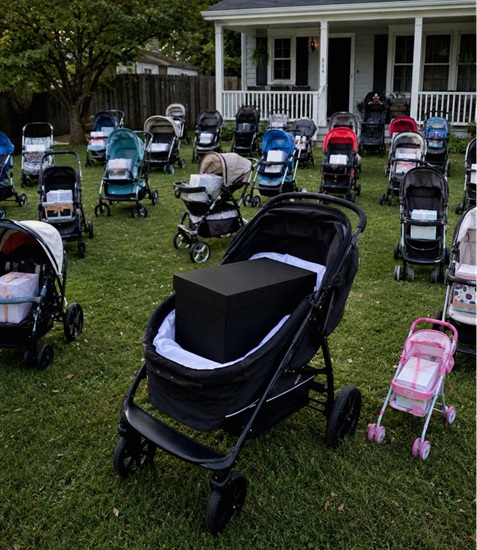
Across the wet grass stood rows of baby strollers, their canopies covered with morning dew. Some were new, while others showed signs of careful use. They appeared in different sizes, colors, and designs, positioned quietly from the sidewalk to the edge of the flower beds.
There were no people nearby and no vehicle unloading them.
Kate stepped outside slowly.
“What is this?” she whispered.
The strollers remained silent in the morning light, each one holding something she could not yet see.

