
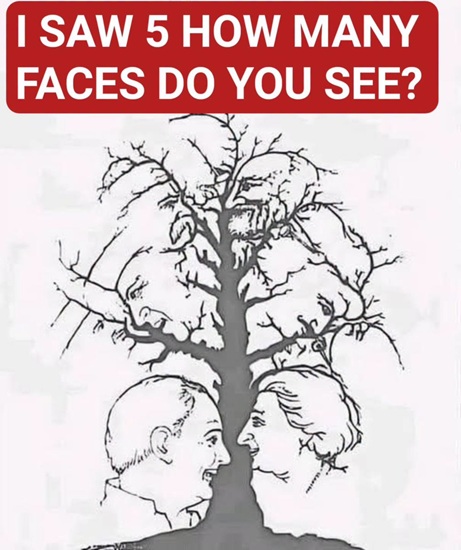
If you are someone who enjoys visual puzzles and brain teasers that test attention and observation skills, then optical illusions like this one are likely to capture your interest. These types of images have become extremely popular online because they combine curiosity, entertainment, and a fun challenge that encourages people to look more closely at details they might normally overlook.
One of the most widely shared examples is an image known as the “National Leaders Tree.” At first glance, it simply appears to be an artistic drawing of a tree. However, when you take a closer look, you will notice that multiple human faces are cleverly hidden within its structure. This transforms a simple illustration into a fascinating visual puzzle that challenges the viewer’s perception.
The task is straightforward: count how many faces you can find hidden in the image. While it may sound easy at first, the illusion is designed in a way that makes the process more difficult than expected. Some faces are clearly visible right away, while others are carefully blended into the branches, trunk, and natural shapes of the tree.
Most people are able to identify at least two faces without much effort, especially those located near the bottom section of the tree. These are considered the most obvious ones and help viewers get started. However, as you continue to observe the image more carefully, you may begin to notice additional faces hidden in less obvious areas.
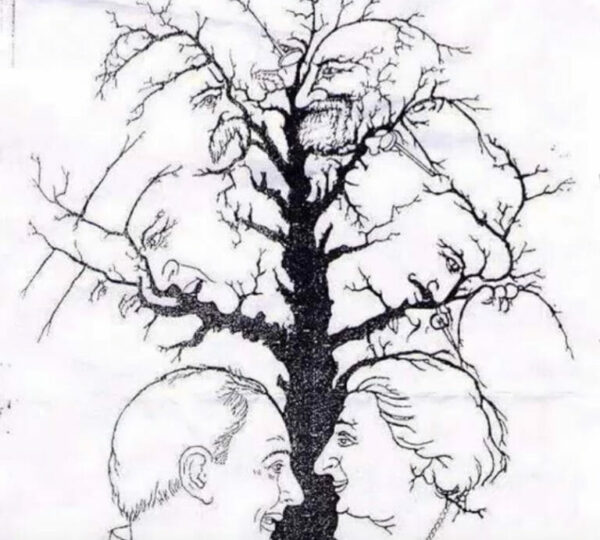
What makes this illusion especially interesting is the way it interacts with human perception. The human brain is naturally programmed to recognize facial patterns, even when they are partially hidden or formed by random shapes. This psychological effect, known as pareidolia, is what makes optical illusions like this both confusing and entertaining at the same time.
As viewers spend more time analyzing the “National Leaders Tree,” they often begin to discover more hidden faces that were not noticeable at first glance. Some appear within the curves of branches, while others are subtly integrated into the texture of the tree itself. The challenge lies in carefully observing every detail without rushing the process.
Many people find that the number of faces they detect increases the longer they study the image. This is one of the reasons optical illusions remain so engaging—they reward patience and close attention. What initially looks like a simple picture gradually reveals a more complex and layered design.
It is important to understand that puzzles like this are created purely for entertainment and visual engagement. While some online posts may attempt to attach meanings or interpretations to the results, there is no scientific evidence that counting faces in such illusions reflects memory ability or predicts any health condition. Instead, they should be viewed simply as fun cognitive exercises.
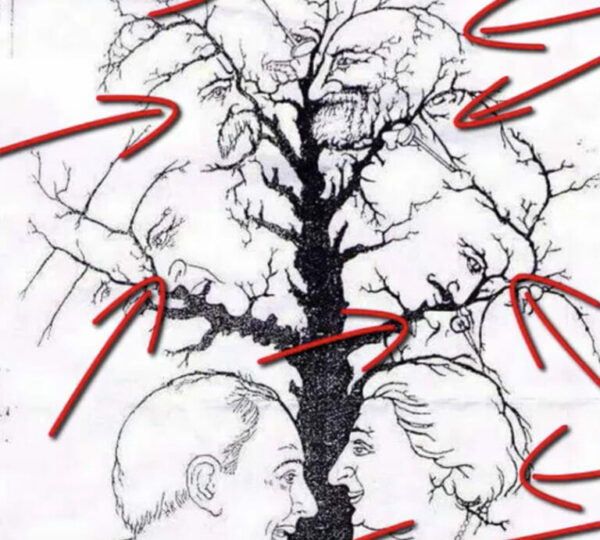
Different viewers often report different results when looking at the same image. Some may only see a few faces, while others claim to find many more after careful observation. This variation is completely normal and depends on individual perception, focus, and how closely the image is examined.
Optical illusions such as the “National Leaders Tree” have become especially popular on social media platforms because they encourage interaction and discussion. People often compare their findings with others, which adds a social and competitive element to the experience.
Another reason these visual puzzles attract so much attention is their accessibility. They do not require any special knowledge or skills—just patience, curiosity, and careful observation. This makes them enjoyable for a wide audience, from casual viewers to puzzle enthusiasts.
As you continue exploring the image, you may notice that your perception changes over time. Shapes that initially looked like random patterns may begin to form recognizable features. This shift in perception is what makes optical illusions so fascinating and enjoyable to explore.
In conclusion, the “National Leaders Tree” is a creative and engaging optical illusion that highlights the complexity of human perception. Whether you find a few hidden faces or many, the real enjoyment comes from the process of observing, analyzing, and discovering details that are not immediately obvious at first glance.

