
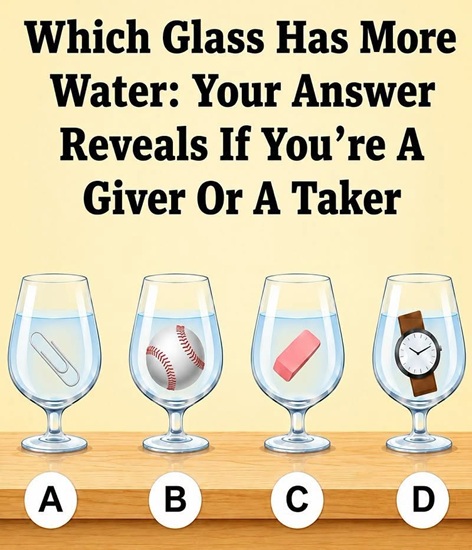
At first glance, this looks like a simple visual challenge designed to test basic observation skills, but it has confused thousands of people online. Four identical glasses are placed in front of you, each filled with water up to the same visible level. Inside each glass is a different object, and the question seems simple: which glass actually contains the most water? What makes this puzzle so interesting is that the answer is not about appearance alone, but about understanding how physical space works.
The four glasses are labeled A, B, C, and D. Each one looks identical in terms of water level, yet each contains a different submerged object. Glass A contains a small paperclip, Glass B contains a large baseball, Glass C has a standard eraser, and Glass D contains a wristwatch. The illusion is created because our eyes naturally assume that equal water levels mean equal amounts of water, but this is not scientifically accurate.
Human perception is often based on fast interpretation rather than detailed analysis. The brain is designed to quickly process visual information and make immediate conclusions. This allows us to function efficiently in daily life, but it also makes us vulnerable to optical illusions like this one. When we see four glasses filled to the same height, we instinctively assume they contain the same volume of liquid.
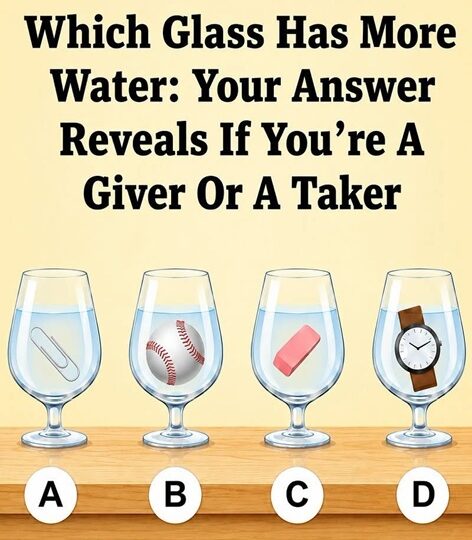
However, the key concept behind this puzzle is displacement. In physics, displacement refers to the amount of space an object takes up when placed into a fluid. When an object is submerged in water, it pushes the water aside based on its own volume. This means that the larger the object, the more water is displaced, even if the water level appears unchanged.
When we apply this principle to the puzzle, the hidden answer becomes clearer. Even though all the glasses appear equally full, the objects inside them are not the same size. The baseball in Glass B takes up the most space, meaning it displaces a large amount of water. The wristwatch in Glass D and the eraser in Glass C also occupy noticeable volume, reducing the actual amount of water inside those glasses.
Glass A, however, contains only a small paperclip, which takes up minimal space. Because it displaces the least amount of water, Glass A must contain the greatest volume of actual water among all four glasses. This is the part of the puzzle that most people miss because they focus on the visible water level rather than the hidden internal volume.
What makes this illusion so effective is that it relies on visual deception rather than complex mathematics. The human brain is trained to trust what it sees at the surface level. When all four glasses appear identical, the mind quickly concludes that no differences exist, even though the internal conditions are not the same.
Puzzles like this are popular because they expose the gap between perception and reality. People often feel confident in their first answer, only to realize later that they overlooked a crucial detail. This moment of realization is what makes the puzzle both frustrating and fascinating at the same time.
Beyond the scientific explanation, these types of puzzles are sometimes used to suggest personality traits based on your choice. While these interpretations are not scientifically proven, they add an entertaining layer to the experience. For example, someone who selects Glass A is often described as highly analytical and detail-focused, someone who notices small but important differences that others may ignore.
Those who choose Glass B might be seen as fast decision-makers who rely on instinct and big-picture thinking. While this approach can be effective in many situations, it can sometimes lead to missing subtle details. Choosing Glass C may suggest a balanced thinker who carefully evaluates multiple factors before making a decision.
Meanwhile, selecting Glass D is sometimes associated with intuitive or symbolic thinking, where a person tends to look beyond surface-level details and interpret deeper meaning. These personality interpretations are purely for entertainment, but they help make the puzzle more engaging for a wider audience.
The real strength of this puzzle lies in its simplicity. There are no hidden mathematical formulas or complicated rules—just a basic physical principle that is often overlooked. Yet even with such a simple concept, most people still answer incorrectly at first because they rely on visual judgment instead of logical reasoning.
In real life, this kind of thinking mistake happens more often than we realize. Whether in business, education, or personal decisions, people frequently rely on first impressions. However, just like in this puzzle, important details are often hidden beneath the surface and can completely change the outcome.
This is why critical thinking is so important. Instead of immediately trusting what appears obvious, it is valuable to pause and consider what might not be visible. What is being displaced? What information is missing? What assumptions are being made without evidence?
Ultimately, the glass puzzle is more than just a visual trick. It is a reminder that perception is not always reality. The smallest object in the glass—the paperclip—turns out to be the key to understanding the correct answer. What seems insignificant at first can completely change the conclusion.
In the end, this puzzle teaches a simple but powerful lesson: what we see is not always the full truth. By looking beyond appearances and thinking more deeply, we can avoid being misled by illusions and make better, more accurate decisions in everyday life.

