
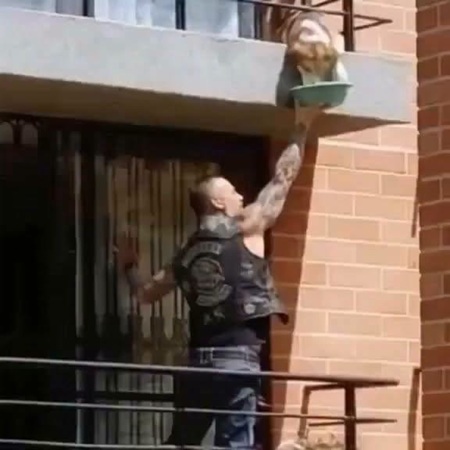
For several days, according to the account, residents of an apartment building had been increasingly worried about a dog left alone on a third-floor balcony. Neighbors could reportedly hear and see the animal from surrounding apartments, and its condition appeared to be getting worse as time passed. Concerned residents tried to find a lawful way to get assistance. The situation was frustrating because the dog was visible, yet reaching the balcony meant gaining access to private property or finding another safe way to reach an elevated part of the building.
The story says that residents contacted people they believed could help, including animal-control authorities, police and property management. However, entering a locked private apartment can involve legal and safety considerations, and the account describes delays while those issues were being addressed. Without independently verified records from the agencies involved, it would be inappropriate to claim exactly why officials did or did not act at a particular moment. What the narrative makes clear is that the residents believed the dog’s situation was becoming increasingly urgent.
As the days passed, the neighbors’ concern reportedly grew. From outside the apartment, they could do little more than observe the balcony and continue asking for assistance. The dog appeared to need food, water and attention, according to the story. For people watching from nearby windows and the ground below, waiting became increasingly difficult. Yet attempting an improvised rescue from several floors above ground could also create serious risks for both the person climbing and the animal.
Then a stranger arrived on a motorcycle.
The man is described in the original account as a bearded biker whose appearance immediately attracted attention. After parking his motorcycle, he reportedly looked toward the upper floors and noticed the dog. He then approached someone associated with management of the building and asked about reaching the apartment. According to the story, he was told that entering the locked unit was not permitted.
What happened next transformed the situation from a neighborhood concern into the central moment of the story.
Instead of simply leaving, the biker reportedly returned to his motorcycle and gathered supplies. He then began making his way up the exterior of the building toward the balcony. Such an action would obviously carry substantial risk, particularly several floors above the ground, and should not be treated as a recommended method for responding to an animal-welfare emergency. In a real emergency, contacting the appropriate local emergency, animal-welfare or property authorities remains the safer course of action.
At least one neighbor initially interpreted what she was seeing very differently.
From her perspective, an unfamiliar man was climbing the outside of an apartment building toward someone’s balcony. Without knowing his intentions, the scene could reasonably appear alarming. According to the account, she considered contacting police because she initially believed she might be witnessing an attempted break-in or another dangerous situation.
Then she looked more carefully.
The man was not described as attempting to remove property or enter the residence for personal gain. Instead, the account says he was trying to reach the stranded dog. As he balanced near the balcony, he reportedly lifted food and water toward the animal. The very details that had initially made the situation look threatening began to take on a completely different meaning once his actions could be seen more clearly.
That change in perspective forms the heart of the story.
The biker’s clothing, beard, motorcycle and unfamiliar presence had apparently contributed to an immediate assumption about who he might be and what he was doing. Yet none of those characteristics actually established his intentions. Observing his behavior provided information that appearance alone could not.
According to the narrative, the dog eventually reached safety and was later placed in a secure home. The biker is portrayed as someone who did not seek publicity for what happened and was more concerned about the animal’s future than receiving recognition. Because the supplied account does not provide independently verifiable documentation identifying the man, the dog or the agencies involved, those details should remain attributed to the story rather than presented as independently established facts.
The account nevertheless raises a broader and useful point about first impressions.
Human beings constantly make rapid judgments based on limited information. Clothing, age, occupation, appearance and even the vehicle someone drives can influence expectations before that person has said or done anything meaningful. Sometimes quick judgment is part of ordinary caution, particularly when a situation appears unusual. The problem begins when an initial impression is treated as proof rather than as something that may need to be reconsidered as additional information becomes available.
The neighbor’s reaction in this story illustrates that distinction.
Seeing an unknown person climbing an apartment building can reasonably cause concern. The lesson is therefore not that people should ignore potentially dangerous situations. Instead, the more careful conclusion is that new evidence should be allowed to change an initial interpretation. Once the man’s behavior suggested he was focused on helping the dog, the situation looked different from what observers had first imagined.
The story also highlights the complicated balance between urgency and procedure.
When an animal appears to be in distress, waiting can feel unbearable. At the same time, private-property laws, building safety requirements and emergency-response procedures exist for legitimate reasons. A person attempting to climb several floors without appropriate equipment could fall, frighten the animal or create an additional emergency requiring rescue personnel.
For that reason, the dramatic action described here should not be interpreted as general safety advice.
Anyone encountering an animal apparently trapped or abandoned should contact the appropriate authorities available in their area and provide clear information about the animal’s condition and location. Photographs or other observations may also help qualified responders understand the urgency, where lawful and appropriate. People should avoid putting themselves or others in unnecessary physical danger while trying to help.
There is another distinction worth making: compassion does not depend on appearance.
Popular storytelling often relies on recognizable visual stereotypes. A large stranger dressed like a biker may be presented as intimidating, while someone wearing professional clothing may automatically appear trustworthy. Real life is considerably more complicated. Clothing and style can tell observers very little about whether a person’s actions will be generous, selfish, careful or irresponsible.
Behavior provides better evidence.
In the supplied narrative, the biker becomes memorable precisely because his actions contradict the assumption created by his appearance. The observer initially sees someone she fears may be doing something wrong. Moments later, she sees someone trying to provide food and water to an animal in distress.
That reversal gives the story its emotional force without requiring the biker to be turned into an exaggerated hero.
He does not need to be described as fearless, perfect or uniquely virtuous. Likewise, the neighbor does not need to be portrayed as cruel for initially becoming concerned. Both reactions can be understood within the information available at different moments. She saw behavior that appeared suspicious and became cautious. When additional evidence appeared, the meaning of the situation changed.
The dog’s welfare remains the most important part of the account.
Animals depend heavily on people for access to food, water, shelter and veterinary care. When a domestic animal appears abandoned or in immediate distress, early reporting can be important. Neighbors may be among the first people to notice unusual circumstances, particularly in apartment buildings where balconies and windows are visible from surrounding homes.
At the same time, responsible concern should focus on obtaining appropriate assistance rather than creating unnecessary confrontation.
The strongest takeaway from the story is therefore more nuanced than simply saying that appearances are deceptive. First impressions are unavoidable, but they should remain open to revision. Caution can be reasonable without becoming prejudice, and compassion can exist in people who do not match someone’s expectations of what a helpful stranger should look like.
The same principle applies beyond this particular narrative.
People regularly encounter strangers with backgrounds, clothing and lifestyles different from their own. It is easy to turn unfamiliarity into a conclusion about character. A more reliable approach is to pay attention to conduct, context and evidence before deciding what another person’s intentions must be.
That does not mean abandoning common sense or personal safety.
If something appears dangerous, contacting appropriate authorities can be entirely reasonable. But when circumstances become clearer, responsible judgment also means being willing to reconsider an earlier assumption. The neighbor in this account reportedly did exactly that: she initially feared she was witnessing something dangerous, then recognized that the man’s actions were directed toward helping the stranded animal.
Ultimately, the story endures because of that reversal.
It begins with a vulnerable dog, worried neighbors and a stranger whose presence appears suspicious. It develops into a situation in which observers discover that the person they initially feared may actually be trying to help. And it ends with the animal reportedly reaching safety rather than with the stranger seeking attention for himself.
Whether encountered online or in everyday life, stories like this are also reminders to separate emotional storytelling from verified reporting. Names, dates, official records and identifiable sources matter when an event is presented as factual news. Without those elements, responsible publishing means clearly describing an account as an unverified narrative rather than adding invented details to make it appear more authoritative.
The broader message, however, does not require exaggeration.
People should take animal welfare seriously. They should seek qualified assistance when an animal appears endangered, avoid unnecessary physical risks, and remain careful about conclusions based solely on someone’s appearance. Most importantly, they should be willing to change their judgment when the evidence in front of them changes.
In the story, the motorcycle, beard and clothing initially shaped how the stranger was perceived. His actions ultimately provided a different picture.
That contrast is what gives the narrative its lasting meaning: appearances can influence a first impression, but they do not provide a complete measure of character. What someone consistently chooses to do—especially when another living being needs help—often tells us far more.

