
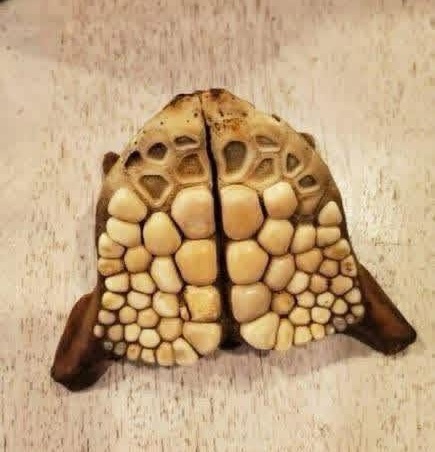
A quiet walk along the shoreline in Pensacola, Florida, led to an unusual discovery that initially puzzled a beachcomber for years. What first appeared to be a strange, fossil-like object found in the sand turned out to be something far more ordinary in scientific terms, yet fascinating in structure: a set of pharyngeal teeth from a freshwater drum fish (Aplodinotus grunniens). Beach environments often produce unexpected finds. As waves move across the shore, they bring in a mix of shells, stones, plant material, and occasionally biological remnants from marine and freshwater species.
While many of these objects are quickly recognizable, others can be difficult to identify without expert knowledge. In this case, the object stood out because of its unusual, tightly packed tooth-like structures. Its appearance did not immediately match typical fish bones or shells, leading to confusion about its origin. The compact, organized pattern gave it a fossil-like look, which added to the mystery for anyone unfamiliar with fish anatomy.
Over time, the object was shared with individuals who had experience in marine biology and natural history. Despite this, it remained unidentified for a long period. This is not uncommon when biological structures are removed from their original context, as even recognizable anatomy can appear unfamiliar when isolated.
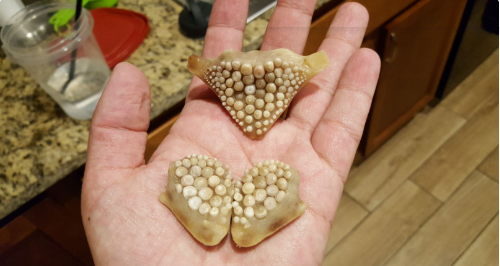
Eventually, the object was identified as part of the feeding apparatus of a freshwater drum fish. Specifically, it consisted of pharyngeal teeth, which are located in the throat region of certain fish species rather than in the mouth where most people expect to find teeth.
Pharyngeal teeth are specialized structures that serve a very different function from typical jaw teeth. In the freshwater drum, they are adapted for crushing rather than tearing. This adaptation allows the fish to consume hard-shelled prey such as mollusks, including clams and snails.
Unlike predators that rely on sharp teeth to capture and slice prey, the freshwater drum uses these internal grinding surfaces to break down shells after food is swallowed. The process takes place in the throat, where the pharyngeal teeth act in a way similar to molars in mammals.
This feeding strategy gives the freshwater drum access to food sources that many other fish species cannot efficiently use. Hard-shelled organisms are abundant in freshwater ecosystems, and the ability to process them provides a strong survival advantage.
The structure of these teeth explains why the beach discovery looked so unusual. Instead of appearing as a simple row of pointed teeth, pharyngeal teeth in the freshwater drum form dense, clustered surfaces. These can look like textured plates or compact mosaics when viewed outside the fish’s body.
Because they are internal structures, pharyngeal teeth are not commonly seen unless a fish is dissected or examined closely. When they are found detached in the environment, they can easily be mistaken for fossils or fragments of unknown origin.
The freshwater drum is a species native to North America and is commonly found in rivers, lakes, and sometimes brackish waters where freshwater and saltwater mix. Its ability to tolerate different environments helps explain how its remains can occasionally appear in unexpected locations.
Although the species is primarily associated with freshwater systems, natural water movement can transport biological material over long distances. Rivers flow into estuaries, estuaries connect to coastal waters, and tides and currents can carry lightweight or durable objects far from their original environment.
Hard structures like teeth are especially resistant to decomposition. This durability allows them to survive long enough to be transported and eventually deposited on beaches, where they may be discovered by beachgoers.
The confusion surrounding the object highlights an important aspect of natural science: context matters. Biological structures that are clear in a full organism can become difficult to identify once separated from surrounding tissues and bones.
In the case of the freshwater drum, the absence of the full skeleton made identification more challenging. Without reference points such as fins, skull structure, or body shape, even experts may take time to recognize isolated anatomical parts.
The freshwater drum itself is a well-studied species known for its adaptability and distinctive feeding habits. It plays an important ecological role in freshwater systems by helping regulate populations of mollusks and other invertebrates.
By feeding on clams, snails, and similar organisms, the freshwater drum contributes to maintaining balance within aquatic ecosystems. Its specialized teeth are a key evolutionary adaptation that supports this diet.
From a biological perspective, pharyngeal teeth are found in several fish species, not just the freshwater drum. They represent an evolutionary solution that allows fish to expand their feeding strategies beyond simple biting or swallowing.
The discovery in Pensacola also demonstrates how coastal environments act as collection points for materials from different ecosystems. Beaches are constantly shaped by natural forces, including tides, storms, and currents, all of which transport organic and inorganic matter.
As a result, beachcombers may encounter objects that originated far inland or in completely different habitats. This mixing of environments can create situations where identification becomes challenging without scientific context.
In this instance, what appeared to be an ancient or fossilized object was actually part of a modern species’ feeding anatomy. This highlights how easily natural structures can be misinterpreted when removed from their biological setting.
The eventual identification of the object as freshwater drum pharyngeal teeth resolved a long-standing mystery. What once seemed unusual became a clear example of functional adaptation in fish biology.
This type of discovery also illustrates the importance of scientific curiosity. Even small or seemingly insignificant objects found in nature can reveal detailed information about species behavior, anatomy, and evolution.
For many people, beach finds are part of everyday exploration, but occasionally they lead to deeper insights into how aquatic ecosystems function. Objects like this serve as reminders that nature often hides complexity in simple forms.
Ultimately, the Pensacola beach discovery is not just about a strange object in the sand. It is about understanding how species adapt, how environments connect, and how easily natural structures can be misunderstood when taken out of context.
The freshwater drum’s pharyngeal teeth may be hidden inside a fish most people never notice, but they play a vital role in its survival. What once caused confusion on a beach is, in scientific terms, a perfectly designed biological tool shaped by evolution.

