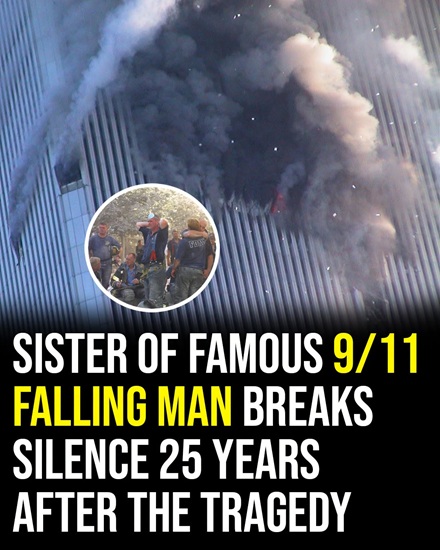
Twenty-five years have passed since the September 11 attacks, yet some images from that morning have never faded from public memory.
Among the most difficult is a photograph that does not show the enormous scale of the destruction.
Instead, it focuses on one person.
One human being, falling from the World Trade Center.
The photograph became widely known as “The Falling Man,” and decades later, the story behind it continues to raise questions about memory, dignity, grief and the way history is documented.
Content note: This article discusses deaths during the September 11 attacks and contains details that some readers may find distressing.
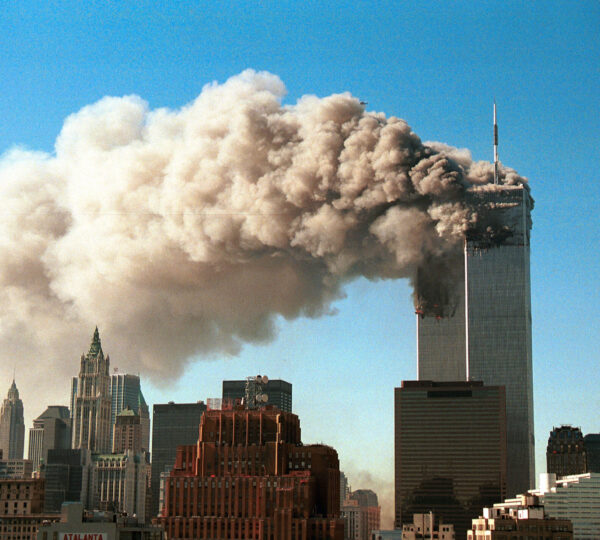
On the morning of September 11, 2001, Associated Press photographer Richard Drew was documenting the unfolding disaster in New York City.
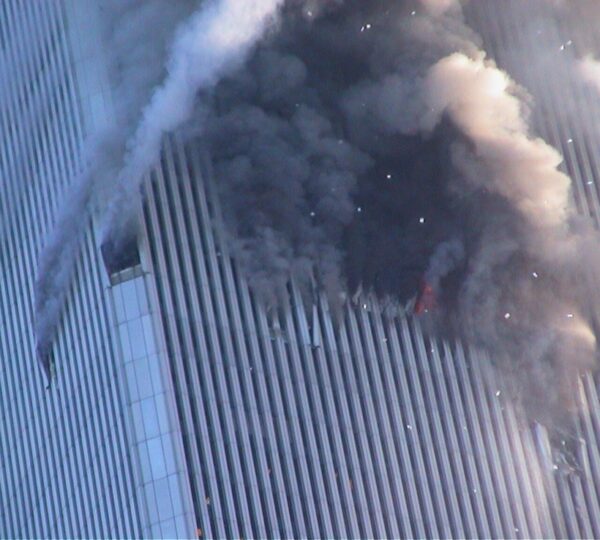
As smoke poured from the World Trade Center, Drew turned his camera toward people who could be seen falling from the towers.
He photographed a sequence of them.
Then, at approximately 9:41 a.m., his camera captured one remarkable frame.
For an instant, the person appeared almost perfectly vertical, visually aligned with the lines of the North Tower behind him.
The photograph looked strangely quiet.
But the reality surrounding that fraction of a second was anything but peaceful.
And Drew did not immediately understand how significant that particular frame would become.
That came later.
A photograph many people did not want to see
After the attacks, the image appeared in newspapers and quickly generated an emotional response.
Some readers considered it an important record of what had happened.
Others found it unbearably personal and disturbing.
The criticism became so intense that the photograph largely disappeared from widespread publication for a period.
Yet it was never truly forgotten.
As the years passed, people began returning to the image and asking a question that had been there from the beginning.
Who was the man?
There is still no definitive answer.
The search for a name
One early possibility was Norberto Hernandez, a pastry chef who worked at Windows on the World, the famous restaurant complex located near the top of the North Tower.
Members of Hernandez’s family disputed the identification.
The mystery remained.
Journalist Tom Junod later conducted an extensive investigation into the photograph for Esquire, looking beyond the single famous image and examining other frames from the sequence taken by Drew.
Eventually, another possibility emerged.
Jonathan Briley.
Briley was a 43-year-old audio technician who worked at Windows on the World.
People familiar with him reportedly saw similarities between Briley and the person visible in Drew’s photographs. His physical appearance and details associated with his clothing also contributed to the theory.
But those clues could not establish his identity with certainty.
No conclusive evidence has ever proved that Jonathan Briley was the Falling Man.
That distinction is essential.
Even 25 years later, the person in the photograph remains officially unidentified.
For Briley’s family, however, the possibility created a deeply personal connection to an image already associated with unimaginable loss.
Remembering Jonathan
Jonathan was much more than a possible identity in a famous photograph.
To his family, he was a brother and loved one with his own history, personality and faith.
His sister, Gwen Briley-Strand, has remembered him as deeply religious. Jonathan had also been ordained a deacon shortly before his death.
Music was another important part of his life.
He grew up playing gospel piano before eventually working professionally with sound.
There was also one seemingly ordinary family moment shortly before September 11 that would later carry enormous significance.
Jonathan joined Gwen and her husband on a last-minute trip to Florida.
At the time, there was no reason to believe the trip would be their final time together.
But it was.
Twenty-five years later, Gwen has described grief as something that does not move neatly with time.
Sometimes, decades seem to have passed.
At other moments, September 11 can feel startlingly close again.
The memories return in waves.
And so does one particularly painful subject.
An important distinction
People seen falling from the World Trade Center have sometimes been described as though they made an ordinary, voluntary decision to end their lives.
That description fails to reflect the extraordinary circumstances they faced.
Those trapped above the impact zones were confronting fire, extreme heat, smoke and conditions from which normal escape was impossible for many.
New York City’s medical examiner did not classify the people who fell from the towers as suicides.
The deaths caused by the September 11 attacks were classified as homicides.
They were victims of the attacks.
For Gwen, her religious faith has helped shape how she thinks about her brother and the other people trapped inside the towers.
She has spoken about believing that those who fell were spiritually received rather than abandoned.
Over time, she has also come to view the famous photograph in a broader way.
Whether the man was Jonathan or someone else, he was somebody’s loved one.
And perhaps that is where the photograph’s meaning becomes larger than its unresolved identity.
Richard Drew’s perspective
Drew has explained that he was not consciously attempting to create an iconic photograph that morning.
He was doing his job as a photojournalist.
Using his camera, he followed what was happening and recorded a sequence of images.
Only afterward did one particular frame stand apart.
The architectural lines of the tower make the person appear almost motionless.
That visual stillness creates a disturbing contrast with what was actually happening.
It is one reason the photograph remains so powerful.
Drew has also emphasized the human dimension of the image.
Behind all the debates over whether it should have been published was an individual experiencing the final moments of his life.
That reality is impossible to separate from the photograph.
From controversy to historical record
Attitudes toward “The Falling Man” have changed considerably since 2001.
What some initially regarded as an image that should not be shown has increasingly been discussed as an important example of photojournalism and historical documentation.
Musician and photography collector Elton John eventually acquired a print for his collection and has spoken about the striking contradiction contained within it — an aesthetically extraordinary photograph documenting something profoundly tragic.
That contradiction has never disappeared.
Neither has the discomfort.
Perhaps that is precisely why the photograph has endured.
One person inside an enormous tragedy
The September 11 terrorist attacks killed 2,977 victims in New York City, at the Pentagon and aboard the four hijacked aircraft, excluding the 19 hijackers.
Numbers that large can be difficult to comprehend.
A photograph of one individual changes the scale.
Suddenly, history is no longer represented only by collapsing buildings, smoke-filled streets or statistics.
It becomes one person.
One family.
One unfinished life.
Jonathan Briley was among the thousands of people killed that day.
Whether he was also the person photographed by Richard Drew remains uncertain, and responsible retellings of the story must preserve that uncertainty.
The photograph itself cannot provide the final answer.
Twenty-five years later, perhaps that unanswered question is no longer the only reason people continue looking at it.
“The Falling Man” forces viewers to confront something much simpler and more difficult.
Every person lost on September 11 had a life before that morning.
They had families, jobs, beliefs, routines and plans for days they would never get to experience.
The unidentified man in Drew’s photograph had all of those things too.
We may never know his name with certainty.
But the absence of a confirmed identity does not make his life anonymous or insignificant.
And after a quarter of a century, that may be the photograph’s most enduring message.
Behind one of history’s largest tragedies was an individual human story.
And behind every individual story was someone who was loved.
