
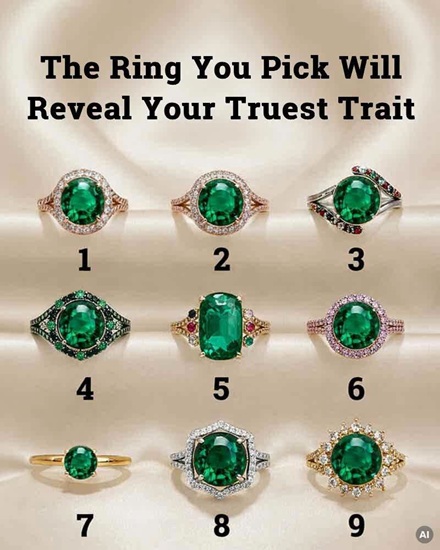
Take a few seconds to look at all nine purple gemstone rings and notice which one attracts your attention first. There is no need to study every detail for a long time or search for a hidden answer. Simply observe the shapes, gemstone cuts, shades of purple, and overall designs. One ring may immediately stand out because it feels elegant, bold, simple, unusual, or visually balanced. Once you make your selection, you can read the personality trait connected to that particular ring. This activity is designed for entertainment and self-reflection rather than as a scientific personality test.
Purple gemstones can create very different impressions depending on their shade, cut, and setting. A soft lavender stone may appear delicate and calm, while a deep violet gemstone can look dramatic and striking. The surrounding metal and decorative elements can also change how a ring appears. Some people naturally prefer minimal jewelry, while others are drawn to large stones or elaborate details. These differences are part of personal taste and can make a visual quiz fun to explore. They should not be treated as scientific evidence about someone’s personality.
The idea behind the quiz is intentionally simple. Instead of answering a long series of questions, you make one visual choice based on what appeals to you at that moment. Each ring is then connected with a positive personality theme such as dependability, peace, confidence, leadership, independence, ambition, courage, determination, or creativity. The descriptions are meant to give you something interesting to think about. They are not intended to place you into a permanent psychological category.
For the most enjoyable result, try to follow your first instinct. If one ring catches your eye immediately, consider choosing it before you begin comparing every detail. Your first reaction may reflect what you find visually appealing right now. That preference could be influenced by color, symmetry, style, memories, fashion, mood, or many other factors. There is no correct ring and no wrong ring. The purpose is simply to enjoy the choice and see whether the description feels familiar.
If Ring One is the design that stands out to you, its personality theme is dependability. This result represents someone who values reliability and tries to be a person others can count on. Dependable people are often associated with keeping promises, handling responsibilities, and remaining steady when situations become difficult. They may prefer thoughtful decisions rather than acting without considering the consequences. Friends and relatives may appreciate their consistency. In this quiz, Ring One symbolizes stability, trust, and responsibility.
Being dependable does not mean never making mistakes or always knowing exactly what to do. Reliable people can still need support and can sometimes change their plans. What matters more is being honest about commitments and making a reasonable effort to follow through. Someone who values dependability may also appreciate routines and clear expectations. They may prefer situations where people communicate openly and respect each other’s time. If this description resonates with you, dependability may simply be a quality you value strongly.
If Ring Two attracts you most, its associated theme is peace and harmony. This description represents someone who enjoys balanced relationships and generally prefers avoiding unnecessary conflict. Such a person may be comfortable listening to different opinions and looking for common ground. They may try to keep conversations respectful even when disagreements occur. Peace-oriented people often appreciate calm environments and stable relationships. In this quiz, the second ring symbolizes cooperation and emotional balance.
Valuing peace does not mean avoiding every difficult conversation. Healthy relationships sometimes require people to express disagreement or establish boundaries. Someone who prefers harmony can still speak clearly when something important needs to be addressed. They may simply prefer solving problems without creating additional tension. Thoughtful communication may matter more to them than winning an argument. If Ring Two is your choice, the description may reflect your appreciation for calm and constructive interaction.
Ring Three is connected with confidence. Someone who chooses this ring may enjoy the description of a person who trusts their own judgment and feels reasonably comfortable expressing ideas. Confidence can help people make decisions even when they do not have perfect certainty. It can also make it easier to try new things and recover after mistakes. Confident people do not necessarily need to be loud or highly outgoing. In this activity, Ring Three represents self-belief and the willingness to move forward.
Healthy confidence is different from believing that you can never be wrong. A genuinely confident person can listen to new information and admit when another person has a better idea. Confidence can also vary between different areas of life. Someone may feel very comfortable at work but nervous in social situations, or the opposite. Experience and practice can strengthen confidence over time. If Ring Three appeals to you, the result may reflect a quality you already recognize or would like to develop further.
Ring Four represents leadership. This description suggests someone who may feel comfortable organizing people, making decisions, or helping a group move toward a shared goal. Leadership does not require a formal title or management position. A person can demonstrate leadership among friends, within a family, at work, or during a group project. Strong leadership often involves listening as well as giving direction. In this quiz, Ring Four symbolizes responsibility, organization, and the ability to guide others.
Good leadership also involves recognizing that no one person has every answer. Effective leaders often ask for input, share responsibility, and acknowledge the strengths of other people. They may need to remain calm when plans change and take responsibility when mistakes occur. Patience and communication can be just as important as decisiveness. Someone who selects Ring Four is not automatically a leader in every situation. The result simply offers leadership as the positive theme linked to that design.
If Ring Five catches your attention, its associated trait is independence. This theme describes someone who values personal freedom and prefers having room to make their own choices. Independent people may enjoy solving problems on their own and taking responsibility for their decisions. They can also value quiet time for thinking or working on personal interests. Having control over their own direction may feel particularly important to them. Ring Five therefore symbolizes autonomy and self-direction.
Independence does not require refusing help or avoiding close relationships. People can be highly independent while still valuing family, friendship, teamwork, and advice from others. Knowing when to ask for assistance can actually be a sign of good judgment. Healthy independence is often about having confidence in personal choices while remaining open to cooperation. If the fifth ring appeals to you, its description may reflect your preference for freedom and personal responsibility.
Ring Six is associated with ambition. This personality theme represents someone who enjoys setting goals and working toward meaningful achievements. Ambitious people may feel motivated when they have a clear objective in front of them. Their goals can involve careers, education, creative projects, personal development, sports, or many other areas. They may be willing to invest time and effort in long-term progress. In the quiz, Ring Six symbolizes motivation and the desire to grow.
Ambition works best when balanced with realistic expectations. Constantly comparing yourself with everyone else can create unnecessary stress. A person can pursue important goals while still protecting time for relationships, rest, and personal well-being. Goals can also change as circumstances change, and modifying a plan does not automatically mean failure. If Ring Six is your choice, achievement and progress may be ideas that feel particularly meaningful to you.
Ring Seven represents courage and boldness. This description is associated with someone who may enjoy challenges or feel drawn toward new experiences. Courage does not mean never feeling nervous or afraid. In many situations, courage means acting thoughtfully even while uncertainty is present. Bold people may be willing to explore unfamiliar opportunities when others prefer to stay with what they already know. Ring Seven therefore symbolizes bravery and openness to new experiences.
Boldness should not be confused with reckless behavior. Taking unnecessary risks is different from making a courageous decision after considering the consequences. Sometimes bravery means moving forward, while other times it means saying no or leaving an unhealthy situation. Good judgment can work alongside courage. If Ring Seven attracts you, its theme may resonate because you value the willingness to face unfamiliar situations.
Ring Eight is associated with determination. This result represents someone who keeps working even when progress becomes difficult. Determined people may understand that important achievements often take more than one attempt. A setback can be disappointing without necessarily ending the effort. Persistence is useful when learning new skills, completing long projects, or working through complicated challenges. In this quiz, Ring Eight symbolizes commitment and endurance.
Determination is most useful when it remains flexible. Repeating an unsuccessful strategy forever is not always a sign of strength. Persistent people can adjust their methods, seek advice, and learn from previous attempts while still pursuing the larger goal. Sometimes changing direction is the smartest form of persistence. If Ring Eight is your choice, you may appreciate the idea of continuing despite obstacles while remaining willing to adapt.
Ring Nine represents creativity and individuality. This personality theme describes someone who enjoys original ideas and personal expression. Creativity can appear through art, writing, fashion, music, design, cooking, technology, problem-solving, or countless everyday activities. A person does not need to work in an artistic profession to be creative. Finding an unusual solution to an ordinary problem can also require imagination. Ring Nine symbolizes originality and curiosity.
Individuality does not mean deliberately rejecting everything popular. It can simply mean being comfortable with personal preferences even when they are different from those of other people. Someone with a strong sense of individuality may enjoy experimenting and discovering what works best for them. They can appreciate other people’s choices without feeling pressure to copy them. If Ring Nine catches your attention, personal expression may be something you value.
Although each ring has a different description, most people possess several of these traits at the same time. Someone can be peaceful and ambitious, independent and dependable, or creative and highly determined. Human personalities are too complex to fit neatly into nine simple categories. People also behave differently depending on circumstances. A person who takes charge in one environment may prefer to follow someone else’s lead in another.
Personality can change and develop over time as well. Experience, relationships, education, responsibility, success, and disappointment can all influence how someone behaves. A person who was once very shy may later become confident in certain situations. Someone who preferred working alone may discover that they enjoy teamwork. Leadership, communication, patience, and independence can all develop through experience. This is another reason the quiz should not be treated as a permanent personality label.
Your choice of ring can still be interesting as a reflection of visual preference. People genuinely differ in the colors, shapes, and decorative styles they find attractive. One person may choose a large, dramatic gemstone, while another may prefer a subtle and simple setting. Another viewer may care more about symmetry than the size of the stone. These are real preferences, but they do not provide a scientifically validated psychological profile.
Mood can also influence what catches your attention. A design that seems perfect today may not be the ring you would select several months from now. Personal memories can affect choices too. A ring may remind you of jewelry worn by someone you care about or of a particular style you have always liked. Fashion and cultural influences also shape preferences. There are many possible reasons why one design stands out.
That is part of what makes an entertainment quiz enjoyable. It does not need to predict personality scientifically in order to create an interesting experience. Reading a description can encourage you to think about qualities you recognize in yourself. You might discover that the result describes something you already value strongly. You might also realize that it represents a trait you hope to develop.
Sometimes a personality description may feel surprisingly accurate. Broad positive descriptions can often apply to many people in at least some situations. Most individuals have experienced moments of confidence, courage, determination, creativity, or independence. Recognizing yourself in a description can therefore feel meaningful without proving that the visual choice predicted your personality. You can enjoy the connection while still understanding the limits of the activity.
The opposite result is equally acceptable. If your ring is linked with leadership but you do not see yourself as a leader, nothing has gone wrong. You may simply like the shape or color of that particular ring. Perhaps leadership is a trait you admire in other people. The quiz has no objective score, so an inaccurate description does not mean you made a bad choice.
The activity can also be enjoyable with friends or relatives. Everyone can look at the rings independently and select one before reading the descriptions. Afterward, people can compare their results and discuss whether the descriptions feel accurate. Two individuals with completely different personalities may choose the same ring. They may also have very different reasons for liking the same design.
This is why the results should not be used to judge another person. Choosing an independence-themed ring does not prove someone is emotionally distant. Selecting an ambitious ring does not mean someone is overly competitive. Choosing a peaceful ring does not mean a person is unable to defend themselves. The descriptions are playful associations rather than psychological conclusions.
If you find yourself attracted to two or three rings equally, that is completely normal. You can choose the design you noticed first or select the one you would most enjoy wearing. There is no requirement that one ring must feel dramatically better than every other option. Personal preferences often overlap. The activity remains valid as entertainment even when your choice is not immediate.
It is also important not to make important decisions based on a ring-selection quiz. A visual preference cannot determine whether someone is suitable for a job, relationship, leadership position, or major responsibility. Real decisions require information about behavior, experience, skills, values, communication, and circumstances. A playful personality quiz does not provide that evidence. It should remain separate from professional assessment.
Scientific personality research uses much more detailed methods. Validated assessments generally include multiple questions and are tested to determine whether they reliably measure particular traits. Even formal personality measures have limitations and require appropriate interpretation. Selecting one piece of jewelry cannot provide the same kind of information. The purpose of this activity is therefore very different from psychological testing.
The quiz can still provide a useful moment of reflection. If your result is dependability, you might think about how important keeping promises is to you. If your result is peace, you might consider how you usually handle disagreement. A confidence result can prompt you to think about situations where you trust yourself. Leadership can encourage reflection on how you work with groups.
An independence result may make you think about how much personal freedom matters in your life. Ambition may encourage you to consider which goals currently motivate you. Courage can raise questions about how you respond to uncertainty. Determination may remind you of something difficult that you continued working on. Creativity can make you think about how you prefer to express your ideas.
None of those reflections requires believing that the gemstone itself revealed something hidden about your mind. The ring did not perform a psychological assessment. The value comes from how you react to the description. You decide whether the idea feels meaningful, inaccurate, interesting, or simply amusing. That keeps the activity honest while preserving its entertainment value.
Color can also affect visual preference in interesting ways. Purple covers a wide range of tones, from very light lavender to deep violet. Different lighting can make the same gemstone appear lighter, darker, warmer, or cooler. The surrounding metal can also affect how people perceive the color. A design in a silver-colored setting may create a different impression from the same stone surrounded by gold.
The cut of the gemstone can make another major difference. Round stones can look very different from oval, pear-shaped, square, or elongated designs. Some cuts create strong flashes of reflected light, while others produce a softer appearance. Decorative stones around the center gemstone can make a ring seem larger and more elaborate. These visual characteristics influence preference without requiring a hidden personality explanation.
Some people may choose based mainly on practicality. A smaller ring may appear more comfortable for everyday wear. Others may deliberately choose the largest or most detailed option because jewelry is something they enjoy using for visual expression. Neither choice is better than the other. Different styles suit different tastes and situations.
You may even find that thinking about why you selected the ring is more interesting than reading the assigned personality result. Perhaps you consistently prefer symmetrical designs. Maybe you are drawn to minimal decoration. You may realize that unusual shapes catch your attention more quickly than traditional ones. These observations relate directly to preferences rather than claiming to reveal an entire personality.
All nine personality themes represent qualities that can be useful in appropriate circumstances. Dependability helps build trust. Peacefulness can support healthy communication. Confidence can make decision-making easier. Leadership can help groups organize effectively. Independence encourages personal responsibility.
Ambition can motivate long-term progress. Courage can help people face difficult situations. Determination supports persistence when goals take time. Creativity can generate new ideas and solutions. None of these qualities needs to be considered more valuable than the others. Different situations benefit from different combinations of strengths.
Every positive trait also benefits from balance. Too much independence can make someone reluctant to accept necessary help. Determination can become stubbornness if new evidence is ignored. Confidence without humility can make communication more difficult. A strong desire for peace may become avoidance if an important issue needs to be addressed.
Ambition can also become exhausting if a person believes they must constantly outperform everyone else. Leadership can become controlling if other people’s ideas are ignored. Creativity may need organization to turn ideas into practical results. Courage benefits from judgment so that unnecessary risks are avoided. Healthy qualities often work best when several strengths support one another.
The nine-ring activity should therefore be viewed as a lighthearted prompt rather than a system for defining people. Human behavior is influenced by far more than one preference. Relationships, life experiences, culture, education, health, environment, responsibilities, and individual circumstances all matter. People can also react very differently depending on where they are and who they are with.
Someone may appear extremely confident among close friends but become nervous during a formal presentation. A person who avoids leadership at work might naturally organize family gatherings. Someone who values independence may still love collaborative projects. These differences show why simple categories cannot fully describe real personalities.
Clear wording is important when presenting a quiz like this. Saying that a ring “is associated with confidence in this quiz” is much more accurate than claiming that the ring “proves you are confident.” The first statement describes the rules of an entertainment activity. The second makes a psychological claim that the activity cannot support. Keeping that distinction clear prevents misinformation.
The same applies when a result happens to feel very accurate. You can enjoy the description without assuming that the design somehow detected your personality. Visual choices do not contain a hidden scientific measurement. The connection was assigned as part of the game. Your own reflection is what gives the description meaning.
If you repeat the activity later and select a different ring, that is also completely normal. Preferences can change with mood, experience, or simply because another design catches your attention. Choosing a different ring would not mean your entire personality had changed. It would only mean you made a different visual selection at another moment.
This flexibility can make the quiz even more enjoyable. You can compare what you choose today with what you might have selected years ago. Perhaps your style has changed. Maybe your priorities have changed as well. The comparison can be interesting without requiring a scientific interpretation.
When sharing the activity with others, it is best to keep the tone playful. Let each person choose without pressure and read the result for entertainment. Avoid insisting that someone “must be” a certain kind of person because of their ring. They know their own experiences better than a visual quiz does. Respect makes the activity more enjoyable for everyone.
It is also useful to remember that no result represents higher value or greater worth. Someone who receives the leadership theme is not automatically better than someone whose result is peace. An ambitious result does not make someone more successful. Creativity does not make someone more interesting. These are simply different positive qualities included in the activity.
So take another careful look at the nine purple gemstone rings. Notice which design you naturally return to after looking at all of them. Consider the color, shape, size, and setting, but do not feel that you need to solve a puzzle. Choose the one you like most. Then read its personality theme and see how you respond.
If the description feels accurate, enjoy the connection. If only part of it seems familiar, focus on that part. If none of it sounds like you, you can simply appreciate the ring as a design you liked. Every reaction is valid because the activity is not measuring a right or wrong answer.
The most interesting part may ultimately be the conversation the result creates. It can encourage people to think about qualities they value, goals they are pursuing, or the way they see themselves. A simple jewelry choice can become a starting point for reflection without needing to make scientific claims. That is enough to make the exercise worthwhile as entertainment.
Most importantly, remember that your personality cannot be reduced to one gemstone, one color, or one visual preference. People are complicated, adaptable, and capable of changing throughout life. A ring choice captures only what looked appealing at a particular moment. It does not determine your future, abilities, relationships, or personal worth.
Choose the ring that stands out to you, read the trait associated with it, and decide whether the description resonates. Treat the result as a playful prompt rather than a psychological diagnosis. There is no correct answer, no incorrect answer, and no hidden score. The purpose is simply to enjoy the nine purple gemstone designs and reflect briefly on the positive qualities connected to them.

