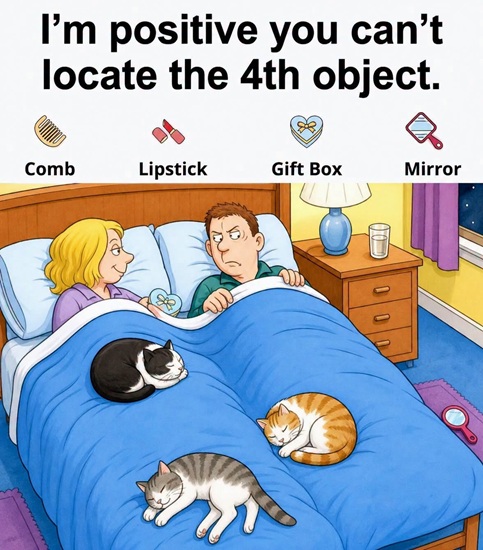
t first sight, the bedroom scene seems completely ordinary. A couple is sitting or resting near a bed while three cats have made themselves comfortable as though they own the entire space. The husband appears noticeably frustrated, while the wife looks much calmer about whatever is happening around them. Nothing immediately suggests that the picture contains a challenge. Yet somewhere within the room are four small hidden objects that can be surprisingly difficult to notice. The objects are not necessarily hidden behind furniture or completely covered by blankets.
Instead, they appear to rely on camouflage. Their colors, shapes and placement allow them to blend into parts of the room that viewers are likely to ignore. Something may resemble a wrinkle in fabric, a mark in wood or a small feature near one of the cats. The challenge is therefore less about whether the objects are visible and more about whether the brain recognizes them as separate items. This is why someone can look directly at the correct area several times without realizing the answer is there.
Human vision works quickly by identifying the largest and most familiar parts of a scene first. In a bedroom, the brain immediately understands the bed, people, cats, blankets and furniture. Once those major elements have been categorized, smaller details can receive far less attention. The hidden objects take advantage of exactly that tendency. The cats are among the most effective distractions.
Their faces, paws, tails and fur naturally attract the eye because animals are visually interesting. Fur also contains irregular patterns, shadows and changing shades that can hide a small object surprisingly well. If something is positioned close to a paw or along the edge of a cat’s body, the brain may automatically assume it belongs to the animal. This makes the areas around the cats worth examining very slowly.
The animals also give the picture a humorous quality. While the husband appears increasingly impatient, the cats look completely unconcerned. They seem perfectly satisfied with the arrangement and have no reason to care about the missing objects. That contrast can pull attention toward the story happening between the characters instead of toward the smaller visual details. In a puzzle, even humor can become part of the distraction.
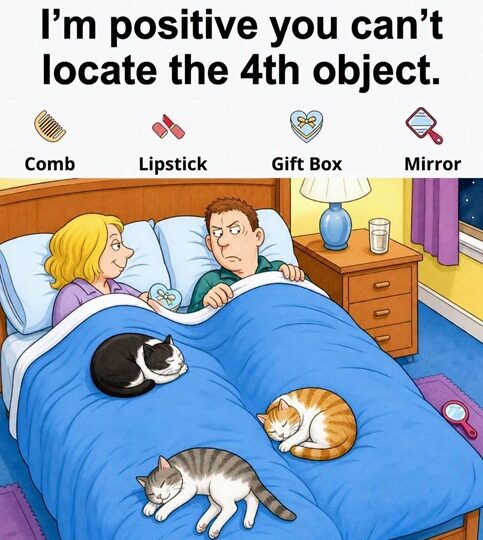
The husband’s expression can have a similar effect. People naturally pay close attention to human faces, especially when the person appears annoyed or confused. A viewer may spend several seconds trying to understand what has upset him before remembering that the real task is to search the room. His apparent frustration can even make the challenge feel more urgent. That urgency may encourage people to scan too quickly rather than carefully.
The wife appears much more relaxed, creating another visual contrast. Her calmness almost makes it seem as though she already understands what everyone else is struggling to find. Whether or not that interpretation is actually intended, it adds personality to the scene. The viewer is left between the husband’s frustration, the wife’s calm expression and the cats’ complete indifference. All of those elements make the image entertaining before the hidden-object challenge is even considered.
A useful approach is to stop looking at the main characters for a moment. The husband, wife and cats are the first things the eyes want to examine, so deliberately ignoring them can help. Instead, focus on the quieter spaces around the room. Look at the edges of the bed, narrow gaps, corners, seams and areas where two objects overlap. These places often receive very little attention during the first scan.
Fabric can be one of the hardest places to search. Blankets, sheets, pillows and clothing create folds and wrinkles that produce dozens of natural lines. A small object with a similar color may disappear into those patterns. Something with a straight edge can resemble a seam, while a curved shape may look like a fold in the material. Searching the entire bed at once can therefore be less effective than checking one section at a time.
Try following the edge of each pillow and blanket individually. Look where one piece of fabric lies over another. Examine the darker areas created by folds and the lighter areas where fabric catches the light. If a shape looks slightly more regular than the surrounding wrinkles, it may deserve another look. The hidden object may reveal itself through its outline before its identity becomes obvious.
Wooden furniture can create similar problems. Natural wood grain contains lines, dark marks, knots and small changes in tone. A brown or dark-colored object can easily merge into that visual texture. The brain recognizes the whole surface as furniture and often stops searching within it. Breaking the furniture into smaller sections can help overcome that shortcut.
Follow the outside edges of wooden surfaces. Look at joints, corners, handles and narrow dark lines. Compare the natural grain with any shapes that seem unusually straight, rounded or geometric. A hidden object may use the wood’s color as camouflage while still having a slightly different outline. Looking for shape rather than color can make it easier to detect.
Shadows are another area that should not be ignored. People often treat dark regions as empty because fewer details seem visible there. That makes shadows particularly useful for hiding small dark objects. Something can sit inside a larger area of darkness and almost disappear. The best way to search those spaces is to look for edges rather than trying to see the object directly.
A regular curve or straight line inside a shadow may be more revealing than the object’s color. Move attention slowly along the border between light and dark. Sometimes only one small part of the object is visible clearly enough to recognize. Once that detail is understood, the rest of the shape may suddenly become obvious.
The areas around the cats deserve the same careful treatment. Do not assume every small shape beside an animal is part of its body. Look closely near paws, tails and ears. Examine the boundaries between fur and bedding. Something positioned where the cat overlaps the blanket may become almost invisible because the brain expects the area to contain irregular shapes.
Overlapping objects are especially useful in visual puzzles because they create natural confusion. Where one item touches another, the eye has to decide which shape belongs to which surface. A small hidden object can fit into that transition without creating enough contrast to stand out. The viewer may classify it incorrectly without ever consciously noticing it.
Another effective method is to divide the entire image into sections. Random searching can feel thorough while actually causing the eyes to revisit the same places again and again. Start in one corner and slowly move across the image. Once the top section has been examined, move to the middle and then the bottom. A structured search reduces the chance that an uninteresting area will be skipped.
Changing the direction of the search can also help. If you naturally look from left to right, try beginning on the opposite side. The brain develops scanning habits very quickly, and those habits can cause the same mistakes to repeat. Looking in reverse order makes the scene feel slightly less familiar. That small change can be enough to reveal something previously ignored.
It is also useful to search for shapes instead of specific objects. If you already know what the missing items are, you may imagine each one in its usual position or orientation. The puzzle may show the item sideways, upside down or partially hidden. Looking for an exact mental image can therefore work against you. Basic shapes are often more reliable.
A straight edge inside a soft blanket is worth noticing. A small circle inside a complex pattern may be important. A regular geometric form near an animal’s fur can look suspicious. The object may become recognizable only after the brain first notices that its outline does not belong naturally to the background.
Size can be another source of confusion. Viewers often expect hidden items to be larger than they actually are. A tiny object may occupy only a small part of the image and therefore receive almost no attention during a normal scan. Adjusting expectations can make the challenge easier. Something that initially looked like a meaningless mark may turn out to have a recognizable structure when examined closely.
Zooming can help with very small details, but it should be used carefully. An extremely close view may remove the context needed to identify an object. A shape can become clearer while becoming harder to understand. Alternating between a close view and the full image is usually more useful. The wider view provides context, while the close view reveals edges and texture.
Distance can work in the opposite direction as well. Some objects become easier to notice when the image is viewed slightly smaller. Patterns that dominate at close range may blend together at a wider scale, making the hidden shape stand out. Changing viewing distance can therefore change the relationship between the object and its surroundings.
If the puzzle begins to feel impossible, taking a short break may be surprisingly effective. After staring at the same scene for several minutes, the brain becomes accustomed to every detail. Everything starts looking normal even when something unusual is present. Looking away interrupts that familiarity. When you return, the image can feel fresh enough for a hidden object to appear almost immediately.
This explains why people sometimes solve a puzzle right after they have nearly given up. Nothing in the picture has changed. The object has not moved. What changed was the viewer’s pattern of attention. A brief reset allowed the brain to interpret the same visual information differently.
Finding the first object can create a false sense of confidence. Once one answer appears, the viewer may believe the puzzle’s method has been discovered. If that object was hidden in fabric, attention may remain focused on the blankets. The remaining objects, however, may use completely different forms of camouflage. Each one can require a different way of looking.
One item may disappear because its color matches the background. Another may be difficult because of its orientation. A third could be placed next to a visually dominant subject such as a cat or human figure. The final object may simply be located somewhere that viewers rarely inspect. Using different tricks keeps the puzzle challenging even after the first discovery.
The last item is often the most frustrating. By that point, the viewer knows the puzzle is solvable because several answers have already been found. Yet the final object seems to have vanished. The same places are checked repeatedly, and people begin questioning whether they counted correctly. Some may even suspect that the fourth item was never included at all.
That frustration is part of what makes the challenge engaging. Giving up after finding three out of four feels much harder than stopping at the beginning. The closer someone gets to completing the puzzle, the more motivated they become to finish. The visual challenge gradually turns into a psychological one.
Human perception is extremely efficient, but that efficiency depends on filtering information. The brain cannot treat every tiny detail in an environment as equally important. It focuses on what appears relevant and simplifies the rest. In everyday life, this process is useful because it prevents people from becoming overwhelmed by unnecessary visual information.
A person entering a bedroom does not need to study every wrinkle in every sheet. They only need to understand the general layout and notice anything important. Hidden-object puzzles reverse that logic. Suddenly, the details normally ignored are exactly the ones that matter most. The viewer has to deliberately resist the brain’s usual shortcuts.
A familiar environment makes this effect even stronger. Bedrooms contain objects people recognize instantly. A bed looks like a bed, and a blanket looks like a blanket. The brain does not feel any need to inspect them carefully. A hidden item can therefore blend into familiar surroundings more effectively than it might in an unusual environment.
The puzzle works best when everything appears to belong exactly where it is. If one object had a bright contrasting color, it would attract attention immediately. Effective camouflage allows the viewer to see the item without understanding what it is. The brain labels it as part of something else before conscious thought can intervene.
That is why discovering a hidden object can feel so satisfying. One moment, the area looks completely normal. The next, the item is obvious. After recognition, it can become almost impossible to understand how it was missed. The visual information was present all along; only the interpretation changed.
People often describe this experience by saying their eyes “did not see” the object. In many cases, the eyes did see it. The problem was that the brain did not assign it the correct meaning. Hidden-object puzzles offer a simple demonstration of how much perception depends on interpretation rather than raw eyesight alone.
The three cats continue to be excellent examples of visual misdirection. Their features naturally encourage close attention. People may study their faces, expressions and positions without realizing that the useful information is somewhere beside them. The animals become visual magnets, pulling attention away from the quieter details.
The human figures function similarly. Faces are difficult to ignore because people are naturally sensitive to emotional expressions. A frustrated face demands explanation. A calm face creates contrast. The interaction between the two people can become more interesting than the actual search, which is exactly why it works so well as part of the puzzle.
One advanced strategy is to identify the least interesting area of the image. Ask yourself which part you have barely examined. Perhaps there is a narrow space near the bed frame or a small section behind a pillow. Areas that feel visually boring may be excellent hiding places because the eyes naturally avoid them.
Negative space should also be checked. Narrow gaps between objects often seem empty and therefore receive little attention. Look between pillows, beside furniture and around places where bodies or objects overlap. An item does not need a patterned surface to hide effectively. Sometimes being located in an ignored gap is enough.
Lighting can guide attention in deceptive ways as well. Bright areas naturally attract the eye, while darker areas feel less important. A hidden item may sit just beside a strong highlight rather than inside it. The brightness becomes the distraction. Examining the areas immediately surrounding the strongest light can therefore be useful.
Edges of the image deserve similar attention. Viewers tend to focus near the center, especially when important characters are positioned there. Corners and borders often receive only a quick glance. A small object placed near the edge can remain unnoticed simply because the viewer never gives that area enough time.
Do not assume each hidden object is shown completely. Part of an item may be concealed behind another shape while enough remains visible to make identification possible. Searching only for complete outlines can cause these partially visible objects to be missed. Look for fragments that seem slightly too regular to belong to the background.
Rotation can create another form of camouflage. An everyday object shown at an unusual angle may become surprisingly difficult to recognize. The brain is used to seeing familiar items in typical positions. Turn the same item sideways and its shape can look almost unrelated. A puzzle can use that weakness without hiding the object at all.
The same principle applies to scale. A common item may appear smaller than expected because of perspective. If the viewer has a rigid expectation about size, the correct object may be rejected immediately. Flexibility is therefore important. Search for structural clues rather than relying only on the familiar appearance of the object.
The puzzle should remain entertainment rather than a test of intelligence. Struggling to find the items does not mean someone has poor eyesight or weak reasoning. The image has been intentionally arranged to exploit normal perceptual habits. Difficulty is part of the design. Different people may also notice different objects first.
One viewer may immediately notice something geometric. Another may be better at spotting subtle color changes. Someone else may recognize an unusual shape near an animal. These differences reflect attention patterns more than overall ability. Two people can study the same picture and experience it very differently.
This is one reason visual puzzles work well when shared. People can compare which objects they found first and which ones caused the most trouble. An item that seemed impossible to one person may have been obvious to someone else. The comparison itself becomes part of the entertainment.
The bedroom scene also works because it feels like a small story rather than a sterile puzzle. The husband’s frustration gives the image energy. The wife’s calmness provides contrast. The cats add humor and visual complexity. The hidden objects are layered into a scene that already contains personality.
After enough searching, the husband’s expression may become increasingly relatable. The viewer who initially laughed at his frustration may begin feeling exactly the same way. The wife, meanwhile, can appear almost unfairly calm. The cats remain the only characters who seem completely satisfied with the situation.
Before giving up, it is worth trying one final slow scan. Start at one corner and move methodically. Follow edges instead of jumping randomly. Look at transitions between different textures. Study the spaces around the cats without assuming every small mark belongs to them.
Check the fabric for shapes that are too regular. Inspect wooden surfaces for outlines that do not follow the grain. Examine shadows for curves or straight lines. Look at narrow gaps and neglected corners. The final object is often sitting somewhere the eyes have already passed several times.
Then change the viewing distance. Look at the entire picture for a few seconds before moving closer again. This can change how patterns and shapes relate to one another. Something that disappeared into texture at close range may stand out at a wider scale.
If necessary, step away briefly. Returning with a fresh view can be more useful than another five minutes of staring. The mind often needs a reset before it can stop seeing the room in the same familiar way.
Once all four objects are finally recognized, the entire picture changes. The hidden items no longer seem hidden at all. They become obvious landmarks within the room. The viewer may wonder how something so visible remained unnoticed for so long.
Nothing in the image actually changed. The husband did not move. The wife remained calm. The cats stayed comfortable on the bed. The four objects were present from the first moment.
Only the viewer’s perception changed.
That simple transformation is what makes hidden-object puzzles so enjoyable. They reveal how much the brain contributes to what people believe they see. Something can sit directly in front of us and remain effectively invisible until the correct interpretation appears.
So before deciding that one of the objects must be missing, take another slow look. Ignore the most obvious characters for a moment. Study the quiet areas that seem unimportant. Examine edges, shadows, fabric, fur and furniture more carefully than before.
The four objects do not need to appear.
They are already somewhere in the scene.
The real challenge is convincing your brain to stop treating them as part of the background long enough to recognize what they actually are.
