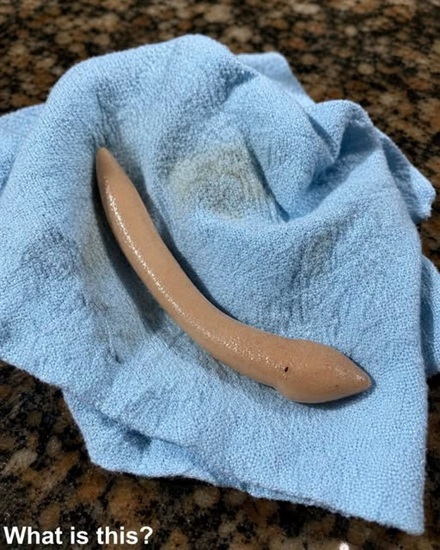
What began as an ordinary moment inside a familiar bathroom quickly became something far more unsettling when a strange dark object was noticed on the floor. At first, there was little reason to think it was anything unusual. Its irregular shape made it look like a small piece of rubber, debris or material that had fallen from a household item. It was dark, soft-looking and difficult to recognize from a distance. Only after a closer examination did the original explanation begin to seem unlikely. The object appeared to be something living.
That realization immediately changed the atmosphere of the room. A bathroom that had felt completely normal only moments earlier suddenly seemed full of places worth inspecting. The floor, corners, towels, fixtures and damp areas all attracted more attention. The object itself was relatively small, but the uncertainty surrounding it made the discovery feel much larger. Nobody seemed to know exactly how long it had been there. It was also unclear whether someone had already passed through the room without noticing it.
Its appearance made identification especially difficult. The creature did not have the obvious legs, wings or shell associated with many insects that commonly enter homes. Instead, its body appeared smooth, flexible and somewhat rubber-like. It was not immediately obvious whether it should even be described as a worm, insect or something else. That uncertainty made the first few moments particularly uncomfortable. When something cannot be placed into a familiar category, the mind often begins considering many different possibilities.
The bathroom was soon examined more carefully. Attention turned first to the corners and the areas around fixtures. Spaces close to the floor were checked, as were damp places that might normally receive little notice. Pipes and drains naturally entered the conversation because they were visible parts of the environment. However, there was no direct evidence establishing that the creature had actually traveled through the plumbing. Its precise route into the bathroom remained unknown.
That distinction is important because an unusual animal found near a drain does not automatically mean that it emerged from the drain. It is easy to make that assumption when a creature associated with moisture appears in a bathroom, but proximity alone does not establish its origin. Small organisms can potentially enter buildings in several ways. Some may be carried inside unintentionally on shoes, clothing, plants or other objects. Others may move through small openings in a structure.
Without witnessing the creature enter the room, none of those explanations could be confirmed. The uncertainty became one of the most memorable parts of the incident. If someone had seen it arrive, the story might have ended quickly. Instead, the animal seemed to have appeared without explanation. That left the people involved trying to reconstruct what might have happened before it was noticed.
Photographs offered the most practical starting point for identification. The animal’s shape and apparent movement could be compared with images of different organisms. Several possibilities could be considered because the creature lacked many of the features people normally use to identify household pests. Eventually, the visual comparison suggested that the animal resembled a leech. That provided a likely explanation for what had been found, although an image-based identification does not necessarily determine an exact species.
Learning that the creature appeared to be a leech produced a complicated reaction. There was some relief in finally having a plausible name for the strange object. At the same time, the word “leech” carries strong associations that can make people uncomfortable. Many people immediately think of blood-feeding animals. That reputation is partly accurate for some species, but the group is more diverse than the popular image suggests.
Leeches are segmented worms related to earthworms. Their bodies are generally flexible, and many species use suckers to attach to surfaces or animals. They can contract and stretch their bodies during movement, which can make their appearance change significantly from one moment to the next. A leech that is shortened may look thick and compact, while the same animal can appear much longer when extended. This flexibility helps explain why it can initially resemble a piece of wet rubber.
Not every leech feeds in exactly the same way. Some species consume blood from vertebrate animals, while others prey on small invertebrates. The well-known blood-feeding behavior has shaped their reputation, but it should not be applied automatically to every species. The biological diversity within the group is much greater than many people realize. Without a reliable species identification, broad assumptions about the individual animal would not be justified.
Many leeches are associated with freshwater environments such as ponds, streams, lakes and wetlands. Some species can also occur in damp terrestrial environments. Moisture is therefore an important part of the lives of many leeches. That ecological association naturally made the wet environment of a bathroom seem relevant. Still, knowing that an animal prefers moisture does not establish how one individual reached a particular indoor location.
The discovery also demonstrated how strongly surroundings influence a person’s reaction to wildlife. Seeing an unusual worm-like animal near a pond may generate curiosity. Seeing the same kind of creature on bathroom tiles can feel far more invasive. Bathrooms are private places associated with hygiene, routine and familiarity. People generally do not expect to encounter wildlife there.
That contrast can make an otherwise small animal seem much more alarming. The animal itself may not have changed, but the setting changes how it is perceived. A bathroom floor is not where most people expect to find a leech-like organism. The unexpected location therefore becomes almost as important as the creature itself. The surprise is created by the difference between what belongs in the room and what people expect to see there.
After the discovery, ordinary parts of the bathroom could suddenly look different. A dark mark near a fixture might receive a second glance. A towel touching the floor could be shaken before use. The drain might be checked before the shower is turned on. Corners that previously seemed completely unimportant could become temporary objects of suspicion.
These reactions do not necessarily mean that a genuine continuing threat exists. They are often the psychological result of an unexpected encounter. Once something unfamiliar appears in a place considered predictable, people naturally become more alert. The mind starts looking for evidence that the incident might happen again. Even harmless shadows or ordinary household sounds can briefly attract more attention.
One of the first concerns may be whether there are additional creatures nearby. Finding one unfamiliar animal can quickly produce thoughts about a possible infestation. Yet a single sighting does not establish that more animals are present. One individual could represent an isolated occurrence. An infestation would require more evidence than one unexplained discovery.
For that reason, it is useful to separate emotional reactions from confirmed observations. The confirmed observation was that one unusual soft-bodied creature was noticed on the bathroom floor. Visual comparison suggested that it resembled a leech. The route it used to enter the bathroom was not observed. There was also no evidence in the account proving that multiple leeches were present.
Maintaining that distinction helps prevent a strange household incident from being exaggerated into a wider claim. A story about one animal near a bathroom drain should not automatically become a claim that leeches commonly travel through household plumbing. The available information simply does not establish that. A drain might be considered as one possibility, but it remains only a possibility without direct evidence.
The same applies to assumptions about cleanliness. Discovering an unfamiliar animal indoors does not automatically mean a home is dirty or poorly maintained. Small creatures can enter buildings accidentally for many different reasons. Environmental conditions, structural gaps, transported objects or chance events may all play roles depending on the situation. Without knowing the route, assigning blame to housekeeping would be speculative.
The bathroom setting does make moisture worth considering. Bathrooms naturally contain more water than many other rooms because of showers, sinks and tubs. Damp towels, small leaks and condensation can also create moist areas. Many organisms prefer humid environments, making moisture a reasonable factor to inspect. However, the presence of moisture still does not prove that it caused the particular animal to enter.
Checking for unnecessary standing water or obvious leaks can be sensible household maintenance regardless of whether a leech is ever found. Drying persistently wet areas can reduce conditions that attract various moisture-loving organisms. It can also make unusual activity easier to notice. These are general maintenance practices rather than proof of the origin of one specific animal.
If repeated sightings occurred, the situation would provide more information. Multiple animals appearing in the same location could justify a closer investigation of the surrounding environment. Photographs, dates and exact locations could help establish a pattern. A relevant professional could then investigate whether plumbing, structural openings or another source was involved. A single event does not provide enough evidence to make that conclusion.
Photographs can still be helpful after an unusual discovery. Clear images showing the animal’s overall shape, relative size and visible details can assist with identification. Movement may also provide useful clues because different animals move in distinctive ways. In cases where accurate identification is important, an experienced wildlife or invertebrate specialist may provide a more reliable answer than an ordinary internet comparison.
For many homeowners, however, scientific identification is not the first concern. The first reaction is usually much simpler: “What is that?” The question becomes more urgent if the object begins moving after initially appearing lifeless. That sudden transition from debris to animal can be particularly startling. Something that seemed completely ordinary moments earlier suddenly demands attention.
The movement of a leech-like animal can contribute to its unusual appearance. Rather than walking on legs, it may contract, stretch and attach itself to surfaces. This can create a looping or inching motion that looks very different from an insect crawling across a floor. When someone has never seen that movement before, it can make the creature appear even stranger. Its shape may change considerably as it moves.
Once identification becomes plausible, earlier observations can suddenly make more sense. The flexible appearance fits the anatomy of a soft-bodied segmented worm. The absence of legs is no longer mysterious. What initially resembled a piece of rubber becomes easier to understand as a living animal. Identification reorganizes the experience even though it does not answer every question.
The strongest unanswered question remains how the creature arrived. Several explanations can be imagined, but imagining a route is not the same as demonstrating it. It may have been carried inside accidentally. It may have entered through an opening elsewhere. Another route may have been involved. Without observation or additional evidence, selecting one explanation would simply be speculation.
This uncertainty can cause the mind to replay the events leading up to the discovery. People may wonder who had most recently used the bathroom. They may try to remember whether the floor had been checked earlier. Someone may question whether the animal could have gone unnoticed for a considerable period. Because the creature was small and dark, that possibility can seem reasonable.
There may also be uncomfortable thoughts about whether someone nearly stepped on it. A person walking barefoot through a familiar bathroom rarely examines every inch of the floor. If an animal blends into the tile or appears similar to debris, it might easily escape notice. However, unless direct contact was observed, there is no reason to report that anyone actually stepped on it. The concern is part of the reaction, not a confirmed event.
Once a strange encounter occurs, people often become much more attentive to familiar surroundings. Small sounds from pipes may seem louder. Water moving through a drain may be noticed more consciously. A shadow beneath a cabinet may prompt a second look. These things were probably present before the incident, but they become noticeable because expectations have changed.
The bathroom itself may remain exactly the same. What changes is the way it is observed. This is a common response after any surprising household discovery. Someone who finds a spider beneath a towel may check towels for several days. Someone who sees an insect near a window may look at the window more carefully afterward. The mind temporarily prioritizes information associated with the recent surprise.
Eventually, this heightened attention usually decreases if nothing else happens. Days can pass without another unusual sighting, allowing normal routines to return. The drain becomes an ordinary fixture again. Towels stop being inspected carefully. Walking across the floor once more becomes automatic. Still, the memory of the original discovery may remain vivid.
That lasting memory is often more psychological than practical. The animal did not need to cause damage or behave aggressively to create a strong impression. Its unexpected presence was enough. Humans generally feel more comfortable when familiar spaces behave predictably. A small creature appearing without explanation disrupts that expectation.
The event is also a reminder that homes are not completely isolated from the natural environment. Walls, doors and windows create barriers, but small organisms can occasionally find their way indoors. People can unknowingly transport animals or eggs on objects. Small gaps can exist around doors or building materials. Nature and indoor spaces are therefore not always as separate as they seem.
This does not mean that unusual animals should be expected regularly in bathrooms. Most people may never encounter a leech-like creature inside their homes. The point is simply that occasional unexpected wildlife encounters can happen. A single unusual discovery should not automatically be transformed into a universal household warning.
Online storytelling can sometimes make that distinction difficult. A photograph of an unfamiliar organism may circulate with a dramatic caption. Viewers then begin adding theories about plumbing, infestations or other frightening possibilities. Some of those theories can eventually be repeated as though they were confirmed. Responsible reporting should separate observation from speculation.
In this story, the observation is straightforward. A dark, flexible creature was noticed on a bathroom floor. Its shape did not resemble familiar household insects. Photographs were compared with images of different organisms. The creature eventually appeared consistent with a leech.
Everything concerning its point of entry remained uncertain. The fact that the animal was found in a bathroom does not independently establish that it lived in the plumbing. Nor does it prove that a drain was the route into the room. A possibility can be discussed as a possibility, but it should not be promoted into a fact without evidence.
That cautious approach does not make the story less interesting. In many ways, the mystery is what makes it memorable. If every detail had an immediate explanation, the incident would simply have been a brief encounter with an animal. Instead, one answer produced another question. The creature could be named, but its arrival could not.
Leeches themselves have a long and unusual relationship with humans. Certain blood-feeding species became historically associated with medical bloodletting. In earlier periods, leeches were used extensively because physicians believed removing blood could treat numerous illnesses. Modern medical understanding has changed dramatically since then. However, specially bred medicinal leeches still have limited uses in particular modern medical settings.
In reconstructive medicine, for example, medicinal leeches may sometimes be used under professional supervision to relieve venous congestion in certain tissues. This controlled clinical use is entirely different from encountering a wild animal on a bathroom floor. Mentioning it simply illustrates that leeches are biologically interesting animals rather than creatures defined only by fear. Their reputation has a complicated scientific and historical background.
Their ecology is equally varied. Some species live primarily in freshwater. Others are adapted to moist environments on land. Different species feed on different organisms and occupy different roles in ecosystems. Some act as predators. Others are parasites. They may themselves be eaten by larger animals.
This diversity is one reason species-level identification matters when making specific claims about behavior. Calling an animal a leech identifies a broad group, not necessarily its exact lifestyle. Without further expertise, statements about what the particular individual eats or how it normally lives should remain cautious. Appearance alone may not provide all the information required.
The same principle applies when judging whether an encounter represents a danger. Simply finding an apparent leech on the floor is different from having an animal attached to the body. A person’s actual health circumstances matter. If contact with an unfamiliar organism creates a medical concern, professional healthcare advice is more appropriate than assumptions drawn from a social-media story.
For an animal merely observed on the floor, the situation is primarily one of identification and household investigation. Documenting the creature and checking the immediate surroundings are practical first steps. If there are no repeated sightings, the incident may simply remain an unusual one-time event. If the situation repeats, more investigation could be justified.
One encounter is not evidence of a widespread problem. This point is particularly important when unusual images circulate online. People viewing a photograph in another country or region should not assume that the same animal is common in their homes. Species distribution, climate and environmental conditions differ considerably. An isolated image cannot establish a local or regional trend.
The story therefore works best as an unusual household discovery rather than as a warning aimed at a particular community. There is no need to imply that residents of any location face a new threat. The interesting part is the unexpected appearance of the creature and the uncertainty that followed. That can be described accurately without adding a local narrative.
A careful account also avoids pretending to know what the original homeowner could not know. The animal was found after it had already entered the room. Nobody watched its journey. No investigation identified a specific entry point. Therefore, the honest conclusion is that the exact route remained unknown.
This may feel less satisfying than a dramatic explanation, but uncertainty is common in real events. Not every mystery receives a complete answer. Sometimes the available evidence establishes only part of what happened. Reporting that limitation directly is more trustworthy than inventing details to complete the story.
The incident can still encourage reasonable awareness. Bathrooms contain water, and persistent moisture problems are worth addressing for many ordinary maintenance reasons. Visible leaks should be repaired. Standing water should not be allowed to remain unnecessarily. Cracks or gaps can be inspected if repeated unusual activity occurs.
These actions are practical household habits rather than evidence that leeches commonly invade bathrooms. They are simply ways to keep indoor spaces easier to maintain and monitor. The discovery of one strange animal may encourage people to notice conditions they had previously ignored. That can be useful without creating unnecessary alarm.
The emotional reaction is equally understandable. People often walk barefoot in bathrooms. They use towels without inspecting them. They reach into showers and tubs automatically. Discovering an unfamiliar organism there can therefore feel more personal than spotting one in a garage or garden.
A room associated with comfort can briefly become a place of uncertainty. This contrast explains why the memory can remain vivid even after the immediate situation ends. The next visit to the bathroom may involve a quick scan of the floor. The person may know rationally that another creature is unlikely to appear at that exact moment. Still, the recent experience remains fresh.
Fear and attention do not always follow statistical probability. A single surprising event can change behavior more strongly than hundreds of ordinary visits that came before it. That does not necessarily mean the person believes a serious danger exists. It simply means the mind remembers unusual experiences more readily than routine ones.
The discovery also illustrates how strongly humans rely on familiar shapes. A beetle, fly or spider can often be recognized almost instantly because its basic form is familiar. A soft-bodied animal with no visible legs presents a harder puzzle. When the brain cannot categorize something quickly, the uncertainty itself can create discomfort.
Finding an eventual match can therefore bring genuine relief. The object is no longer completely unknown. It belongs to a recognizable biological group. Information about that group becomes available. The situation begins to feel less mysterious.
Yet knowing the name can introduce new associations. In this case, the word “leech” may immediately remind people of blood feeding. That mental image can be stronger than the actual evidence concerning the individual animal. Remembering that leeches are biologically diverse helps keep those associations in perspective.
The important factual point is not that the discovery was harmless or dangerous in every possible circumstance. It is that the available story does not establish a major threat. It describes an unusual animal encountered unexpectedly indoors. The strongest responsible conclusion should remain proportional to that evidence.
If another similar creature never appeared, the incident may ultimately have been nothing more than a strange isolated event. If repeated appearances occurred, that would create new information and could justify further investigation. The appropriate conclusion can change when the evidence changes. Until then, one sighting remains one sighting.
This evidence-based approach is useful for many viral household stories. An image may be genuine while the explanation attached to it is speculative. A creature may really have been found, while claims about how it arrived remain unsupported. Separating these parts allows an interesting story to be told without turning uncertainty into misinformation.
The discovery therefore remains memorable for a simple reason. Something that initially looked ordinary was not ordinary at all. A dark shape that seemed like trash or rubber eventually appeared to be a living animal. The discovery changed the mood of a familiar room almost instantly.
Then came the questions. What was it? Where had it come from? How long had it been there? Could there be another one? The likely identification provided an answer to the first question. The remaining questions were much harder to resolve.
The possibility of a drain or plumbing route was one of several ideas, but there was no direct evidence confirming it. The possibility that the creature had been carried indoors was another. An opening elsewhere in the building could also be considered. The honest answer was that the route could not be determined.
That unanswered element was what allowed the story to linger. The animal itself could be removed, but uncertainty could not be removed as easily. For a while, familiar parts of the bathroom carried new significance. The incident became attached to the room in memory.
Over time, normality would likely return. Ordinary routines usually overcome the temporary alertness created by one unexpected event. Yet it is easy to imagine that the next dark object on the floor would receive a much closer look. Once someone has mistaken a living creature for debris, the lesson is difficult to forget.
The story does not require claims about widespread infestations or dangerous plumbing systems to hold attention. Its strength comes from something much more relatable: the sudden realization that a familiar environment contained something completely unexpected. That moment can happen anywhere and with many different types of animals.
What matters is describing it accurately. The creature appeared to resemble a leech. The exact species was not established from the available information. Its route into the bathroom was unknown. No evidence demonstrated an infestation.
Those limitations are not weaknesses in the story. They are part of what actually happened. Real-life discoveries often leave unanswered questions. Responsible reporting acknowledges those gaps rather than filling them with the most dramatic theory available.
In the end, the bathroom itself had not become a fundamentally different place. It still contained the same tiles, fixtures, drains and towels. What changed was the awareness of the person who had seen the creature. A place once taken completely for granted suddenly seemed worthy of another glance.
That reaction captures the entire incident better than any exaggerated warning could. One small animal appeared where nobody expected it. It was initially mistaken for an inanimate object. A closer look suggested otherwise. Eventually, it appeared to be a leech.
The identification provided some clarity but not a complete explanation. Nobody could say with certainty exactly how it arrived. Nobody could prove that it came through a drain. There was no confirmed evidence that more were hiding nearby.
Sometimes that is simply where an unusual story ends. Not with a dramatic revelation, but with a reasonable conclusion based on what can actually be observed. A strange animal appeared in an unexpected place, prompted plenty of questions and then became a memory that made an ordinary bathroom seem unfamiliar for a little while.
The creature was small, quiet and initially easy to overlook. Yet its discovery was enough to change an ordinary moment into something memorable. It showed how quickly assumptions can change once people take a closer look. Something that appeared to be trash turned out to resemble a living organism.
And perhaps that is why the encounter remained so unsettling. It was not because every frightening possibility was confirmed. Most of them were not. It was because something unexpected had appeared silently in a familiar space without leaving a clear explanation behind.
For anyone who has ever noticed a strange animal inside a home, the reaction is easy to understand. First comes surprise. Then curiosity. Then the search for identification. Finally comes the attempt to understand how it got there.
Sometimes all of those questions receive answers. Sometimes only a few do. In this case, the most reasonable identification was a leech, while its exact route into the room remained uncertain. That is enough to preserve both the mystery and the accuracy of the story.
The final lesson is simple. Strange discoveries can be interesting without being exaggerated. Possibilities can be discussed without being presented as facts. A single animal does not automatically indicate an infestation, and finding something near plumbing does not automatically prove that it traveled through the pipes.
The most accurate version of the incident therefore remains the simplest one. A strange, flexible creature was discovered on a bathroom floor. It initially looked like an ordinary piece of debris. Closer observation suggested that it was alive, and comparison with images indicated that it resembled a leech.
Exactly how it got there was never established.
That unanswered question is what transformed an otherwise tiny household discovery into a story difficult to forget.
