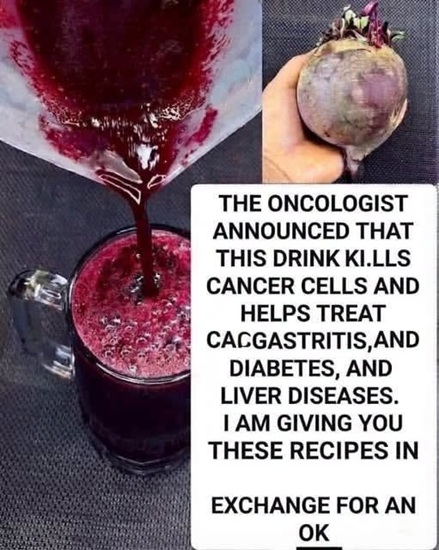
A deep-red beetroot drink has been circulating online alongside dramatic claims about cancer, diabetes, gastritis and liver disease. The image is visually simple, showing beetroot next to a dark red beverage, but the wording attached to it makes very strong medical promises. It suggests that the drink can help with several serious illnesses and refers to an oncologist as the source of the information. However, the material does not identify the medical professional, provide a hospital or research institution, or link the claims to a specific clinical study.
That lack of verifiable information is important when evaluating any health-related statement. Beetroot itself is a widely consumed vegetable that can be eaten raw, cooked, roasted, blended or made into juice. It contains nutrients and naturally occurring compounds that researchers have studied for a number of possible health effects. Some research has focused on dietary nitrate, which can influence nitric oxide pathways and blood-vessel function. These areas of research are legitimate and scientifically interesting. However, being nutritious or biologically active is not the same as being proven to treat a serious disease.
The strongest claim associated with the image concerns cancer. The phrase suggesting that the drink can “kill cancer cells” can easily be understood as meaning that drinking it may treat cancer in people. The information presented does not establish that conclusion. Cancer is not a single illness but a large group of diseases that differ greatly in their causes, behavior and treatment. A broad statement about one beverage therefore requires very strong supporting evidence.
Laboratory research can sometimes show that certain compounds influence cells under controlled conditions. Those findings can help researchers understand biological mechanisms and decide what should be studied further. But a laboratory result does not automatically mean that drinking or eating the same substance will produce an equivalent therapeutic effect in a patient. The human body processes foods through digestion, absorption and metabolism, all of which can change the way substances behave. This is why laboratory findings and proven medical treatments should not be treated as interchangeable.
Cancer care is also highly individualized. Depending on the diagnosis, treatment may involve surgery, chemotherapy, radiation therapy, immunotherapy, targeted therapy, hormone therapy or combinations of different approaches. Decisions are generally based on the type and stage of cancer, test results and the health of the individual patient. A viral image cannot evaluate those factors. It therefore cannot provide the same level of information as a qualified medical team.
The use of the word “oncologist” gives the viral message an additional appearance of authority. Oncology is a medical specialty focused on cancer, so readers may naturally give greater weight to a statement attributed to an oncologist. But the image does not provide the doctor’s name or any details that would allow the statement to be independently verified. There is no clinic, hospital, publication or interview cited. A professional title by itself is not enough to prove a medical claim.
The image also connects the drink with diabetes. Diabetes is a chronic condition involving problems with blood-glucose regulation, and its management can vary widely between individuals. Some people may manage the condition through diet and physical activity, while others may require medication, insulin or additional treatment. Diet is an important part of diabetes management, but this does not mean that a single vegetable drink has been proven to cure or replace established care.
Beetroot has been included in some research examining metabolic and cardiovascular health. Researchers have investigated whether beetroot juice may influence factors such as blood pressure, circulation or certain markers related to metabolism. These studies can provide useful scientific information. However, they should not be interpreted as proof that beetroot juice cures diabetes. A single finding or small study cannot support a sweeping medical conclusion.
The claim involving gastritis also deserves careful interpretation. Gastritis refers to inflammation of the stomach lining, but it can develop for different reasons. Treatment depends on the cause, symptoms and individual circumstances. The viral image does not identify what type of gastritis is being discussed or explain how beetroot would supposedly treat it. No dose, frequency or clinical evidence is presented.
The same issue applies to liver disease. The term “liver disease” includes many different conditions that can have very different causes and medical consequences. A single beverage cannot reasonably be assumed to treat all of them without specific evidence. The image does not identify a particular liver condition or explain how the claimed benefit was measured. Broad wording therefore goes far beyond what the post actually demonstrates.
This does not mean beetroot has no nutritional value. Beetroot can be part of a balanced diet, and it contains compounds that researchers continue to study. The important distinction is between eating a nutritious food and using that food as a medically proven therapy. Those ideas should remain separate. A vegetable does not need to cure disease in order to be considered healthy or useful as part of normal eating habits.
One area where beetroot juice has received more substantial research attention is blood pressure. Beetroot contains nitrate, which can be converted through biological pathways into nitric oxide. Nitric oxide plays a role in the relaxation of blood vessels. Because of this, researchers have examined whether beetroot juice may influence blood-pressure readings in certain groups of people.
Some clinical studies and reviews have reported modest reductions in systolic blood pressure under specific conditions. These findings are interesting but much narrower than the claims found in viral posts. They do not show that beetroot juice cures hypertension, and they certainly do not establish that it treats cancer, diabetes, gastritis or liver disease. Scientific results should be described only within the limits of what was actually tested.
This difference demonstrates why context matters. Real medical research usually describes who participated in a study, how much of a product was used, how long the study lasted and what outcomes were measured. Researchers also discuss limitations and uncertainty. Viral graphics usually remove all of that complexity. They present a simplified conclusion without showing the evidence that would be necessary to justify it.
The term “natural” can also influence how readers interpret a health claim. Foods and plants are often perceived as automatically safe or effective because they occur naturally. But natural origin does not prove medical effectiveness. Many natural substances can have biological effects, and some may interact with medications or existing health conditions. Evidence and individual circumstances still matter.
Another important issue is dosage. A compound that produces an effect in a laboratory may be used at a concentration very different from what someone would obtain by drinking a glass of juice. Without dosage information, it is impossible to know whether a viral claim resembles the conditions of any actual scientific experiment. The post does not provide that information. This makes it even harder to interpret the medical promises seriously.
Research duration is similarly important. Some studies examine short-term changes after a single serving, while others observe people over several weeks or months. A short-term change in a biological marker is not the same as proof that a disease has been treated. These distinctions can disappear completely in simplified health posts. Careful reporting should restore that missing context.
The image also appears to use an engagement-focused format. It suggests that additional recipes may be shared after viewers respond or interact with the post. This type of presentation is common on social media and is designed to encourage participation. Engagement itself does not prove whether the information is true or false. A post can receive many reactions while still lacking scientific support.
The absence of a clearly defined recipe is another limitation. The image visually suggests beetroot as the main ingredient, but it does not fully identify what the drink contains. There are no clear quantities or preparation details. Different juices or mixtures can vary substantially in concentration and nutritional composition. Without knowing exactly what is being consumed, the health claim becomes even more difficult to evaluate.
Visual presentation can make health information appear more convincing than it actually is. A brightly colored drink, a recognizable vegetable and large medical claims create an immediate connection in the reader’s mind. The design can make the conclusion feel simple and memorable. But a persuasive image is not the same as scientific proof. Evidence must exist independently of the presentation.
Serious illnesses can also make simple solutions especially appealing. Cancer, diabetes and chronic liver conditions can involve long-term treatment, uncertainty and stress. A familiar vegetable may sound more comforting than complicated medical care. That emotional appeal is understandable. However, whether something feels reassuring has no bearing on whether it has been proven effective.
This is why extraordinary health claims should be examined carefully before they influence medical decisions. If a food is said to treat several serious diseases at once, readers should ask what studies support the claim. They should also ask whether the research involved actual patients, how many people participated and whether the result has been independently reproduced. If those details are missing, the claim should remain uncertain.
Another useful question is whether the post identifies exactly what outcome was measured. Researchers may study blood pressure, inflammation markers, exercise performance or laboratory values. A change in one measurement does not automatically mean that a disease has been cured. Medical conclusions must match the actual outcome of the research. Viral content often makes the conclusion much broader than the original evidence.
The phrase “kills cancer cells” is a good example of this problem. A substance may affect certain cells in a laboratory experiment, yet still fail to become an effective cancer treatment in humans. Many potential therapies show interesting laboratory activity without ultimately proving useful in clinical practice. This is one reason cancer research requires multiple stages of investigation. No single laboratory observation can replace that process.
The same caution applies to antioxidants. Beetroot contains compounds with antioxidant properties, but the presence of antioxidants does not prove that a food cures cancer or other diseases. Antioxidant activity is a biological property, not a clinical diagnosis or treatment outcome. Using scientific-sounding terms without context can create an impression of certainty that the evidence does not support.
Health reporting is more accurate when it distinguishes among different levels of evidence. Laboratory experiments, animal studies, observational studies and randomized human trials each provide different kinds of information. Systematic reviews may then examine results across multiple studies. A viral image rarely tells readers what type of evidence exists. Without that information, the strength of the claim cannot be properly assessed.
A modest, specific conclusion can still be useful. For example, saying that beetroot juice has been studied for possible effects on blood pressure is reasonable. Saying that it may have certain cardiovascular effects under specific conditions is also very different from calling it a cure. Scientific accuracy often requires narrower language. That may sound less dramatic, but it is more reliable.
People should also be cautious if any online post encourages them to stop prescribed treatment. There is no evidence in the viral image showing that beetroot juice can safely replace chemotherapy, diabetes medication or treatment for liver disease. Abruptly changing medical care can carry serious risks. Diet and conventional treatment can sometimes exist together, but one should not automatically be substituted for the other.
This does not diminish the importance of nutrition. Dietary habits can influence overall health and may play a role in managing many conditions. Vegetables, fruits, grains, proteins and other foods can all contribute to a balanced eating pattern. But dietary support and disease treatment are not the same concept. Keeping that distinction clear prevents reasonable nutrition advice from turning into medical misinformation.
Individual circumstances also matter. A drink that fits comfortably into one person’s diet may not be appropriate in the same amount for someone else. Existing medical conditions, medications and dietary restrictions can all affect what is suitable. Generic social-media posts cannot assess those factors. Personalized decisions require individualized information.
The safest interpretation of the viral image is therefore a limited one. It shows beetroot and a dark-red drink accompanied by dramatic health statements. What it does not show is sufficient evidence that the beverage treats the illnesses listed. That gap between presentation and proof should remain central to the discussion.
Readers can still enjoy beetroot without accepting unsupported medical promises. It can be eaten because of its taste, used in recipes or included as part of a varied diet. Beetroot juice can also be consumed as a beverage. None of those choices require believing that it is a miracle treatment. A food can have value without being a cure.
The same reasoning can be applied to many other viral remedies. Online posts regularly make dramatic claims involving fruits, herbs, spices, teas and homemade mixtures. Some ingredients may be nutritious or scientifically interesting. Others may have been studied for specific effects. But every medical claim still needs evidence appropriate to that particular claim.
The reliability of a health statement increases when readers can trace it to transparent sources. A named researcher, published study, clear methodology and well-defined outcome make a claim easier to evaluate. Anonymous statements, vague diseases and undefined recipes make it much harder. These signs can help readers separate genuine health information from exaggerated content.
Scientific research is also constantly evolving. New studies can strengthen, weaken or refine earlier conclusions. That is why responsible reporting avoids absolute language when evidence remains uncertain. Saying that something “may help” in a defined context can be appropriate if research supports it. Saying that it cures several major illnesses requires a far higher standard.
The viral beetroot drink claim goes beyond what can reasonably be concluded from the material shown. The image does not identify the oncologist, specify the complete recipe or provide clinical evidence supporting the treatment claims. It also groups several unrelated medical conditions into one broad promise. Those limitations should be made clear whenever the post is discussed.
The more responsible conclusion is not that beetroot is useless, nor that it is dangerous. The conclusion is simply that its nutritional qualities should not be confused with proven treatment for serious disease. Beetroot can remain part of a healthy diet while unsupported medical claims are rejected. These two ideas can exist together without contradiction.
Anyone dealing with cancer, diabetes, persistent stomach problems or liver disease should rely on appropriate medical evaluation rather than a viral image. A healthcare professional can assess the specific diagnosis, medical history, medications and other individual factors. Online content cannot perform that role. Health decisions should therefore be based on information that can be properly verified.
Ultimately, the beetroot drink image is a useful reminder of how easily nutritional information can be transformed into exaggerated medical claims. A familiar vegetable, a colorful beverage and a dramatic headline can create a powerful message. But the strength of the evidence remains more important than the strength of the presentation. When serious illnesses are involved, accuracy and careful interpretation matter far more than virality.
Beetroot continues to be an interesting subject of nutrition research, especially because of its natural nitrate content and possible cardiovascular effects. Future research may provide more detail about where it is useful and where it is not. Until then, claims should remain proportionate to the evidence available. Scientific interest is not the same as proof of a cure.
The simplest takeaway is also the most accurate. Beetroot can be enjoyed as a nutritious food, and beetroot juice has been studied for certain physiological effects. What has not been established by the viral material is that the drink cures cancer, diabetes, gastritis or liver disease. Extraordinary health claims should always be supported by extraordinary evidence before they are presented as fact.
