
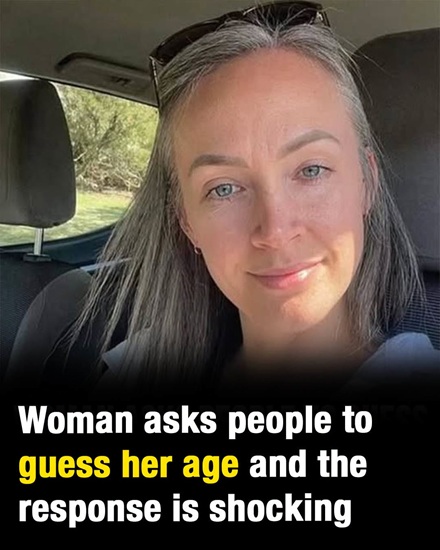
Asking strangers on the internet to judge your appearance can lead to surprisingly different reactions. That is exactly what happened to a woman named Emily Jane after she posted a short TikTok video and invited viewers to guess her age. She appeared naturally, without makeup or beauty filters, and wanted to see what people would say. The responses quickly became far more varied than she expected. Some viewers thought she was younger than her real age, while others placed her in her forties, fifties, or even close to 60.
What began as a simple online question soon became a broader conversation about grey hair, beauty standards, and how people interpret age. Emily later explained that one of the most surprising guesses placed her at about 58 years old. Other commenters estimated that she was in her forties or early fifties. At the same time, some people believed she was in her twenties or thirties. The enormous difference between those guesses demonstrated how subjective age estimation can be.
Everyone was looking at the same person, but their answers stretched across several decades. That alone suggested that appearance does not provide a precise or universal way to determine someone’s age. After seeing the responses, Emily posted another video and revealed the answer. She had recently turned 36. The fact that some viewers had estimated her age more than 20 years higher clearly surprised her. She questioned whether she genuinely appeared close to 60 and began discussing what might have influenced the comments. Rather than simply becoming angry with the people who guessed incorrectly, she focused on why the estimates had been so different.
One of the most obvious features was her naturally grey hair. Emily explained that she started going grey when she was approximately 19 years old. By her mid-thirties, she had decided not to constantly hide that natural color. Because grey hair is traditionally associated with older adults, she believed that some viewers automatically interpreted it as evidence that she was much older than she actually was.
Several commenters agreed with that explanation. They said her face appeared consistent with someone in her thirties but that the grey hair changed their initial impression. Others suggested that people simply are not accustomed to seeing younger women confidently allow their natural grey hair to remain visible. For these viewers, hair color seemed to be the strongest reason the guesses became so high.
Grey hair, however, does not appear at the same age for everyone. Some people begin noticing grey strands in their teens or twenties, while others maintain most of their original hair color well into later adulthood. Genetics plays an important role in when hair loses pigment. As a result, grey hair by itself cannot reliably determine whether a person is 30, 50, or 70.
Emily’s own experience was a clear example of this variation. Because she had begun greying around 19, the appearance of grey hair was not a sudden sign that she had entered middle age. It had been part of her appearance for many years. Someone unfamiliar with early greying, however, might naturally associate the same hair color with a much older person.
Another important part of Emily’s original video was that she was not presenting herself through the highly polished style commonly seen on social media. She said she was not wearing makeup and had not applied a beauty filter. She also said she had not undergone cosmetic procedures. The image viewers saw therefore reflected how she naturally looked at that moment rather than a heavily edited version of her face.
That distinction became central to the discussion. Social media platforms frequently expose users to images created with professional lighting, makeup, careful posing, and digital filters. In many cases, the final image may look quite different from how the person appears during an ordinary day. When those polished images become familiar, an unedited face can seem unusual even though natural skin texture, lines, shadows, and other details are completely normal.
Emily also mentioned another temporary factor that may have affected her appearance. She had a newborn baby and had experienced sleepless nights. Lack of sleep can make anyone appear tired, particularly around the eyes. She said the visible under-eye areas in the video reflected her recent routine rather than some hidden health problem or dramatic change in her appearance.
This also demonstrates why estimating age from one short video is unreliable. Lighting, sleep, facial expression, hairstyle, camera angle, and countless temporary conditions can influence the way someone looks in a particular moment. A person photographed after a full night of sleep may look different from the same person after several exhausting days.
Emily nevertheless believed the comments raised a bigger question. She wondered whether social media has influenced how people expect women of different ages to look. Her theory was that repeated exposure to filters, cosmetic treatments, retouched images, and carefully curated content may cause people to compare ordinary faces with unrealistic standards.
That interpretation cannot be proven simply from her TikTok comments. The viewers did not all explain their reasoning, and each person may have used different visual clues. Some may genuinely have focused only on the grey hair. Others may have been influenced by makeup-free skin or tired eyes. Another person may simply have been poor at estimating age.
Still, Emily’s question reflected a broader conversation that has been happening for years. Online platforms allow people to smooth skin, alter facial proportions, brighten eyes, change jawlines, and remove features associated with ordinary aging. Many of those changes can happen instantly through software rather than professional editing.
As these tools become increasingly common, users may sometimes forget how much variation exists in natural faces. Skin has pores. Fine lines appear when people smile. Under-eye shadows can become more visible after a difficult night. Faces are not perfectly symmetrical. None of these features automatically means a person is older than they actually are.
The discussion surrounding Emily also revealed how differently grey hair is interpreted depending on gender and cultural expectations. Men with grey hair are often described as distinguished or mature, while women have traditionally experienced stronger pressure to cover grey roots. Those expectations have begun changing, but they have not disappeared entirely.
More women are now choosing to stop dyeing their hair and allow natural grey or white tones to grow in. For some, the decision is practical because frequent coloring requires time and expense. For others, it is simply an appearance they prefer. There is no single correct way to handle natural greying.
Emily appeared comfortable with her choice. The surprise came from realizing how strongly other people associated that choice with age. She did not seem to view her natural hair as evidence that she looked old. To her, it was simply the hair she had developed unusually early.
One commenter suggested that Emily looked her actual age once the grey hair was mentally separated from the rest of her appearance. Another said her skin looked youthful while the hair made her seem older at first glance. These responses supported Emily’s suspicion that people were using hair color as a shortcut.
Visual shortcuts are common when people make rapid judgments. Human brains constantly process clothing, hair, posture, facial structure, and other characteristics when forming first impressions. These impressions happen quickly and are not always accurate.
Age estimates are especially vulnerable to those shortcuts. Someone wearing conservative clothing may be guessed older than the same person wearing casual clothing. A beard can change perceptions of a man’s age. Grey hair can change perceptions of both men and women. Makeup can also influence estimates depending on the style used.
The age of the person doing the guessing may matter as well. Younger people sometimes interpret adulthood differently from older adults because they have different reference points. A teenager may consider someone in their late thirties much older than a person in their sixties would.
Emily was reportedly interested in this aspect too and encouraged viewers to mention their own ages when answering. The idea was to see whether age perception changed depending on the observer. The responses remained inconsistent, reinforcing how subjective the exercise was.
The situation also showed how quickly online questions can become much larger conversations. Emily asked for opinions, but once a video reaches a large audience, there is no way to control every response. Some people answer thoughtfully. Others make jokes. Some intentionally exaggerate. Others respond without considering how the comment may be received.
That does not necessarily mean everyone who guessed Emily older was trying to insult her. She had explicitly asked viewers for their estimates, so many were simply participating. An incorrect age guess is not automatically an act of cruelty.
However, the tone of online comments can sometimes be harsher than face-to-face conversation. People may write statements they would hesitate to say directly to someone. The distance created by a screen can reduce normal social restraint.
Emily’s reaction therefore became relatable to many users who have posted something casually and received unexpectedly personal responses. Once appearance becomes the subject, strangers may feel invited to discuss hair, skin, weight, clothing, and other details.
The larger lesson is not necessarily that people should never ask for opinions. Instead, it is useful to recognize how unpredictable large online audiences can be. A question asked out of curiosity may produce answers far beyond what someone expects.
Emily ultimately appeared to take the situation with perspective. Rather than deciding that she needed to dye her hair or change her face, she continued discussing why people had reacted the way they did. This turned an uncomfortable surprise into a conversation about perception.
Her approach also helped separate actual age from perceived age. Emily was 36. That was an objective fact. Whether someone believed she looked 28, 42, or 58 was an opinion.
The distinction sounds obvious, but social media often blurs it. People sometimes treat subjective beauty judgments as though they were measurable truths. In reality, appearance depends heavily on personal taste, culture, experience, and context.
There is also no single correct way for a 36-year-old woman to look. Two women born on the same day may have completely different hair colors, facial structures, skin textures, heights, weights, and personal styles.
One may have grey hair.
Another may have no visible grey at all.
One may wear makeup every day.
Another may never use it.
One may have undergone cosmetic procedures.
Another may prefer not to.
None of those choices changes their actual age.
They simply influence how other people interpret appearance.
Emily’s video highlighted the difference between those two concepts remarkably well.
The conversation about filters became particularly relevant because many beauty filters are subtle. Earlier filters often produced obviously artificial effects. Modern versions can smooth skin or alter proportions without making the changes immediately noticeable.
A viewer may know intellectually that filters exist but still absorb the resulting images as part of what a normal face is supposed to look like.
When the same viewer encounters a completely unfiltered face, ordinary texture or tiredness may stand out more strongly.
This does not mean filters are inherently harmful or that everyone using one is misleading others. Many people use them simply for entertainment. The concern arises when edited images become the primary standard against which natural appearances are judged.
Emily seemed to believe this phenomenon may have played a role in the responses she received.
Some commenters strongly agreed.
Others insisted the explanation was much simpler.
They blamed the grey hair.
That disagreement is part of what made the story interesting.
There may never be one answer.
Human perception rarely works through one single factor.
People make judgments using combinations of visual information.
Hair color was probably important for some viewers.
Tiredness may have mattered to others.
The lack of makeup may have influenced another group.
Some guesses may simply have been random.
There is no reliable method of determining exactly why hundreds of strangers reached different conclusions.
What can be said confidently is that Emily’s appearance challenged some people’s expectations.
A 36-year-old woman with natural grey hair did not match the mental image those viewers had formed of someone in their mid-thirties.
That mismatch produced inaccurate estimates.
Instead of treating the mismatch as proof that Emily looked wrong, it may be more reasonable to question the assumptions behind the estimates.
Natural greying is one example of why appearance does not always follow conventional timelines.
Some people lose hair early.
Some develop wrinkles later.
Some appear younger than their age according to popular expectations.
Others appear older.
These differences are ordinary parts of human variation.
Lifestyle can influence appearance, but genetics is also significant.
Sun exposure, smoking, stress, sleep, skincare, and other factors can affect skin over time.
Yet none of these factors allows strangers to calculate someone’s age precisely.
Even professionals can make incorrect estimates from photographs.
Social media adds even more uncertainty because images may be edited or presented under controlled conditions.
Emily chose the opposite approach.
She showed herself naturally.
That made the results particularly interesting.
Some people correctly recognized her as approximately 36.
Others were dramatically wrong.
The experiment therefore revealed more about the viewers’ expectations than about Emily’s chronological age.
Her comments section also became a small example of how society interprets female aging.
Visible signs traditionally associated with age are often treated as something women should conceal.
Grey hair is dyed.
Lines are smoothed.
Photographs are retouched.
Makeup can minimize shadows and texture.
When someone deliberately chooses not to hide those things, viewers may initially interpret the result as unusual.
Emily’s response suggested that she was not interested in completely following those expectations.
She had stopped coloring her naturally greying hair.
She appeared without filters.
She did not apologize for looking tired while caring for a newborn.
Those choices gave the discussion a more personal dimension.
The video was not simply a test of how old she looked.
It became a demonstration of how much appearance can change when common digital and cosmetic enhancements are removed.
At the same time, it is important not to turn her story into criticism of women who choose makeup, hair dye, or cosmetic procedures.
Personal appearance decisions are individual.
A woman who enjoys coloring her hair is not less authentic.
A woman who prefers grey hair is not automatically more authentic.
Both choices can coexist.
The more useful point is that neither choice should become the mandatory standard for everyone else.
People should be allowed to decide how they want to present themselves.
Emily made one choice.
Some strangers interpreted it differently than she expected.
That was the entire foundation of the viral moment.
The story also reflects how strongly age continues to be connected with value in online culture.
Being told that someone looks older is frequently presented as an insult, while being told they look younger is treated as praise.
But aging itself is not a failure.
A person can be attractive at 36, 50, 60, or 80.
Someone guessing an older age does not automatically mean they are saying the person looks bad.
This distinction can reduce some of the emotional weight surrounding age estimates.
Emily’s surprise focused primarily on the distance between the guesses and reality.
Being mistaken for 58 when you have just turned 36 is objectively a large difference.
It is understandable that she wanted to know why.
But someone who actually is 58 should not be treated as though that age is negative.
The issue is accuracy, not the value of being older.
That nuance is often lost in viral headlines.
Online stories sometimes exaggerate the emotional impact by suggesting that a person was “destroyed” or “humiliated” by comments.
Emily’s own response appeared more thoughtful than that.
She was surprised.
She questioned the estimates.
And then she used the experience to start a conversation.
That approach keeps the story grounded without turning it into unnecessary drama.
It also makes the larger subject more useful.
People reading the story can ask themselves what clues they use when estimating someone’s age.
Would grey hair immediately add ten or twenty years in their minds?
Would an unfiltered face look older than expected?
Would makeup change the estimate?
Would knowing Emily had a newborn affect the judgment?
These questions reveal how flexible perception can be.
One image can produce dozens of interpretations.
That is why online appearance judgments should always be taken with some skepticism.
A stranger’s comment is not an objective measurement.
Likes and replies do not make an opinion more scientifically accurate.
A viral consensus can still be wrong.
Emily knew exactly how old she was regardless of what the comment section believed.
The story also provides a reminder about comparison.
Seeing heavily edited people online can make ordinary appearances seem inadequate.
But social-media images often show only selected moments.
People choose flattering photographs.
They delete unflattering ones.
They adjust lighting.
They use makeup.
They select angles.
They may apply filters.
The resulting feed is not necessarily dishonest, but it is incomplete.
Everyday life contains many more versions of a person’s appearance.
Someone may look different first thing in the morning compared with a formal photograph taken later that day.
Both images are still the same person.
Emily’s unfiltered video captured only one ordinary moment.
That moment included grey hair and visible tiredness.
It did not provide a permanent definition of how she looks.
This is another reason the age guesses should be viewed casually.
A person’s appearance changes throughout a single day, let alone across months and years.
Lighting alone can alter how deep shadows and facial lines appear.
Phone cameras can distort proportions depending on distance and lens settings.
Expression also changes perception.
A broad smile may make someone look different from a neutral expression.
None of this makes the video meaningless.
It simply shows why visual age estimates have large margins of error.
Emily’s experiment worked precisely because those errors became so visible.
If everyone had answered 35 or 36, there would have been little to discuss.
Instead, the comments revealed assumptions that she had not expected.
The grey-hair discussion became one of the strongest themes.
Many commenters explicitly connected it with their estimates.
That suggests hair color probably played a meaningful role, even if it was not the only factor.
Emily seemed comfortable continuing to wear her hair naturally afterward.
That decision reinforced the idea that she did not interpret the comments as instructions to change herself.
She had asked a question.
She received surprising answers.
And she learned something about how strangers interpreted her appearance.
That is a much healthier framing than presenting the episode as a beauty failure.
There was nothing objectively wrong with Emily’s appearance.
The viewers simply disagreed about what age it represented.
In fact, the enormous disagreement undermines the idea that there was one obvious answer.
If she genuinely looked unmistakably 58, people would not also have guessed twenties and thirties.
The spread itself demonstrates uncertainty.
This is perhaps the most interesting conclusion from the entire story.
People believe they can estimate age visually with confidence.
Yet when asked independently, they may disagree by decades.
That should encourage modesty about first impressions.
It may also encourage greater acceptance of natural variation.
A 36-year-old can have grey hair.
A 50-year-old can have very few wrinkles.
A 60-year-old can look very different from another 60-year-old.
There is no universal template.
The internet often rewards simplified categories, but real people do not fit them neatly.
Emily Jane’s video became popular because it exposed that tension in a simple way.
She did not conduct a scientific study.
She did not claim to.
She simply asked strangers how old they thought she was.
Their responses created an accidental experiment in perception.
Then she revealed the correct answer.
She was 36.
The highest guesses were far older.
Her natural grey hair appeared to be one major reason.
Her lack of makeup and filters may have contributed to some interpretations.
Her tiredness from caring for a newborn was another detail she mentioned.
And Emily herself wondered whether social-media beauty standards had influenced the entire exercise.
There is no way to determine exactly how much each factor mattered.
But the question remains worth considering.
Perhaps the biggest lesson is not about whether Emily looked 36.
It is about how quickly people attach age to visual cues.
Grey equals older.
Smooth skin equals younger.
Makeup can change perceptions.
Clothing can change perceptions.
Even posture can change perceptions.
These shortcuts make judgments faster but not necessarily more accurate.
When those judgments involve real people, remembering their limitations can make online conversations more respectful.
It can also make people less likely to treat comments as objective truths.
Emily’s real age did not change because someone wrote 58.
Her grey hair did not suddenly become a problem because strangers associated it with older adulthood.
And her decision to appear without makeup did not require an apology.
Ultimately, the viral moment offered an unexpectedly simple reminder.
People age differently.
People perceive age differently.
And social media can magnify those differences by allowing thousands of opinions to appear in one place.
Emily asked strangers to guess.
They guessed.
Many were wrong.
Instead of allowing those guesses to define her, she questioned the assumptions behind them.
That is what transformed a casual TikTok question into a much broader conversation about natural appearance, grey hair, and the complicated way people think about aging.

