
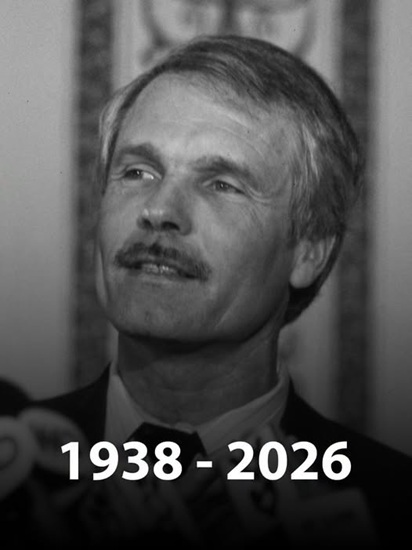
Ted Turner, the influential media entrepreneur who helped reshape modern television, died on May 6, 2026, at the age of 87. Turner Enterprises said he died peacefully while surrounded by members of his family. His passing marked the end of a remarkable life that connected broadcasting, professional sports, philanthropy, environmental conservation and international initiatives. Although he created several major media brands, Turner will always be most closely associated with CNN, the cable network that introduced round-the-clock television news to a mass audience.
Robert Edward Turner III was born in Cincinnati, Ohio, on November 19, 1938. He spent much of his childhood in the American South and eventually became closely identified with Atlanta and the state of Georgia. His first experience in business did not come from television. Instead, it came through the outdoor advertising company built by his father, where Turner learned about sales, competition and expansion.
Turner attended Brown University but did not complete his degree. After the death of his father in 1963, he assumed control of the family billboard company at a relatively young age. The responsibility forced him to become an aggressive business operator quickly. Rather than simply maintaining the company, he expanded it and began looking for opportunities outside traditional advertising.
His attention soon moved toward broadcasting.
In 1970, Turner acquired a struggling UHF television station in Atlanta. At the time, the station had limited reach and competed against larger, more established broadcasters. Turner filled the schedule with older films, syndicated television programs and sports content that could be purchased relatively inexpensively.
The station itself was only the beginning.
Turner became interested in satellite technology and the possibility of distributing a local television signal far beyond its original market. During the 1970s, the Atlanta station began appearing on cable systems around the country. It eventually became one of the best-known examples of what came to be called a “superstation.”
That development was significant because traditional television stations had usually been tied to local geographic markets. Satellite distribution made it possible for one station to reach viewers in many different states. Turner understood early that cable technology could weaken those old boundaries.
His Atlanta station eventually became associated with Turner Broadcasting System, better known as TBS.
Turner built the channel around an unusual combination of movies, syndicated entertainment and live sports. He understood that cable operators needed programming that viewers would actively seek out. Sports became especially valuable because live games encouraged people to watch at specific times and return regularly.
The Atlanta Braves became an important part of that strategy.
Turner acquired the baseball team in the 1970s and used his television station to broadcast Braves games far beyond Georgia. As the superstation reached more homes, baseball fans across the country could regularly watch a team that had once been primarily regional.
This exposure helped give the Braves a national following.
Turner’s approach also demonstrated how media ownership and sports ownership could reinforce each other. The team provided attractive live programming for the television station, while the station gave the team exposure in markets it otherwise might never have reached.
His involvement with the Braves was anything but passive.
Turner was a highly visible owner and became known for his unconventional behavior. During one especially unusual period, he even attempted to manage the team himself for a game. The episode became part of his larger reputation as an executive who was willing to ignore conventional boundaries.
His interest in competition extended beyond baseball and business.
Turner was also a highly accomplished sailor. In 1977, he captained Courageous to victory in the America’s Cup, one of the most prestigious competitions in international sailing. His success brought him recognition beyond the media industry and reinforced his public image as an intensely competitive personality.
But his most consequential business idea was still ahead.
By the late 1970s, television news in the United States remained dominated by major broadcast networks. Viewers generally received national television news at scheduled times, particularly during evening newscasts.
Turner saw a limitation in that system.
If viewers missed a scheduled broadcast, they had to wait for another one. Major events could interrupt normal programming, but there was no major national network devoted entirely to news throughout the day and night.
Turner believed that could change.
His idea was simple to describe but extremely difficult to execute: create a television network that broadcast news twenty-four hours a day, seven days a week.
Many people in the television industry were skeptical.
A permanent news operation would require reporters, producers, camera crews, technical facilities and presenters working around the clock. It would need enough content to fill every hour of every day. There was also no guarantee that enough viewers would watch to support such an expensive operation.
Turner decided to take the risk.
On June 1, 1980, Cable News Network officially began broadcasting.
CNN introduced an entirely different rhythm to television news. Viewers no longer needed to wait for a scheduled evening program. At almost any hour, they could turn on the television and find reporting, interviews, analysis and updates on developing events.
The launch changed more than programming.
It changed expectations.
Under the traditional system, people adjusted their routines around news broadcasts. CNN reversed that relationship. The network remained available continuously, allowing viewers to enter the coverage whenever they wanted.
The early years were difficult.
CNN had fewer resources than the established broadcast networks and faced considerable skepticism. Some industry observers questioned whether the network could survive financially. Others doubted that audiences would want to watch news for so many hours.
Turner continued investing.
He expanded CNN’s operations, hired journalists and built reporting capabilities in different parts of the world. The network gradually became more competitive and increasingly useful when major stories developed without warning.
Breaking news helped prove the value of the format.
A network already devoted entirely to journalism did not need to interrupt entertainment programming before covering an emergency. It could remain with a story for hours, providing updates as new information became available.
That flexibility became one of CNN’s greatest strengths.
Major events during the 1980s helped establish the network. Its international reach grew, and CNN became more recognizable outside the United States as well.
The transformation became especially clear during the Persian Gulf War in 1991.
CNN’s live coverage demonstrated how a twenty-four-hour network could follow an international crisis continuously. Viewers around the world watched events unfold rather than relying only on reports delivered later.
The Gulf War became one of the defining moments in CNN’s history.
It also reinforced the central assumption behind Turner’s original gamble: people wanted access to news while events were happening.
Other companies took notice.
Over time, additional twenty-four-hour news channels appeared in the United States and in other countries. Continuous television news evolved from an unusual experiment into a standard part of the global media industry.
Turner had helped create the modern twenty-four-hour news cycle.
His impact did not stop with CNN.
Turner Broadcasting continued expanding during the 1980s and 1990s. TNT became another major cable network, offering films, television programs and sports.
Cartoon Network created a dedicated destination for animated programming.
Turner Classic Movies developed a separate identity around classic cinema.
Those channels reflected another important Turner idea.
Cable television did not require every network to serve every audience. One channel could focus primarily on news. Another could emphasize movies. Another could serve children and animation fans.
Specialization eventually became a defining characteristic of cable television.
Turner also understood the value of content libraries.
His acquisition of MGM/UA in the 1980s was financially complicated and created substantial pressure on his company. Turner later sold important portions of the business, but he retained access to valuable film and television properties.
Those libraries became useful for programming his growing group of cable channels.
The transaction illustrated the risk-taking style that defined much of his career.
Turner often made extraordinarily ambitious moves.
Some worked brilliantly.
Others created enormous financial problems.
His attempt to take over CBS in 1985 was another example. The effort ultimately failed, but the attempted acquisition showed how dramatically Turner’s position in the industry had changed.
He was no longer simply an outsider running a small Atlanta television station.
He had become a serious challenger to established broadcasting institutions.
By the 1990s, Turner Broadcasting had grown into one of the most important companies in cable television.
Its networks covered news, entertainment, sports, movies and animation.
In 1996, Turner Broadcasting merged with Time Warner in a transaction valued at approximately $7.5 billion.
The deal created one of the largest media combinations of its era.
For Turner, the merger represented a major achievement but also a significant change. He had spent years building a company heavily influenced by his own personality and instincts.
After the merger, his properties existed within a much larger corporate organization.
Turner remained an important executive and shareholder, but he no longer exercised the same independent control.
The situation became even more complicated after the merger of AOL and Time Warner.
The combination was initially promoted as a landmark union between traditional media and the rapidly growing internet sector.
Instead, the transaction became one of the most famous disappointments in American corporate history.
The decline in AOL’s value damaged Turner financially.
His influence within the combined organization also diminished.
Turner eventually left the Time Warner board in 2006.
By that point, the television networks he helped create had become established institutions capable of continuing without him.
His business legacy was already secure.
Yet Turner increasingly focused his attention beyond media.
Philanthropy became one of the defining features of his later life.
In 1997, Turner announced that he would commit up to $1 billion to support United Nations causes.
The pledge was extraordinary in both size and visibility.
At the time, it was widely described as one of the largest charitable commitments ever made by an individual.
The United Nations Foundation was subsequently created to help manage that commitment and support UN-related priorities.
Its work covered areas including global health, peace and security, women and children, international cooperation and environmental challenges.
Turner remained closely associated with the organization for decades.
The scale of his pledge also influenced broader discussions about philanthropy among extremely wealthy individuals.
Turner demonstrated that private fortunes could be committed to global causes at levels usually associated with large institutions.
His philanthropic work also included security issues.
Turner joined former U.S. Senator Sam Nunn in establishing the Nuclear Threat Initiative in 2001.
The organization focused on reducing threats related to nuclear, biological and other dangerous weapons.
Turner had expressed concern about nuclear risks for many years.
The initiative allowed him to direct money and public attention toward those concerns.
Environmental conservation became another major priority.
Turner eventually became one of the largest private landowners in the United States.
His properties covered vast areas and were used in part for conservation, habitat management and wildlife restoration.
He became particularly associated with efforts involving American bison.
Large bison populations were maintained on Turner-owned land.
His conservation activities also extended through organizations such as the Turner Foundation and the Turner Endangered Species Fund.
These groups supported work involving biodiversity, water resources, habitat protection and threatened wildlife.
Turner’s environmental interests occasionally overlapped with his media businesses.
He was involved with the environmental animated series “Captain Planet and the Planeteers,” which debuted in 1990.
The program introduced environmental themes to younger audiences through entertainment.
The Captain Planet Foundation later continued supporting youth-focused environmental projects.
International sports also became part of his broader vision.
Turner created the Goodwill Games during a period of Cold War tension.
The first competition took place in Moscow in 1986.
The Games were intended in part to create another form of interaction between countries after political disputes and Olympic boycotts had affected international sports.
The Goodwill Games never reached the prominence of the Olympics.
Still, they reflected Turner’s characteristic preference for large projects.
He rarely approached an idea cautiously once he believed in it.
Turner’s personality was nearly as well known as his businesses.
He became famous for speaking directly and sometimes provocatively.
His public comments occasionally generated controversy.
He was not known for the restrained public style common among many corporate executives.
That made him highly recognizable.
Supporters saw him as fearless and imaginative.
Critics sometimes viewed him as impulsive or arrogant.
Both characteristics appeared repeatedly throughout his career.
The willingness to take risks helped create CNN.
The same willingness occasionally led to investments that caused serious financial problems.
Turner’s professional story was therefore not simply one of uninterrupted success.
It included mistakes, failed deals, debt and corporate conflicts.
Those setbacks did not prevent him from continuing to pursue new projects.
His personal life also attracted public attention.
Turner married three times and had five children.
His marriage to actress and activist Jane Fonda lasted from 1991 until 2001.
Because both were internationally famous, their relationship received extensive media coverage.
Turner’s family history also contained significant personal hardship.
His father died by suicide in 1963.
The event forced Turner to assume responsibility for the family business while still relatively young.
He later discussed emotional challenges and difficult periods from his life.
His later years brought additional health concerns.
In 2018, Turner publicly disclosed that he had Lewy body dementia.
Lewy body dementia is a progressive neurological condition that can affect thinking, movement and other aspects of daily functioning.
His public appearances gradually became less frequent.
By then, however, the media world he had helped build was already deeply established.
CNN had been broadcasting continuously for decades.
TBS, TNT, Cartoon Network and Turner Classic Movies had become familiar television brands.
His philanthropic institutions had developed histories of their own.
The television industry itself had also changed dramatically.
Cable television had grown from a relatively limited technology into a major force.
Later, cable faced its own disruption from streaming services and digital platforms.
News increasingly moved onto websites, phones and social media.
Yet one principle remained familiar.
Audiences expected news to be available immediately.
That expectation was central to Turner’s original vision for CNN.
Turner did not invent the internet or mobile news.
But his belief that information should be accessible whenever people wanted it anticipated an important part of the modern media environment.
The twenty-four-hour news cycle had advantages and disadvantages.
Continuous coverage allowed audiences to follow wars, elections, disasters and other major events in real time.
Journalists could remain with developing stories instead of compressing everything into short scheduled broadcasts.
International events became easier for distant audiences to follow.
At the same time, permanent news programming created pressure to fill airtime continuously.
Competition intensified.
The distinction between reporting, commentary and entertainment sometimes became more complicated.
Digital media later accelerated those pressures even further.
Those debates are now part of Turner’s complicated legacy.
But they do not change the historical importance of CNN’s launch.
In 1980, a national network devoted entirely to news throughout the day and night was still considered a highly risky experiment.
Turner invested in the idea before anyone knew whether it would succeed.
It survived.
It expanded.
It became internationally recognized.
Competitors copied the model.
Eventually, the concept became so familiar that younger viewers could easily forget how radical it once seemed.
His influence on sports television was similarly important.
Broadcasting Braves games nationally demonstrated how media distribution could broaden a team’s fan base.
The strategy helped show that local sports franchises could become national television properties.
Sports rights later became one of the most valuable categories in media.
Turner understood their importance long before modern rights fees reached their current scale.
He also understood the strategic importance of owning content.
Television distribution was valuable.
Programming people wanted to watch made that distribution much more powerful.
Sports filled his superstation.
Movies supported his entertainment networks.
Animation helped build Cartoon Network.
News created CNN.
The strategy connected many parts of his media empire.
His philanthropy followed a similarly expansive approach.
The $1 billion commitment associated with the United Nations Foundation was not a minor charitable side project.
It became one of the defining actions of his later life.
His conservation work involved millions of acres.
His security initiatives addressed global threats.
Turner consistently pursued projects at unusually large scale.
That was true whether the goal was commercial or charitable.
After Turner’s death, organizations connected with different parts of his life issued tributes.
CNN remembered the founder who had challenged the traditional television news model.
The United Nations Foundation highlighted the unprecedented philanthropic pledge that helped establish the organization.
Sports organizations remembered his involvement with professional teams and sailing.
Environmental groups focused on his conservation work.
The range of those tributes demonstrated how broad his public life had been.
Few media executives were associated with so many unrelated fields.
Turner was simultaneously a broadcaster, sports owner, sailor, philanthropist, conservationist and public personality.
He was also a businessman willing to fail publicly.
Not every major gamble worked.
The MGM transaction created severe financial pressure.
The CBS takeover attempt failed.
The AOL-Time Warner era cost him heavily.
But the failures were part of the same willingness to take risks that produced his greatest successes.
CNN might never have existed if Turner had demanded certainty before investing.
The superstation model might never have expanded under his leadership if he had accepted the limitations of traditional local broadcasting.
His career repeatedly demonstrated a willingness to imagine a media environment that did not yet exist.
The television world eventually moved much closer to that vision.
When Turner began in broadcasting, viewers had relatively few channels.
News arrived mostly at fixed times.
Sports teams had more regional audiences.
Satellite television was still developing.
Cable networks were not yet dominant cultural institutions.
By the time Turner died, television and digital media operated continuously.
News was available every minute.
Sports were distributed globally.
Hundreds of specialized channels and streaming services competed for audiences.
It would be inaccurate to credit Turner alone for that transformation.
Many entrepreneurs, engineers, journalists and companies helped create modern media.
But Turner was one of the people who accelerated the change.
He recognized possibilities in cable and satellite distribution before many established executives fully appreciated them.
Then he invested aggressively in those possibilities.
That is why his legacy extends beyond the individual companies he founded.
He helped change expectations about what television could be.
He showed that a local station could become national.
He demonstrated that a cable news network could operate continuously.
He helped prove that specialized networks could build loyal audiences.
He connected sports ownership with national television distribution.
He later showed that the fortune generated by those businesses could be redirected toward philanthropy and conservation.
Turner Enterprises announced that Ted Turner died peacefully on May 6, 2026, surrounded by family.
He was 87 years old.
His death closed a long and often unconventional public life.
Yet many of the ideas associated with him remain visible every day.
Television news still operates around the clock.
Major stories are followed continuously.
Sports organizations rely heavily on media distribution.
Specialized entertainment networks remain part of the broadcasting landscape.
The organizations created through his philanthropic work continue operating as well.
Turner’s legacy is therefore neither simple nor limited to one achievement.
His outspoken personality generated controversy.
Some business decisions failed.
Some investments cost him heavily.
His innovations also contributed to a faster and more competitive media culture that continues to generate debate.
At the same time, his importance as a media pioneer is difficult to dispute.
The most lasting symbol of that influence remains CNN.
Turner imagined a television network that would never stop reporting news.
The idea sounded excessive to many people when he proposed it.
On June 1, 1980, he turned it into reality.
Decades later, continuous news became so ordinary that audiences often expected important information to appear immediately.
That expectation now extends far beyond television.
News websites update constantly.
Phones send breaking-news alerts.
Livestreams begin within minutes.
Social platforms carry events around the world in real time.
The technology changed dramatically.
The demand for constant access remained.
Ted Turner was one of the people who recognized that demand before it became obvious.
He turned a family billboard business into a major media empire.
He built television brands that reached millions of homes.
He changed sports broadcasting.
He committed extraordinary amounts of money to philanthropy.
He protected large areas of land and wildlife.
He spent much of his life making decisions that other people considered too ambitious.
Some of those decisions failed.
Others changed entire industries.
That mixture of risk, success and controversy made Turner one of the most distinctive media figures of the twentieth and early twenty-first centuries.
His death marks the end of the person behind the original CNN gamble.
The idea itself continues.
Around the world, television news remains available every hour of every day.
The media landscape has evolved far beyond the cable system Turner entered decades ago, but the basic principle he helped popularize remains deeply embedded in modern journalism.
News no longer waits for a scheduled hour.
For better and for worse, it never really stops.
That is one of Ted Turner’s most enduring legacies.

