

When Jeni Bonell first met Ray, becoming the mother of an exceptionally large family was nowhere in her plans. She has recalled that she did not initially want children, while Ray imagined eventually becoming a father to at least four. At the time, even that number seemed enormous to Jeni. Her perspective changed after she became a mother, however, and the couple’s family continued growing over the years. Eventually, Jeni and Ray became parents to 16 children, creating a household that has attracted considerable public interest in Australia.
The Bonells are based in Toowoomba, Queensland, and their family consists of nine boys and seven girls. Earlier reporting has identified their children as Jesse, Brooke, Claire, Natalie, Karl, Samuel, Cameron, Sabrina, Tim, Brandon, Eve, Nate, Rachel, Eric, Damian and Katelyn. Because interviews about the family were published at different times, the ages quoted in older articles should not be treated as their current ages. Several of the oldest children have since reached adulthood, moved away from home and begun families of their own.
Jeni has explained that her change of heart about motherhood happened gradually rather than through one dramatic decision. She initially became comfortable with the possibility of one or two children. After experiencing parenthood, she found herself wanting another child, and the family’s path eventually led far beyond the four children Ray had originally imagined. The couple has consistently described their unusually large household as the arrangement that ultimately felt right for them, while acknowledging that the same choice would not suit every family.
Daily life naturally requires organization on a scale that most households never encounter. Food is one of the clearest examples. In a 2019 interview with Mamamia, Jeni estimated that grocery shopping generally cost the family around A$600 per week at that time. The figure reflected their circumstances during that period rather than a permanent present-day budget, since food prices and the number of children living at home have changed over the years.
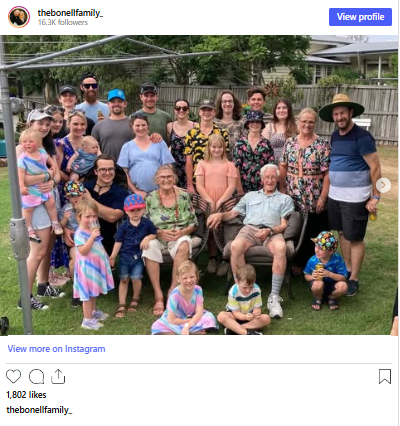
The quantities involved could be remarkable. Jeni said the household went through approximately 50 litres of milk each week and could use one or two loaves of bread every day. Shopping therefore required more than simply deciding what the family wanted for dinner. Jeni had to consider quantities, prices, storage space and which products could be purchased economically in larger amounts. She also looked for discounted items and tried to stock up when regularly used products were available at better prices.
Meal planning was equally important because the number of people eating at home could vary significantly. Jeni has said that some evenings might involve approximately eight people at the dinner table, while larger gatherings could bring the number above 20. Older children had work, study and other commitments, and some had already moved into their own homes. That meant cooking required flexibility rather than preparing exactly the same quantity every night.
Instead of relying on expensive or complicated meals, the family became accustomed to preparing relatively simple dishes in substantial quantities. Practicality mattered when food needed to serve a crowd. Jeni has also shared aspects of the family’s meal preparation and grocery shopping publicly, demonstrating how planning and familiar ingredients can help make large meals more manageable. Her approach has emphasized budgeting and organization rather than suggesting there is a single perfect way to feed a large household.
Cooking skills are also shared within the family. Jeni has spoken about teaching the children how to prepare food rather than allowing them to depend entirely on their parents. During an earlier interview, she said that one of her children, then 12 years old, could prepare a roast dinner for approximately 20 people with little supervision. Learning to cook served two purposes: it helped the household function while also giving the children practical skills they could use as adults.

The same principle applies to cleaning and other responsibilities. The Bonells developed a roster system to distribute age-appropriate household jobs among the children. Jeni has said that children generally begin participating in the roster from around age eight. Tasks can include sweeping, mopping, clearing the table, helping with meals and completing other routine jobs. Responsibilities can change as the children grow older and their school, work or extracurricular schedules become different.
Jeni has explained that the family introduced the system after realizing that attempting to do everything herself was neither practical nor particularly helpful for the children. If one person performed every household task, the workload would become overwhelming while the children would miss opportunities to develop independence. The roster therefore became part of everyday family life rather than a temporary response to an especially busy period.
Laundry is another ordinary chore that becomes extraordinary when multiplied across such a large household. In her 2019 interview, Jeni described completing three loads each day using a 10-kilogram washing machine. She estimated that this was comparable to roughly six loads in a more typical machine. Washing is only one part of the process, of course. Clothes also need to be dried, folded, sorted and returned to the correct family members.
School routines have required similarly careful coordination. At different points, Jeni has had children attending multiple schools simultaneously while older siblings were studying, working or beginning careers. Sporting activities and part-time employment added additional commitments. She has remarked that she once assumed raising many small children would represent the busiest period of her life, only to discover that coordinating teenagers and older children could be even more complicated.
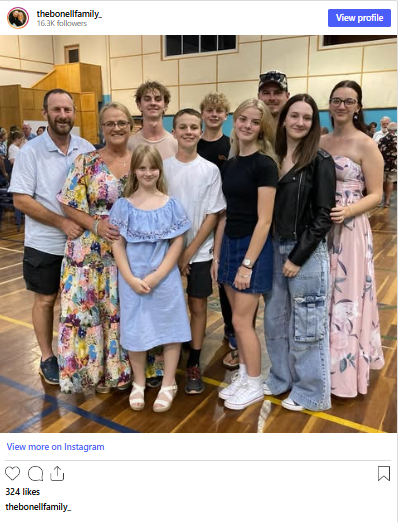
Transportation consequently became another major part of the family’s routine. Getting numerous children to different destinations at different times requires planning well beyond the standard school run. As children became old enough to work or pursue separate activities, their schedules increasingly moved in different directions. Organization, communication and preparation became essential for keeping the household functioning without every day turning into an avoidable scramble.
Despite the logistical challenges, family dinners have remained important. The number of people present might change considerably, but sitting down together provided an opportunity for whichever family members were home to reconnect. Some evenings were understandably hectic, while others ran more smoothly. Jeni has spoken about accepting that unpredictability rather than expecting a household with so many people to operate perfectly at every moment.
Even taking a family photograph can become an amusing challenge. Coordinating 18 people means there is a strong chance that someone will blink, look away or make a funny expression just as the picture is taken. Jeni has joked about needing a wide lens to fit everyone into the frame. Rather than seeing imperfect photographs as failures, the family has treated those small quirks as an authentic reflection of their busy life together.
Financial planning has always been another significant consideration. Raising 16 children involves expenses that cannot simply be ignored, and Jeni has openly acknowledged that maintaining a very large family requires sacrifices. Housing, groceries, clothing, school-related expenses, transportation and countless smaller purchases all need to fit within a household budget. The Bonells have therefore emphasized knowing what money is coming in and understanding where it is being spent.
As the children became teenagers, employment also became part of their education in responsibility. In later reporting, Jeni explained that the children generally began taking part-time jobs when they reached an appropriate age. Earning their own money helped them understand the relationship between work, spending and saving. It could also allow older children to pay for some discretionary purchases themselves rather than expecting their parents to provide everything they wanted.
The family’s financial circumstances have naturally changed as the children have grown. Older articles described many more children living under the same roof, while later reporting showed that several had already moved out. A 2022 report, for example, said nine of the 16 children were still living at home at that point. Consequently, older grocery totals and household figures should be understood as snapshots from particular periods rather than current measurements that remain unchanged indefinitely.
Faith has also been discussed in coverage of the Bonell family. Jeni and Ray have spoken publicly about their Christian beliefs and involvement with church. However, Jeni has pushed back against reducing their decision to have a large family solely to religion. Their own explanation has focused on how their attitude toward parenthood evolved over time and how continuing to expand the family ultimately felt appropriate for them.
Another deeply personal part of their history involves pregnancy loss. Jeni has previously said that she and Ray experienced the loss of seven babies. She has discussed how those experiences affected the way she thought about pregnancy and motherhood. This aspect of their story adds important context to the dramatic transformation between Jeni’s early belief that she did not want children and the life she eventually built as a mother of 16.
Ray has worked as an electrician, while both parents have had to balance employment and family responsibilities. Their household has required teamwork rather than depending entirely on one parent. They have also emphasized the importance of maintaining their relationship as a couple despite the demands surrounding them. Finding time together may require planning, but Ray has spoken publicly about the importance of partners continuing to make time for one another.
Over the years, the family has gradually entered a new phase. Some of the oldest Bonell children have married and established households of their own, and Jeni and Ray have become grandparents. The transition illustrates how a large family does not remain frozen in the period when all the children are young and living together. The structure constantly changes as children grow, leave home and create lives of their own.
Those changes also mean that descriptions of the Bonells from different years can look very different. One interview may describe 11 children still living at home, while a later report may mention nine. Ages, grocery spending and schedules also change. Accurate accounts therefore need to identify older figures as historical information rather than automatically presenting them as current facts.
What remains consistent is the family’s reliance on systems. Chore rotations, advance preparation, meal planning, shopping strategies and shared responsibilities allow routine tasks to be divided into manageable pieces. None of those techniques is particularly unusual on its own. What makes the Bonells distinctive is the scale at which they have had to apply them.
Their experience also provides a useful reminder that large-family life should not be romanticized as effortless. Jeni has openly discussed the cost, workload and sacrifices involved. A household of this size produces more laundry, more food preparation, more scheduling conflicts and more financial pressure. At the same time, the Bonells have repeatedly described their family as something they value deeply and have chosen to manage through cooperation and planning.
Nor do Jeni and Ray present their choices as instructions for other people. Family size is a personal matter shaped by finances, health, circumstances, values and individual preferences. What worked for them would not necessarily work for another couple. Their story is notable precisely because their household is unusual, not because it represents a standard that other families are expected to follow.
Perhaps the most remarkable element is how different Jeni’s eventual life became from the future she originally imagined. She once thought Ray’s hope for four children sounded excessive and initially did not see motherhood as part of her plans. Decades later, they had four times that number. What began as a disagreement about whether to have children developed gradually into an enormous family that neither of them could have fully pictured when they first met.
Behind the headline-grabbing number of 16 children are ordinary family responsibilities magnified many times over. Meals still need to be prepared, clothes still need washing, children still need transportation, bills still need paying and relationships still require attention. The Bonells’ solution has been to rely on organization, shared responsibilities and flexibility as their family has moved through different stages of life.
Today, older reports about the family offer snapshots of an evolving household rather than a single permanent picture. The children who were once described as teenagers have continued growing, and the family structure has continued changing. What those interviews consistently document is how Jeni and Ray adapted everyday routines to the unusual scale of their household.
From enormous grocery trips to rotating chore schedules and crowded family dinners, the Bonells built systems around the practical demands of raising 16 children. Their experience does not suggest that such a life is simple or suitable for everyone. Instead, it shows how one Australian family responded to an extraordinary household size with planning, teamwork and a willingness to adjust as circumstances changed — a life far removed from the future Jeni once expected for herself.

