
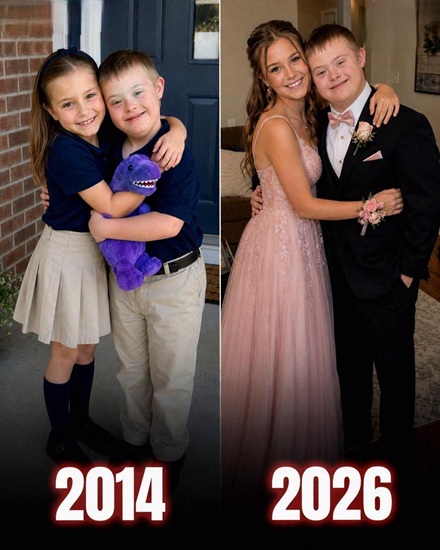
I was six when I made a promise to Noah that I assumed would disappear along with most of our childhood plans. We met during first grade and became friends for reasons that seemed incredibly important at the time: neither of us liked raisins, and both of us were fascinated by dinosaurs. Noah had Down syndrome, but that was only one part of the person I knew. He was funny, determined, occasionally stubborn and astonishingly good at remembering baseball statistics.
He was also brutally honest about my artwork, once informing me that the people I drew looked like “potatoes that learned how to walk.” Our friendship developed naturally. We sat together whenever we could, traded snacks during lunch and argued about which dinosaur would win imaginary battles. Noah rarely allowed me to win an argument simply because we were friends. If he disagreed with something, I heard about it immediately. At the same time, he had an unusual ability to notice when something was bothering me.
Long before either of us understood complicated adult relationships, we understood something simpler: we enjoyed being around each other, and we could depend on each other. The promise that followed us into adulthood began on an ordinary afternoon. Our first-grade teacher announced that she was getting married, and the classroom immediately became chaotic with questions about dresses, cakes and weddings. Noah announced that his own wedding would someday have an enormous chocolate cake and absolutely no slow music. According to him, slow songs were pointless because nobody could dance properly to them. Most of us laughed, but another boy sitting nearby responded differently.
“Who’s going to marry you?” he asked Noah. “Nobody will.”
I didn’t fully understand the assumptions behind the comment. I simply saw what happened to my friend.
Noah stopped smiling.
I immediately told the other boy that he was wrong.
“Somebody will love Noah.”
Noah turned toward me.
“Would you?”
At six years old, this seemed like a perfectly reasonable question.
“Maybe,” I answered. “But first we’re going to prom.”
He looked confused.
“What’s prom?”
I explained that it was a big dance people attended when they were almost grown up.
Noah held out his pinkie.
“Promise?”
I wrapped mine around his.
“Promise.”
Twelve years passed, and somehow Noah never forgot.
We grew up together without having identical lives. Some years we shared classes, while during others our schedules barely overlapped. We developed different interests and met new friends, but we remained part of each other’s lives. When my parents divorced, Noah never pretended he had a magical solution. He sat beside me, listened when I wanted to talk and distracted me when I didn’t. Sometimes support meant discussing my family. Other times it meant listening to him explain baseball statistics I had absolutely no interest in learning.
Years later, my first serious relationship ended badly. I spent several days convinced that my entire world had collapsed.
Noah arrived with ice cream.
“I told you he was an idiot,” he said.
“You say that about every boy.”
“Yes.”
“That doesn’t make you right.”
He opened the ice cream.
“So far, my record is perfect.”
I laughed despite myself.
Those were the moments that defined our friendship far more than the childhood promise did.
By senior year, prom was approaching quickly. People were discussing dresses, suits, dates and after-parties, but I already knew who I wanted to go with. When Noah reminded me of the promise we had made in first grade, I didn’t treat it as an obligation.
I wanted to go with him.
He was my best friend.
There was no dramatic announcement and no grand gesture. We simply agreed that the promise still stood.
On prom night, I was upstairs finishing my hair when the doorbell rang. I heard my mother answer it.
Then everything downstairs became strangely quiet.
Noah had arrived wearing a carefully fitted dark suit and bow tie. He held my corsage in one hand and looked enormously pleased with himself. Normally, Mom would have greeted him immediately. She had known him for years and had always welcomed him into our home.
This time, something was different.
When Mom saw Noah dressed for prom, her expression changed.
She stared at him for several seconds.
Then she recovered, smiled and told him I would be downstairs shortly.
A minute later, she appeared in my bedroom.
She closed the door.
Then she locked it.
I turned away from the mirror.
“What’s going on?”
Mom sat on the edge of my bed.
“You can go to prom with Noah.”
I stared at her.
“I know.”
“But there’s one condition.”
I laughed nervously.
“Home before midnight?”
“No.”
Her hands were shaking.
“You need to know something first.”
The expression on her face made my stomach tighten.
“What?”
“Something about Noah’s family. And something I should have told you years ago.”
I sat beside her.
Mom explained that the story of our friendship had actually begun before either Noah or I was born.
She had known Noah’s mother years earlier.
The two women had once worked at the same community center and had become close friends. Eventually their lives moved in different directions. Jobs changed, addresses changed and regular conversations became occasional ones.
Then both women became pregnant within a relatively short period of each other.
Their friendship briefly returned.
Mom told me that she had been frightened about becoming a parent. Money was tight, her relationship with my father was already experiencing difficulties, and she often questioned whether she was prepared for motherhood.
Noah’s mother was navigating her own transition into parenthood.
When Noah was born and his family learned he had Down syndrome, they suddenly had additional information to understand while adjusting to life with a newborn.
Mom remembered visiting them.
She expected Noah’s mother to talk about fear.
Instead, she talked about expectations.
According to Mom, Noah’s mother wanted one thing understood clearly: her son should have opportunities to develop his own personality, interests and relationships without constantly being reduced to a diagnosis.
She didn’t want people automatically feeling sorry for him.
She wanted them to know him.
Mom never forgot that conversation.
Several months later, I was born.
For a while, the two families remained in contact. Eventually another change in circumstances separated them, and regular communication faded again.
Years passed.
Then I came home from my first weeks of school talking constantly about a boy named Noah.
I told Mom about the raisins.
I told her about the dinosaurs.
I complained about his criticism of my drawings.
Eventually, she realized exactly whose child he was.
“You knew Noah before I did?” I asked.
“Technically,” Mom answered.
“Why didn’t you tell me?”
Her answer surprised me.
“Because I didn’t want you to think you had to be his friend.”
She explained that once she realized who Noah was, she deliberately avoided making the connection into something important for me.
She did not want our friendship to become an assignment inherited from our mothers.
She wanted us to choose it.
And we did.
Year after year.
Still, that didn’t explain why she had chosen prom night to reveal everything.
Mom looked down at her hands.
Then she told me about another memory.
When Noah and I were younger, an adult had once watched us playing together and described me as a “wonderful little girl” for taking care of him.
Mom had been deeply uncomfortable with the comment.
Not because helping someone was wrong, but because the description completely misunderstood our relationship.
I wasn’t Noah’s caretaker.
I was his friend.
And he had supported me just as often as I had supported him.
Mom had watched Noah sit beside me during the divorce.
She had watched him make me laugh when I was heartbroken.
She had watched us argue, forgive each other and grow up.
Reducing all of that to me doing something kind for a person with Down syndrome erased Noah’s contribution to our friendship.
As prom approached, Mom worried that people might make the same assumption again.
She knew there might be comments about how “sweet” or “generous” I was for attending prom with Noah.
That was why she had stopped me.
Her condition had nothing to do with preventing me from going.
It was exactly the opposite.
“If somebody treats Noah like he’s your charity project tonight,” she said, “don’t agree with them just to be polite.”
I stared at her.
“That’s your condition?”
“Yes.”
Her voice softened.
“You’re not taking Noah to prom. You’re going to prom together.”
That distinction stayed with me.
Mom was not asking me to become Noah’s defender in every conversation. He was perfectly capable of speaking for himself.
She was asking me not to participate in a version of our friendship that wasn’t true.
I hugged her and went downstairs.
Noah looked immediately at the clock.
“What took you so long?”
“Mom was telling me something.”
He shook his head.
“She talks too much.”
Mom heard him.
“I can still cancel your invitation into this house, Noah.”
He grinned.
“No, you can’t. You like me.”
She laughed.
He was right.
Noah carefully fastened the corsage around my wrist, and we posed for more photographs than either of us wanted.
Then we left.
Prom was not a life-changing movie scene.
It was better than that.
It was normal.
We ate mediocre food, took ridiculous pictures with our friends and spent far too much time arguing about the music.
When the DJ played a song Noah liked, he immediately pulled me toward the dance floor.
He danced with enormous confidence and questionable technique.
I wasn’t much better.
Later, one of our classmates approached us.
She knew about our childhood promise.
She smiled at me.
“This is so sweet of you.”
I immediately remembered Mom’s words.
Before I could respond, however, Noah did.
“Sweet of her?”
The classmate looked uncertain.
Noah pointed toward himself.
“I had plenty of options.”
There was a moment of silence.
Then all three of us laughed.
Noah had handled the situation himself, exactly as he had handled countless situations throughout our friendship.
I realized that Mom’s lesson worked in both directions.
Respecting Noah didn’t mean jumping in front of him every time someone said something awkward.
Sometimes respect meant letting him answer for himself.
He wasn’t fragile.
He didn’t need every uncomfortable moment removed from his path.
He needed the same thing everyone else deserved: the freedom to speak, make choices, build relationships and be recognized as a complete person.
Near the end of the evening, the DJ announced a slow song.
Noah groaned.
“This is exactly what I warned everyone about in first grade.”
“You still remember that?”
“I remember everything important.”
We walked onto the dance floor anyway.
For a moment, I thought about the six-year-old version of myself sitting beside him at that classroom table.
We had believed adulthood was unimaginably far away.
Yet there we were.
The promise had survived twelve years.
More importantly, the friendship had survived them too.
We had experienced changing classrooms, family problems, disagreements, new friends and heartbreak.
Neither of us had carried the other through all of it.
We had carried parts of it together.
That became the real meaning of the evening.
Our friendship wasn’t valuable because I had befriended someone with Down syndrome.
It was valuable because Noah and I genuinely mattered to each other.
His diagnosis was a real part of his life and experiences, but it was never the complete definition of his personality.
He was funny.
He was stubborn.
He loved baseball far more than I ever would.
He hated raisins.
He believed slow songs were a waste of everyone’s time.
And he remained convinced that my artistic ability peaked sometime around second grade.
After graduation, adulthood gradually changed the rhythm of our friendship. We no longer saw each other automatically because school placed us in the same building every day.
We developed separate responsibilities.
We met new people.
But distance did not erase our history.
Whenever I remembered prom, the first thing that came to mind was not Down syndrome.
It wasn’t even my mother’s revelation.
I remembered Noah standing outside our house with my corsage, looking as though he had just won the biggest baseball game imaginable.
I remembered his jokes.
I remembered dancing badly.
And I remembered finally understanding something my mother had recognized years earlier.
Friendship is not measured by which person appears to need more help.
Real friendship moves in both directions.
Sometimes I supported Noah.
Sometimes he supported me.
Sometimes neither of us needed support and we simply enjoyed being together.
The promise we made at six gave our story a memorable beginning, but keeping that promise was never the most important part.
The twelve years between the promise and prom were what mattered.
Those years transformed two children who happened to like dinosaurs into two people who understood each other’s strengths, flaws and ridiculous habits.
Mom’s revelation didn’t change my decision that evening.
I was always going to prom with Noah.
What it changed was my understanding of the history surrounding us.
Our mothers had known each other before we existed.
They had shared fears about becoming parents.
Then life separated them, only for their children to independently find each other years later.
Maybe that coincidence made the story unusual.
But it didn’t create our friendship.
Noah and I did that ourselves.
And that was exactly why Mom had kept the truth from me for so long.
She wanted our friendship to belong to us.
Twelve years after a pinkie promise made in first grade, it still did.

