
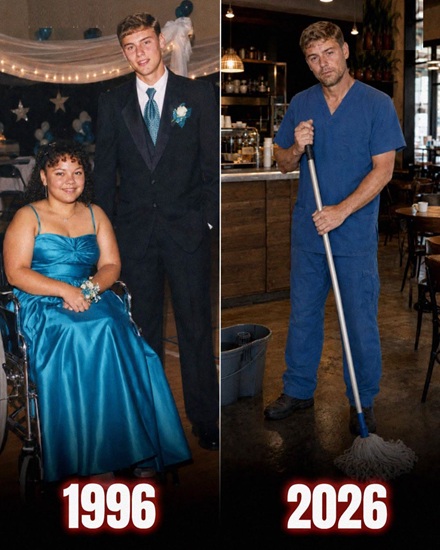
Six months before my senior prom, everything I thought I understood about my future changed. I was seventeen, busy worrying about school, dresses, friendships and all the ordinary things that seemed enormous at that age. Then a serious car accident left me badly injured and facing months of rehabilitation. My legs were broken, my spine had been damaged, and suddenly the conversations around me were no longer about college or prom. They were about mobility, recovery and what kind of independence I might eventually regain.
By the time prom arrived, I wanted nothing to do with it. I was tired of people looking at me differently and even more tired of wondering whether their kindness came from pity. My wheelchair had become part of my daily life, but emotionally I was still trying to understand what had happened. When my mother brought my dress into my room and encouraged me to go, I told her I would rather stay home than spend the evening being watched.
She refused to let me disappear.
My mother reminded me that the accident had already taken enough from me. It did not deserve to take every experience that came afterward as well. I did not feel brave, and I definitely did not feel ready, but eventually I agreed.
That evening she helped me get dressed and made sure everything was comfortable before taking me to the school gym.
The room was filled with music, decorations and classmates who seemed to move effortlessly through a world that now felt unfamiliar to me. Friends came over to compliment my dress, take photographs and tell me they were glad I had come. I smiled, thanked them and watched as they gradually returned to the dance floor.
For most of the first hour, I stayed near the edge of the room.
Then Marcus walked over.
He stopped directly in front of me and asked whether I wanted to dance.
I thought I had misunderstood him.
“Marcus, I can’t dance,” I said.
He simply nodded.
“Then we’ll figure out what dancing means tonight.”
Before I had enough time to become embarrassed, he guided my wheelchair onto the dance floor. I could feel people looking in our direction, and every instinct told me to retreat.
Marcus, however, acted as though nothing unusual was happening.
He took my hands and moved with the music. Then he carefully turned my chair in a small circle.
When he saw me smile, he spun me again.
I started laughing.
For those few minutes, I stopped thinking about hospital rooms, doctors or everything my body could no longer do. I was simply a teenager at prom dancing with someone who had asked me because he wanted to.
When the song ended, Marcus brought me back toward the table.
I asked him why he had done it.
He shrugged.
“Because nobody else asked.”
I never forgot that answer.
A few weeks after graduation, my family moved so I could continue rehabilitation closer to specialists. Life became a cycle of appointments, surgeries and physical therapy.
Marcus and I lost contact.
At first, I assumed I would eventually return and see everyone again. Then months turned into years, and the people from high school slowly became memories.
My recovery took much longer than I had expected.
I learned how to transfer safely from a wheelchair. Later I learned to stand with support and eventually to walk short distances.
There were good days and terrible ones.
What surprised me most was how differently I began seeing the world around me.
Buildings that had once seemed ordinary suddenly revealed barriers everywhere.
Entrances had steps without ramps. Bathrooms were difficult to navigate. Accessible doors were sometimes hidden around the back of buildings as though people with mobility challenges were supposed to remain invisible.
That frustration eventually shaped my career.
I studied architecture and became increasingly interested in accessible design. College took longer than I had planned, but I finished and found work with several design firms.
Years later, I opened my own company.
Our goal became simple: create spaces that did not merely satisfy accessibility rules but actually made people feel welcome.
By the time I reached fifty, my life looked nothing like the future I had imagined at seventeen.
Then one afternoon, near one of our construction sites, I walked into a small café and accidentally spilled coffee across the counter.
A man working nearby immediately came over to help.
He wore medical scrubs beneath a café apron and walked with a noticeable limp.
He cleaned the spill, found napkins and arranged for another coffee before I could protest.
When he looked at me, something about his face felt familiar.
He seemed to notice the same thing.
“You look familiar,” he said.
I studied him more closely.
The years had changed him, but his eyes had not.
The following afternoon, I returned to the café.
When he came near my table, I finally said what I had been thinking all night.
“Thirty years ago, you asked a girl in a wheelchair to dance at prom.”
He stopped completely.
Then he whispered my name.
“Emily?”
It was Marcus.
We sat down together, and three decades seemed to collapse into one conversation.
I learned that his life had changed soon after graduation. His mother became seriously ill, and with his father no longer around, Marcus began working to help support her.
Football, scholarships and other plans gradually disappeared.
He worked wherever he could.
Warehouses, delivery routes, maintenance jobs and medical support work all became part of his life.
Eventually he injured his knee but continued working because stopping did not seem financially possible.
When I asked why he had never received proper treatment, he gave me a tired smile.
“There was always something else that needed the money.”
I began visiting the café regularly.
At first, we simply talked.
He told me about his mother, his jobs and the way years seemed to disappear when survival became the only priority.
I told him about rehabilitation, architecture and how the accident had eventually influenced the work I chose to do.
When I offered financial help, Marcus refused immediately.
I understood why.
So instead of offering charity, I offered him a job.
My firm was developing an adaptive recreation center, and we needed people who understood disability, injury and the emotional side of losing physical abilities.
Marcus insisted he was not qualified.
I told him that was exactly why I wanted him there.
He eventually agreed to attend one planning meeting.
During that meeting, our designers showed him the plans and asked what we might be missing.
Marcus studied them quietly.
Then he pointed to an accessible entrance located near a service area.
“You’ve made it possible for someone with a wheelchair to get inside,” he said. “But you’ve also made them enter through the place nobody else uses.”
The room became silent.
He continued.
“Accessible isn’t the same thing as welcoming.”
He was right.
That meeting led to another.
Soon Marcus was helping us understand details that drawings and regulations could not teach.
His consulting work gradually became regular employment.
At the same time, he finally agreed to see a specialist about his knee.
The damage could not be completely reversed, but treatment and physical therapy reduced his pain and improved his mobility.
One afternoon after an appointment, he admitted something quietly.
“I thought this was just how the rest of my life was supposed to feel.”
I understood exactly what he meant.
Months later, while sorting through an old box at home, I found the photograph from prom.
Marcus and I were on the dance floor, both smiling.
I brought it to the office.
He picked it up carefully.
“You kept this?”
“Of course.”
Then he told me something I had never known.
He had tried to find me after high school.
By the time he learned my family had moved, his mother’s illness had taken over his life.
Years passed.
Then decades.
“I thought you forgot about me,” I said.
Marcus shook his head.
“I wondered about you for thirty years.”
That was the moment our relationship began changing.
Not suddenly.
Not like a movie.
We were two adults with complicated lives, old injuries and decades of experiences between us.
But slowly, friendship became something deeper.
Marcus became an important part of the recreation center.
He eventually began training coaches and mentoring young people recovering from major injuries.
He never promised them that everything would return to the way it had been before.
Instead, he reminded them that losing one version of themselves did not mean losing their entire identity.
Months later, our community center finally opened.
Families filled the building, children explored the gym and music played through the main hall.
Marcus found me standing near the edge of the crowd.
He walked over, smiled and held out his hand.
“Would you like to dance?”
For a moment, I was seventeen again.
But this time I did not hesitate.
I took his hand.
“We already know how.”

