
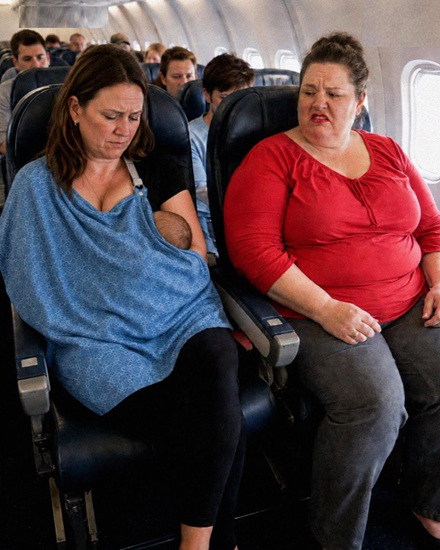
Only a month had passed since I buried my husband, Mark, when I boarded a six-hour flight with our two children. My mother had invited us to stay with her for a while, hoping a change of surroundings might give us some relief from the grief filling every corner of our home. Louise was eight, while Noah was only five months old. I wasn’t expecting the trip to fix anything. I simply wanted a few days when waking up did not immediately remind me that Mark was gone. Cancer had taken him at thirty-seven after nine difficult months.
Before his illness, Mark had been the person who remembered everything I forgot and somehow remained calm whenever I became overwhelmed. After his death, even ordinary tasks felt unfamiliar. I still occasionally reached toward his side of the bed at night before remembering. While packing for the trip, I placed one of his blue sweaters in my carry-on even though I had no reason to bring it. Louise noticed but didn’t say anything.
Instead, she put her favorite stuffed rabbit beside the sweater.
The airport was difficult enough, but boarding brought another complication. The flight was full, and our assigned seats placed Louise in the row directly behind me. I sat in the aisle seat with Noah while she reassured me that she could see me through the gap between the seats. She was trying to sound independent, but I knew the previous month had frightened her too.
The woman sitting beside me seemed irritated almost immediately.
She looked at Noah and warned me that she did not want to listen to a crying baby for the entire flight.
I was too exhausted to argue.
“I’ll do everything I can,” I said.
She responded that parents always said that before everyone around them ended up suffering.
Louise leaned forward.
“My brother is usually really good on planes.”
The woman barely acknowledged her.
I gave Louise a small look that told her not to continue.
For nearly two hours, Noah slept.
I watched the clouds beneath us and tried not to think about Mark’s final weeks. Every once in a while, Louise reached forward to touch my shoulder, almost as though she needed confirmation that I was still there.
Then Noah woke.
At first, he whimpered.
Within seconds, he was crying.
I checked his diaper, offered his pacifier and rocked him against my shoulder.
Nothing worked.
He was hungry.
I carefully arranged a nursing cover and began feeding him.
The crying stopped almost immediately.
The woman beside me, however, became even more upset.
She suggested that I should take Noah into the airplane bathroom if I needed to feed him.
I told her calmly that a restroom was not an appropriate place for a baby to eat.
She shook her head.
“People shouldn’t have to see this.”
I felt my face becoming warm.
Normally I might have ignored the comment. But after everything I had endured during the previous month, I had very little emotional energy left.
“He’s five months old,” I said. “He’s hungry. I’m feeding him.”
That should have ended the conversation.
It didn’t.
The woman continued making remarks about parents who traveled with babies and questioned why I couldn’t keep my child quiet without making other passengers uncomfortable.
Then Louise appeared beside us.
“Mom,” she said, “take my seat.”
I shook my head.
“You don’t need to do that.”
“I know.”
She looked at the woman.
“But I want to.”
Eventually, I moved one row forward while keeping Noah safely against me.
Before I changed seats, Louise leaned close and whispered something.
“She dropped a picture.”
I didn’t understand what she meant.
Several minutes later, I saw Louise bend down and retrieve a small photograph from the floor beside the woman’s shoe.
The woman noticed.
“That belongs to me.”
“I know,” Louise replied. “You dropped it.”
Louise’s tablet was open on her lap.
On its screen was a photograph of me holding Noah while Louise rested against my shoulder.
She placed the woman’s photograph beside it.
Then she asked a remarkably simple question.
“Would you want someone talking to your daughter the way you talked to my mom?”
The woman stared at her.
For several seconds, she didn’t answer.
Then she looked at the photograph.
The woman pictured there was holding a baby.
“My daughter,” she finally said.
She pointed toward the infant.
“And that’s my grandson.”
Louise waited.
“Would you want someone treating her like that?” she asked again.
The woman’s expression changed.
“No.”
Louise nodded.
“Then please don’t do it to my mom.”
There was no shouting.
No dramatic confrontation.
Just an eight-year-old asking someone to apply the same compassion to a stranger that she would want shown to her own child.
After Noah finished eating, I returned to my original seat.
The woman was holding the photograph carefully.
“My name is Evelyn,” she said.
I introduced myself.
Then she told me something unexpected.
She had never met the grandson in the photograph.
Her daughter, Jenna, had invited her several times, but their relationship had become strained.
“Why?” I asked.
Evelyn hesitated.
“I don’t approve of many of her choices.”
She listed several disagreements involving Jenna’s lifestyle, her partner and the way she was raising her child.
Then Evelyn admitted something that made the entire encounter suddenly clearer.
She was traveling to meet her grandson for the first time.
She had spent much of the flight mentally preparing everything she wanted to tell Jenna she was doing wrong.
I looked down at Noah.
“You didn’t know anything about me either,” I said.
Evelyn lowered her eyes.
“No.”
I decided to tell her what she could not possibly have known.
“My husband died a month ago.”
She looked at me immediately.
I explained that Mark had been thirty-seven and that cancer had taken him after nine months of illness.
“I am trying to learn how to raise these children without their father,” I said. “You watched me for a few minutes and decided you already knew what kind of mother I was.”
Evelyn’s eyes filled with tears.
“I’m sorry.”
I believed she regretted what she had said.
But regret and change were not necessarily the same thing.
“Don’t apologize because my daughter made you uncomfortable,” I told her. “Apologize because you understand why what you said was unfair.”
She remained quiet for a moment.
Then she nodded.
“I understand.”
Evelyn took out her phone.
“I need to message Jenna.”
She opened their conversation but hesitated.
“What should I say?”
I smiled slightly.
“I can’t write your apology.”
“I don’t know where to start.”
“Tell her what you did wrong without explaining why you were justified. Then tell her what you intend to do differently.”
Evelyn began typing.
She told Jenna that she realized she had spent too much time judging her decisions from a distance.
She admitted that she had been preparing to arrive with criticism rather than support.
Then she wrote that she wanted to meet her grandson without telling Jenna how she should raise him.
She pressed send.
We waited.
Ten minutes later, a reply appeared.
Jenna told her mother she could still come.
But there was a condition.
She needed Evelyn to genuinely mean what she had written.
Evelyn read the message several times.
“Do you think she believes me?” she asked.
“She doesn’t have to believe you yet,” I said. “You have to show her.”
That seemed to affect Evelyn more than anything else I had said.
An apology could be written in minutes.
Changing behavior would take much longer.
When our flight landed, we walked toward baggage claim together.
My mother was waiting for us near the arrivals area.
Before reaching her, however, I noticed Evelyn suddenly stop.
A younger woman stood near the baggage carousel with a baby resting against her chest.
It was Jenna.
Evelyn approached slowly.
She did not immediately reach for her grandson.
Instead, she stopped several feet from her daughter.
“May I hug you?”
Jenna hesitated.
Then she nodded.
They embraced briefly.
I couldn’t hear what Evelyn whispered afterward, but Jenna listened.
There was no dramatic reconciliation.
No instant solution to years of disagreement.
But they walked toward the baggage carousel together.
Sometimes a beginning is enough.
Several weeks later, while we were still staying with my mother, an envelope arrived.
Inside was a photograph.
Evelyn was sitting beside Jenna on a sofa, carefully holding her grandson.
Neither woman looked completely relaxed, but they were together.
On the back, Evelyn had written that she was learning to ask before offering advice and listen before criticizing.
She thanked Louise for asking the question she had needed to hear.
Louise pinned the photograph to my mother’s kitchen board.
“Why are you keeping it?” I asked.
She thought about her answer.
“Because she changed.”
“People don’t change that quickly.”
Louise shrugged.
“Maybe not. But they can start.”
I looked at the photograph again.
She was right.
Mark used to tell Louise that being brave did not mean never being frightened. Sometimes courage simply meant speaking when remaining silent felt easier.
That day on the airplane, Louise had spoken.
She had defended her mother without cruelty and challenged a stranger without humiliating her.
And somehow, while our own family was trying to understand how to continue after losing someone we loved, my eight-year-old daughter had reminded another family that a difficult relationship could still have a better next chapter.
She hadn’t repaired everything.
She had simply interrupted one bad moment.
Sometimes that is where change begins.

