
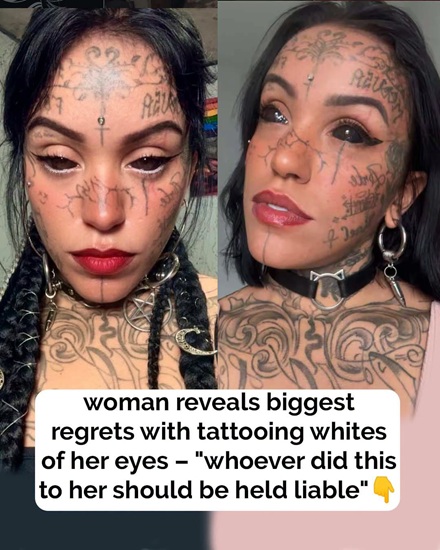
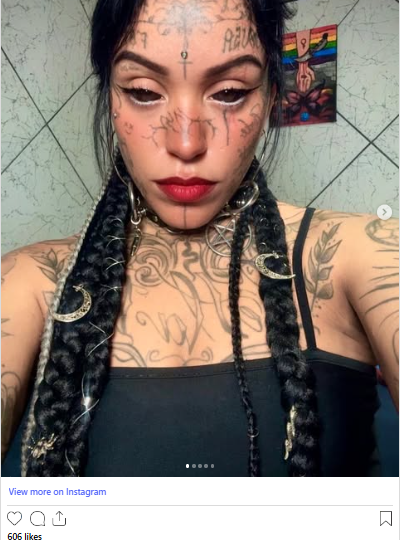
Lavinia Mesquita, a Brazilian tattoo artist and online content creator known by her nickname Lav Medusa, has attracted worldwide attention after speaking publicly about her experience with scleral tattoos — a controversial form of body modification that involves injecting ink into the white part of the eye. The procedure is considered one of the most extreme forms of tattooing because it involves a sensitive area of the body where even small mistakes can potentially lead to serious complications.
Mesquita has shared that the decision dramatically changed many aspects of her daily life and that she now regrets some of the consequences associated with the procedure. Through interviews and social media posts, Mesquita has described the personal challenges she says began after having both of her eyes tattooed. She claims the change in her appearance has affected her professional opportunities, personal relationships, and interactions with people around her.
According to her own statements, some people react negatively when they see her unusual eye appearance, and she believes that her appearance has influenced how others judge her before getting to know her as a person. One of the biggest difficulties Mesquita has discussed is finding employment. She has explained that visible body modifications, especially facial and eye tattoos, can create barriers when applying for jobs because some employers may have strong opinions about unconventional appearances.
While workplace attitudes toward tattoos have changed significantly in recent years, studies and social discussions have shown that highly visible modifications can still influence hiring decisions in some industries. Mesquita says she has personally experienced these challenges since changing her appearance.
She has also spoken about how her eye tattoos have affected her social and personal life. According to Mesquita, some people struggle to maintain eye contact with her because the tattooed sclera changes the natural appearance of the eyes. She has said that strangers sometimes make assumptions about her personality or beliefs based only on her appearance. Although she identifies as a Christian, she claims that some people have incorrectly associated her appearance with negative stereotypes or extreme beliefs.
Perhaps the most emotional part of Mesquita’s story involves her family. She has said that her appearance has been difficult for her children to understand and that they have sometimes reacted with fear or confusion. These statements reflect her personal experience as a mother trying to balance her identity, appearance, and family relationships. However, the specific reactions of her children are personal claims and have not been independently verified.
Beyond the social consequences, Mesquita has raised concerns about possible effects on her eyesight. She has claimed that after the procedure she experienced significant changes in her vision, including difficulty reading, seeing certain details, and performing everyday activities without assistance. She has also said that she fears the possibility of eventually losing her eyesight because of complications related to the tattoos.
Medical experts have explained that scleral tattooing is not comparable to a normal skin tattoo because the eye is a highly delicate organ. The white part of the eye, known as the sclera, is a thin protective layer surrounding the eyeball, and placing ink in this area requires extreme precision. If the procedure is performed incorrectly, complications may occur, including inflammation, infection, increased eye pressure, retinal problems, or other forms of vision damage.
Australian ophthalmologist Dr. Ben LaHood has discussed the medical risks associated with scleral tattoos, explaining that serious complications are possible depending on the technique used, the experience of the person performing the procedure, and whether proper sterile conditions are maintained. Unlike traditional tattoos, where ink is placed in the skin, scleral tattooing involves working close to structures that are essential for vision.
One of the claims Mesquita has made is that she now sees the world differently, including experiencing a reduction in her ability to see colors. Medical experts have noted that normal color vision is primarily controlled by cone cells located in the retina, meaning that simply placing ink on the sclera would not usually change color perception. However, if a procedure caused deeper eye damage, severe inflammation, or another medical complication, vision changes could potentially occur.
The discussion surrounding Mesquita’s experience has renewed public debate about extreme body modification and the importance of understanding medical risks before undergoing unusual procedures. While many people choose tattoos and other modifications as a form of self-expression, specialists warn that procedures involving sensitive organs require careful consideration and should only be approached with full awareness of possible consequences.
Mesquita’s story has become a widely discussed example of how a personal decision involving appearance can have unexpected effects on health, career opportunities, and relationships. Her experience has encouraged conversations about the balance between individual expression and protecting long-term well-being.
The story of Lavinia Mesquita has brought increased attention to scleral tattooing, a procedure that remains one of the most debated forms of body modification. Unlike traditional tattoos placed on the skin, scleral tattoos involve injecting pigment into the eye area, making the procedure significantly more complex and medically sensitive. Although some people pursue the practice as a form of artistic expression or personal identity, eye specialists have repeatedly warned that the risks can be much more serious than those associated with ordinary tattoos.
According to ophthalmologists, possible complications from scleral tattooing can include severe inflammation, infections, damage to internal eye structures, increased pressure inside the eye, and permanent changes to vision. The level of risk depends on many factors, including the skill and experience of the person performing the procedure, the materials used, the cleanliness of the environment, and whether the technique is performed correctly. Because the eye is extremely delicate, even a small mistake can potentially create long-term problems.
One of the concerns raised by medical professionals is that many people who perform scleral tattoos are not trained medical specialists. The eye is not an ordinary tattoo surface, and injecting ink too deeply or in the wrong location could potentially damage important structures. Experts have emphasized that anyone considering such a procedure should understand that the consequences may not always be reversible and that correcting complications can be difficult.
Mesquita has also spoken about experiencing black tears after receiving her eye tattoos. According to ophthalmologists, dark-colored tears can occur shortly after the procedure because excess pigment may leave the injection areas while the eye is healing. However, doctors have noted that persistent black tears long after the procedure would not be considered a typical outcome and could indicate another issue that requires medical evaluation.
Her concerns about possible vision loss have also attracted attention. Experts explain that blindness is a recognized but uncommon risk of scleral tattooing, especially if complications such as infection, serious inflammation, or accidental injury to deeper eye structures occur. However, the possibility of severe damage does not mean that every person who undergoes the procedure will experience the same results. Each case depends on individual circumstances and medical factors.
The debate surrounding Mesquita’s experience also highlights a broader conversation about extreme forms of self-expression. Tattoos, piercings, and other body modifications have become increasingly accepted in many societies, with millions of people using them as a way to express creativity, identity, or personal beliefs. However, procedures involving sensitive areas of the body require a different level of consideration because the potential risks may extend beyond appearance.
Interestingly, eye tattooing does have legitimate medical applications when performed by qualified specialists in controlled environments. Certain medical procedures involving pigmentation of the eye can be used for specific conditions, such as improving the appearance of a damaged eye or reducing visual discomfort in certain patients. These medical techniques are performed under strict professional standards and are different from cosmetic scleral tattooing performed for artistic reasons.
Mesquita’s story has gained attention because it combines several issues that attract public discussion: personal choice, beauty standards, social judgment, medical safety, and the limits of body modification. Many people have expressed sympathy for the difficulties she describes, while others have viewed her experience as a warning about carefully researching permanent decisions involving health.
For Mesquita, the experience has become a deeply personal lesson about the long-term impact of decisions made for artistic expression. She has said that she did not fully understand how dramatically the tattoos would influence her future when she first chose to undergo the procedure. Her story reflects the importance of considering not only immediate results but also possible effects years later.
The reaction to her case also shows how quickly personal stories can spread in the digital age. As a content creator, Mesquita’s experiences reached millions of people online, creating conversations among supporters, critics, and medical professionals. While social media can help people share their experiences and raise awareness, experts remind the public that personal stories should not replace professional medical advice.
Ultimately, Lavinia Mesquita’s experience has become a widely discussed example of the importance of informed decision-making. Extreme body modifications may represent creativity and individuality for some people, but they can also involve serious risks that should not be ignored. Understanding those risks, consulting qualified professionals, and carefully considering long-term consequences are essential before making permanent changes to the body.
Her story continues to generate discussion around the world, not only because of her unusual appearance but because it raises important questions about personal freedom, health, and responsibility. Whether viewed as a story of regret, self-expression, or a warning about medical risks, Mesquita’s experience has encouraged many people to think more carefully about the choices they make and the possible consequences that may follow.

