
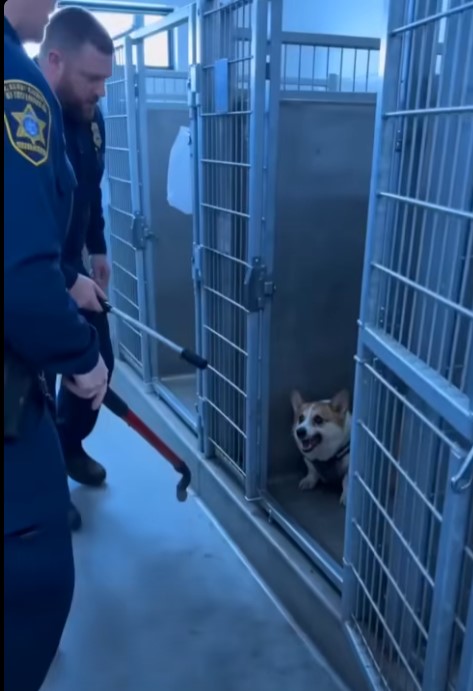
The bold red lettering on the clipboard left no ambiguity. In a crowded municipal shelter where difficult decisions were routine, another “unadoptable” case had quietly reached its end point. In one of the isolation kennels, a small Corgi identified only as Tag #842 sat pressed into the corner, his body shaking uncontrollably. Staff members described him as one of the most reactive dogs they had ever handled during intake. He barked, snapped, and resisted any attempt to approach him, leading many to believe he was beyond rehabilitation.
To most of the team, the conclusion seemed unavoidable. But veterinary technician Sarah Miller wasn’t convinced. Years of working in animal care had taught her that fear and aggression often look identical on the surface. What others interpreted as hostility, she saw as panic—raw, unfiltered, defensive fear. The Corgi wasn’t charging forward to attack; he was desperately trying to keep something—or himself—safe. As the scheduled euthanasia time approached, Sarah requested a final review.
When she entered the isolation corridor, the atmosphere was heavy and sterile, lit by flickering fluorescent lights that cast uneven shadows across the concrete floor. The Corgi immediately recoiled, flattening himself against the wall in an instinctive attempt to disappear. That was when Sarah noticed something that had not been clearly documented in the intake report: a large, worn black tactical harness strapped tightly around the dog’s small frame.
It looked completely out of place.
The harness was not typical pet equipment. It appeared military-grade—reinforced stitching, metal attachment points, and weathered fabric that suggested long-term field use. It was oversized for a dog his size and fastened in a way that seemed improvised, as though urgency had been involved in its placement.
But what stood out most was not the harness itself.
It was how the dog behaved around it.
Every time Sarah moved closer, the Corgi shifted his body to shield the front pouch of the harness. He wasn’t trying to escape her. He was protecting the gear. His entire posture was defensive, not toward people in general, but toward access to that specific object.
At first, Sarah suspected a severe hidden injury—perhaps a tumor or wound beneath the straps that explained both his behavior and distress. That possibility was serious enough to halt the procedure temporarily.
She called for additional time.
Slowly, she knelt a few feet away, speaking in a calm, steady tone. The dog growled weakly, but it lacked aggression. It sounded more like exhaustion mixed with fear. Step by step, Sarah reduced the distance, careful not to trigger a full defensive response.
When she finally reached the harness, her hands paused for a moment.
The dog stiffened.
But he didn’t lunge.
That hesitation allowed her to continue.
Her fingers traced the outer pouch, where she felt something unusual beneath the fabric. It wasn’t rigid like bone or equipment. It shifted slightly when pressed. Sarah froze instantly, realizing this was not what anyone had assumed.
She carefully unfastened the compartment.
What she discovered inside completely changed the situation.
A newborn kitten, extremely small and fragile, was curled tightly within the pouch.
It was barely conscious. Its body was cold, its breathing shallow, and its eyes still closed. It had clearly been hidden and protected inside the harness for an extended period.
For a moment, everything about the Corgi’s behavior made sense.
He wasn’t dangerous.
He wasn’t unstable.
He was protecting life.
Every bark, every snap, every defensive movement had been driven by instinctive guardianship. He had been shielding the kitten from perceived threats in an environment he did not trust.
As Sarah gently lifted the kitten out, the Corgi’s entire demeanor shifted. The tension in his body softened. He leaned forward cautiously, sniffing the tiny animal, watching every movement with intense focus. The aggressive behavior that had defined him moments earlier disappeared completely.
In its place was quiet vigilance.
Shelter staff who arrived shortly after stood in stunned silence. The dog they had labeled as dangerous was now sitting calmly beside the table, eyes locked on the kitten as if responsible for its survival.
But the situation became even more serious.
When Sarah removed the harness fully, she discovered a deeper injury hidden underneath. The Corgi had a significant chest wound, partially sealed by pressure from the tight straps. The harness had unintentionally acted as a stabilizing bandage, slowing blood loss and keeping him alive long enough to reach the shelter.
The moment it was loosened, his condition deteriorated rapidly.
He collapsed.
Emergency intervention began immediately as staff rushed both animals into treatment. What had started as a euthanasia case turned into a critical double rescue effort within minutes.
While stabilizing the dog, technicians examined the harness more closely. Inside a concealed inner section, they discovered an identification card.
It belonged to Captain Daniel Reed.
The shelter manager recognized the name instantly. Captain Reed was her son, a military officer who had gone missing during a severe flood-related accident days earlier. His vehicle had been reported lost near a collapsed rural roadway, and search efforts had failed to locate him.
The discovery changed everything.
The Corgi, now believed to be named Barnaby, was not a stray. He was a trained military working dog assigned to Captain Reed.
Investigators later reconstructed a likely sequence of events. During the accident, both man and dog had survived the initial impact. Despite serious injury, Barnaby had continued moving through dangerous terrain. At some point, he encountered a vulnerable newborn kitten and, driven by instinct, carried it securely within the only available protective space—the harness.
Even while injured, he had preserved both lives connected to him: the kitten and the identification card that would eventually guide rescuers to his handler.
That detail proved crucial.
Using the information from the ID and environmental clues from the harness, rescue teams narrowed their search area significantly. Within a short time, they located Captain Reed alive, though injured and in urgent need of medical evacuation.
Against all expectations, multiple lives were saved because of the dog once considered dangerous.
The kitten survived.
The captain survived.
And Barnaby survived his emergency treatment.
Days later, after stabilization and recovery, Barnaby was brought to the hospital for a reunion. Captain Reed, still weak but conscious, reached out as the dog was placed beside him.
There were no dramatic reactions.
Only recognition.
Barnaby moved closer, resting his head gently against his handler’s arm, calm and steady for the first time since entering the shelter.
Those who witnessed the moment described it as profoundly quiet but deeply emotional—a connection that needed no explanation.
The dog once labeled “too aggressive” had, in reality, been carrying out one final act of loyalty.
And in doing so, he became the reason several lives were saved.
In the end, Barnaby’s story became a lasting reminder that fear is not always violence, and silence is not always emptiness. Sometimes, the most misunderstood behavior hides the most extraordinary form of protection.

