
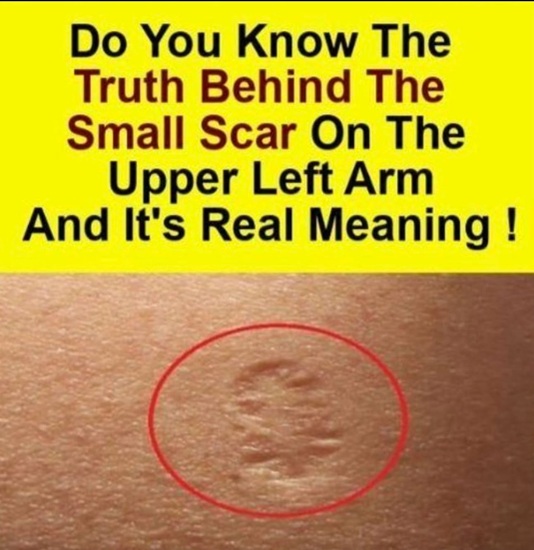
I have a clear memory of noticing a distinct scar on my mother’s arm when I was a child. It was located high on her upper arm, close to the shoulder, and had a very specific circular pattern that immediately caught my attention. The mark looked like a cluster of small indents surrounding a slightly deeper central point, almost like a faded imprint from something long past. At the time, I could not explain why I found it so interesting, but I remember staring at it more than once during ordinary moments at home.
Childhood curiosity often attaches itself to small details like that, even when we don’t fully understand their meaning. As I grew older, that memory slowly faded into the background of my life. I never actively thought about the scar again, even though I continued seeing it whenever I was near my mother. It remained unchanged in appearance, always in the same place, but my attention no longer focused on it.
It became part of the visual familiarity of her presence, like something the mind registers but does not question. In hindsight, I realize that I may have even asked her about it once, but if she answered, the explanation never stayed with me. Childhood conversations often dissolve into memory gaps like that.
Years passed without me giving the scar any real thought. Life moved forward, filled with new experiences, responsibilities, and distractions that replaced older curiosities. That small detail on my mother’s arm quietly disappeared from my conscious attention. It was not forgotten completely, but rather stored away in a part of memory that rarely gets accessed. It would take an unexpected encounter many years later to bring that forgotten curiosity back into focus in a very real way.

One summer, while traveling by train, I helped an elderly woman step carefully off the carriage. It was a simple act of assistance, something done almost automatically in the moment without expectation of significance. However, as I supported her arm, I noticed something unusual that immediately stopped my attention. On her upper arm, in nearly the same position as my mother’s scar, was an almost identical circular mark. The resemblance was striking enough to instantly trigger a memory I had not consciously revisited in years.
The train was preparing to depart, and the brief encounter ended before I had the chance to ask her about the mark. I remember feeling slightly unsettled by the missed opportunity, as if I had been given a glimpse of an answer without the ability to fully understand it. That moment stayed with me even after I continued my journey. It created a sense of unfinished curiosity that I could not easily ignore. Later that day, I decided to call my mother and finally ask about the scar I had seen throughout my childhood.
When I brought it up, my mother reacted with a calmness that suggested she had explained it before. She told me that she had, in fact, mentioned it to me on more than one occasion. However, as is often the case with childhood information, I apparently never retained it. She then explained that the scar was the result of a smallpox vaccination, something that was once a routine part of medical care for children in her generation. Her explanation immediately connected the scattered pieces of memory I had carried for years.
Smallpox was once one of the most dangerous infectious diseases known to humans. It caused severe illness, including high fever and widespread skin eruptions that often left lasting scars on survivors. In many historical outbreaks, the disease had a significant mortality rate, making it a major global health concern for centuries. Entire populations were affected during periods of epidemic spread, and medical communities around the world worked extensively to develop methods of prevention. The introduction of vaccination became one of the most important turning points in controlling the disease.
Through coordinated global vaccination efforts, smallpox eventually became the first human disease to be declared eradicated. In the United States, routine vaccination programs were phased out after the disease was eliminated in 1952. Over time, continued international cooperation led to its official global eradication, marking a major achievement in medical history. For people born before vaccination programs ended, the smallpox vaccine was a standard part of childhood healthcare. The visible scar it left behind became a common feature across generations.
The reason the vaccine left a scar is related to the method used during administration. Unlike modern injections, the smallpox vaccine was delivered using a special bifurcated needle that punctured the skin multiple times. This allowed the vaccine to reach deeper layers of the skin and initiate an immune response. The controlled introduction of the virus caused a localized reaction, which went through several stages of healing. First, a small bump would form, which then developed into a fluid-filled lesion.
Over time, that lesion would break open and gradually scab over as the body healed. This natural healing process resulted in a permanent circular scar at the site of vaccination. The mark varied slightly from person to person, but it often shared a recognizable pattern. For many individuals, including my mother, it became a lifelong physical reminder of early vaccination practices. Although medically minor, the scar carried historical significance as evidence of protection against a once-feared disease.
As I reflected on this explanation, I began to understand the scar in a completely different way. What had once been a childhood curiosity turned into a connection to a major moment in medical history. It was no longer just a mark on my mother’s arm, but part of a broader story about disease, prevention, and scientific progress. Something so small in appearance carried a much larger meaning when viewed through the lens of history and public health.
In the end, this simple realization changed the way I viewed memory and everyday details. The scar that once seemed mysterious was actually part of a shared human experience across generations. It reminded me that even the smallest physical marks can carry stories that connect personal lives to global history.

