
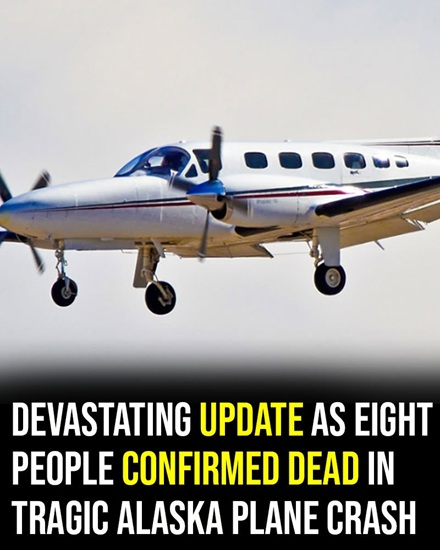
Eight people were killed after a charter aircraft crashed while attempting to reach the remote Cape Newenham Long Range Radar Site in southwest Alaska. The aircraft, a Cessna 441 Conquest II operated by Anchorage-based Security Aviation, was carrying two pilots and six passengers. The flight had departed Anchorage and was transporting personnel connected with work at the isolated radar installation.
Search-and-rescue personnel responded after the aircraft went down near the destination, but authorities confirmed that nobody aboard survived. The crash has prompted an investigation by the National Transportation Safety Board, with assistance from other relevant agencies. Investigators have not yet announced a final probable cause. The aircraft had departed Ted Stevens Anchorage International Airport on the morning of August 20, 2026.
Its destination was the Cape Newenham Long Range Radar Site Airport, located in a sparsely populated and geographically challenging part of Alaska. According to information released after the accident, the flight was chartered by the U.S. Army Corps of Engineers. Two Army Corps employees were among the passengers, while four other passengers were contractors. The remaining two occupants were the pilots operating the aircraft. Their journey was connected with professional work at the radar site rather than a regularly scheduled commercial passenger service.
Cape Newenham is a remote installation where aviation provides an important transportation connection for personnel, equipment, and supplies. Alaska contains numerous communities and work sites that cannot be reached easily by the extensive road networks common in more densely populated areas. Aircraft consequently play an essential role in transportation across much of the state. The isolation of places such as Cape Newenham can also create logistical challenges for routine operations and emergency responses. Weather, terrain, transportation availability, and distance can all affect access.
These general conditions provide useful context, although they do not by themselves explain why this particular aircraft crashed. Information released by federal investigators has provided an initial outline of the flight’s final moments. The aircraft approached the Cape Newenham airport but did not complete a landing on its first attempt. According to the NTSB, the pilots conducted a missed approach and then prepared for another attempt. The aircraft was subsequently on its second landing approach when the accident occurred.
Investigators have said the pilots were operating under instrument conditions because visibility prevented them from relying fully on outside visual references. Contact with the aircraft was eventually lost, and the wreckage was located close to the airstrip. The crash site was reported to be roughly a quarter to a third of a mile west of the runway.
Investigators described the surrounding area as rising or mountainous terrain, creating additional difficulties for personnel trying to reach and examine the wreckage. The aircraft was heavily fragmented, and authorities also reported evidence of a post-crash fire. Those conditions can make the process of documenting and recovering components more complicated. Investigators must carefully identify where pieces are located before important evidence is moved. In a remote environment, helicopters and specialized support may be necessary to transport personnel and equipment safely.
Search-and-rescue teams moved quickly once the emergency became known. Alaskan Command reported that an Alaska Air National Guard HH-60W Jolly Green II helicopter responded with support from an HC-130J Combat King II aircraft. Guardian Angel personnel from the 212th Rescue Squadron were able to reach the area near the wreckage. After arriving at the crash site, responders confirmed the devastating outcome: all eight people who had been aboard the Cessna had died. The response required personnel to operate in a difficult and isolated environment. Officials later acknowledged the work of the military and civilian organizations involved in reaching the scene.
Lt. Gen. Robert Davis, who leads Alaskan Command, the Alaskan NORAD Region and Eleventh Air Force, expressed condolences following confirmation of the fatalities. He described the accident as a devastating loss for the wider military community and recognized that those aboard had been traveling in connection with important work in a demanding environment. Davis also emphasized support for relatives, friends, and colleagues affected by the deaths. Public statements following fatal accidents often focus initially on the victims and their families while investigators begin the separate process of determining what happened. Officials followed established notification procedures before releasing identifying information about those who died.
The professional purpose of the flight helps explain why several different organizations have been affected by the tragedy. Two passengers were employees of the U.S. Army Corps of Engineers, while four were contractors associated with work at the radar installation. Two pilots completed the total of eight people aboard. Some of the contractors were connected with companies supporting work in the region. Authorities and employers have issued statements expressing sympathy to families and coworkers. The deaths therefore extend beyond a single organization, affecting multiple workplaces and communities connected with operations at Cape Newenham.
Security Aviation also responded publicly after the accident. The Anchorage-based charter operator expressed condolences to the relatives and friends of those who died and said it was cooperating with investigators. The company provides charter aviation services in Alaska, where private and contracted flights frequently connect remote locations with larger transportation centers. At this stage, there is no factual basis for assigning responsibility to the operator, pilots, aircraft, weather, or another individual factor. Aviation accidents can involve complex combinations of circumstances, and determining what happened requires evidence rather than assumptions based on preliminary information.
Weather conditions around the airport are among the subjects investigators are examining. Reports following the crash indicated fog, low clouds, mist, and reduced visibility around the time the aircraft was approaching Cape Newenham. Those conditions can require pilots to navigate primarily by reference to flight instruments and established instrument procedures. Investigators have confirmed that the crew was operating in instrument conditions during the approach. However, the existence of poor visibility does not prove that weather caused the accident. Weather information is one component of a much larger investigation that will examine the aircraft, crew, procedures, terrain, and available flight information.
The fact that the crash occurred during a second landing attempt is also significant to investigators, but it should not be interpreted as proof of a particular cause. Missed approaches are established aviation procedures used when a landing cannot be safely completed or when required conditions are not met. Conducting one does not automatically indicate that something was wrong with the aircraft or crew. Investigators will examine what occurred during the first approach, why the landing was not completed, how the second approach developed, and what happened before the aircraft struck terrain. Reconstructing that sequence is essential before meaningful conclusions can be reached.
Radar information may help investigators understand the aircraft’s final flight path. Data can potentially provide information about direction, altitude, speed, and changes in movement during the approach. Investigators can compare that information with weather observations, communications, published procedures, and physical evidence recovered from the wreckage. No single source necessarily provides the complete explanation. Aviation investigations are designed to combine multiple forms of evidence so that conclusions are based on the overall record rather than one isolated detail. This process can take significant time, particularly when an accident occurs in difficult terrain.
The National Transportation Safety Board is leading the investigation. Its investigators are expected to examine the wreckage and review operational records, maintenance history, pilot qualifications, weather information, radar data, communications, and other evidence relevant to the flight. The Federal Aviation Administration is also involved in the response and investigative process. Investigators may additionally interview people familiar with the aircraft, operation, destination, and conditions surrounding the flight. The objective is not simply to identify what happened immediately before impact but to understand the sequence of circumstances that produced the accident.
A preliminary report may eventually provide additional factual information, but preliminary findings should not be confused with a final determination of probable cause. NTSB investigations frequently continue for months or longer because investigators need time to analyze evidence and test possible explanations. Early reports generally document facts known at that stage without making a final judgment about responsibility. Additional information can also change the understanding of events as records and physical evidence are examined. For this reason, claims about the cause of the Cape Newenham crash should remain cautious until the investigation reaches supported conclusions.
The aircraft involved was a Cessna 441, commonly known as the Conquest II. It is a pressurized twin-engine turboprop aircraft that has been used for business, private, and charter transportation. Identifying the aircraft type provides factual context but does not indicate why the accident occurred. Investigators will examine the specific aircraft involved, including relevant systems and components that can be recovered from the site. Maintenance documentation and operational records can help determine its condition before the flight. Conclusions about mechanical problems should not be made unless evidence from the investigation supports them.
The terrain surrounding the airport will receive attention as investigators reconstruct the final approach. Cape Newenham lies in an isolated region where rising ground and changing weather can create demanding operating conditions. Investigators need to understand the aircraft’s position relative to the runway and surrounding terrain throughout the approach sequence. They will also examine what information was available to the pilots and how the flight was being conducted. Again, describing challenging terrain does not mean terrain alone caused the accident. It is simply one of several factual elements relevant to understanding the environment in which the flight was operating.
The remote location also creates practical difficulties for the investigation itself. Unlike an accident near a major airport or highway, personnel cannot necessarily drive directly to the wreckage with equipment. Weather may restrict helicopter operations, and investigators need to consider their own safety while working around steep or uneven terrain. Recovering significant aircraft components can require careful planning. These logistical issues may influence how quickly certain stages of the field investigation can be completed. Thorough documentation remains important even when difficult access makes the work slower.
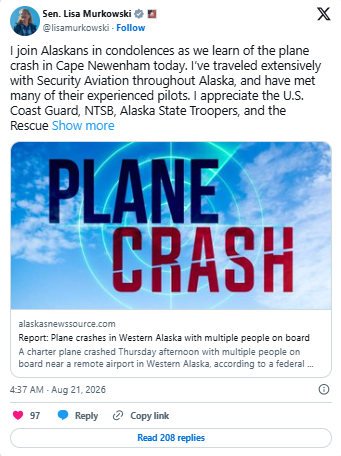
Alaska Sen. Lisa Murkowski publicly expressed sympathy after learning about the crash. She also acknowledged the emergency personnel and organizations involved in responding to the accident and noted her familiarity with Security Aviation from previous flights. Such statements reflect the human impact of a fatal event, but they should remain separate from determining technical responsibility. Elected officials, witnesses, social media users, and news audiences do not have access to all of the evidence being collected by investigators. The NTSB’s eventual findings will carry far more weight in explaining the accident than speculation during the first days following the crash.
Responsible reporting is particularly important following aviation accidents because incomplete early information can easily produce misleading conclusions. A report that the aircraft encountered poor visibility does not automatically mean weather caused the crash. A second landing attempt does not automatically demonstrate pilot error. Likewise, the aircraft’s age or model cannot establish mechanical failure without supporting evidence. Each possibility must be evaluated against records, physical evidence, flight information, and established investigative methods. Until then, the accurate description is that the cause remains under investigation.
The confirmed sequence currently provides a clearer picture without requiring speculation. A Security Aviation Cessna 441 departed Anchorage carrying eight people to Cape Newenham. The aircraft was chartered for a flight connected with work at the remote radar site. It reached the destination area and made an approach that did not result in a landing. The crew then attempted another approach while operating in limited visibility. The aircraft crashed near the runway in rising terrain, and search-and-rescue personnel later confirmed that everyone aboard had died.
Those facts are already significant without adding dramatic or unsupported details. Eight families lost relatives, and several organizations lost employees or colleagues. Search-and-rescue personnel faced the difficult task of reaching the remote crash location and confirming there were no survivors. Investigators then began the separate responsibility of documenting the wreckage and collecting evidence. For the people personally connected with the victims, the investigation will not change the magnitude of the loss. It may, however, eventually provide answers about why a routine work-related charter flight ended in tragedy.
The accident also highlights the important role aviation plays in connecting Alaska’s remote facilities. Many locations throughout the state depend heavily on aircraft because geographic isolation makes conventional ground transportation impractical or impossible. Charter operators transport workers, residents, supplies, government personnel, and equipment across enormous distances. Thousands of such flights form part of everyday transportation in Alaska. The Cape Newenham accident should therefore be examined on its own evidence rather than used to make unsupported generalizations about aviation across the state.
As investigators continue their work, additional details about the flight may become publicly available. Radar information could provide a more precise reconstruction of the aircraft’s path. Weather records can establish the conditions that existed during each approach. Examination of the wreckage may provide information about aircraft systems and the sequence of impact. Maintenance and operational records can supply further context. Investigators will then compare these different sources before determining which factors contributed to the accident.
The process requires patience because a reliable explanation is more valuable than an immediate one. Major transportation investigations are intended to identify evidence-supported causes and, when appropriate, recommend changes that could reduce the likelihood of similar accidents. Reaching those conclusions too quickly would risk overlooking important information. This is why investigators typically avoid declaring a probable cause during the earliest stages. The Cape Newenham investigation remains active, and any definitive explanation should wait for the findings of the agencies examining the evidence.
For now, attention remains centered on the eight people who died and those affected by their loss. They were traveling to a remote installation to carry out professional responsibilities when their flight ended near its destination. The two pilots and six passengers represented several organizations, but they shared the same final journey aboard the charter aircraft. Condolences have been expressed by military leaders, government officials, employers, and others connected with the operation. Search-and-rescue personnel and investigators have continued working in difficult conditions following the accident.
What happened during the aircraft’s final approach will ultimately depend on evidence collected and analyzed by aviation safety specialists. Until that investigation is complete, there is no responsible basis for declaring one factor responsible. The confirmed facts establish that the Cessna 441 crashed near Cape Newenham during a second landing attempt in challenging visibility conditions and that all eight people aboard were killed. Everything beyond those established facts must be evaluated carefully. The investigation now has the task of determining why the flight ended so close to the remote Alaska airstrip it had been trying to reach.

