
At first sight, this optical illusion looks extremely simple. You are shown what appears to be a plate with several circular elements arranged in a pattern, along with a straightforward question asking how many circles you can identify. Most people instinctively feel confident when they first look at it. The image seems clear, the task feels easy, and the answer appears obvious within seconds. However, the real challenge of this puzzle is not in what you see at first glance, but in how your brain interprets what is in front of you.
As viewers begin to examine the image more closely, that initial certainty often starts to fade. What once seemed like a simple visual task slowly becomes more complicated. Some individuals focus only on the most visible circular shapes, while others start noticing additional forms created by edges, shadows, and spacing between objects. Because of this, different people often arrive at different answers even though they are observing the exact same image.
This difference in perception is a direct result of how the human brain processes visual information. Our eyes do not function as perfect recording devices. Instead, the brain constantly interprets and organizes incoming data based on experience, expectation, and context. When an image is unclear or open to interpretation, the brain fills in missing details to create a complete picture. This process is automatic and happens within fractions of a second.
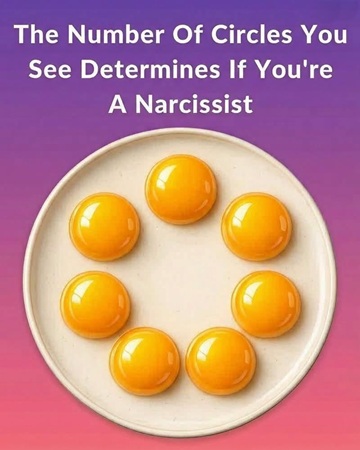
Some people tend to prioritize the most obvious elements in a scene. They naturally focus on the clearly defined objects and ignore subtle structural details. In this case, they may count only the most visible circles and quickly settle on a lower number. Others take a more analytical approach, paying attention to every curve, overlap, and shape formed by the composition. As a result, they may count more elements than the first group.
A key concept behind this phenomenon is figure-ground perception. This refers to the brain’s ability to distinguish between the main subject of an image and its background. In ambiguous visuals, this separation is not always clear. What one person sees as background, another may interpret as a meaningful shape. This is one of the main reasons why optical illusions can produce multiple valid interpretations at the same time.
Attention also plays a major role in how we interpret visual puzzles. Human attention is limited, and the brain must constantly decide what information is most important. To cope with this, it uses mental shortcuts that help process information quickly. While these shortcuts are useful in everyday life, they can also lead to differences in perception when dealing with complex or ambiguous images.
These types of visual challenges are widely shared online not only because they are entertaining, but also because they encourage discussion. When people compare answers, they often realize that others see the same image differently. This creates curiosity and conversation, as individuals try to understand why their perception does not match someone else’s. The value of the puzzle lies less in the final number and more in the experience of observing these differences.
It is important to understand that claims suggesting these illusions can measure intelligence, personality, or psychological traits are not scientifically supported. While it may be tempting to interpret the results in a deeper way, a single image cannot accurately determine cognitive ability or emotional characteristics. These types of interpretations are generally created for entertainment purposes rather than scientific analysis.
However, optical illusions still provide useful insight into human perception. They demonstrate that what we see is not a direct copy of reality, but rather a constructed interpretation created by the brain. This is a key concept in cognitive science and psychology, where researchers study how humans process visual stimuli and make sense of uncertain information.
In everyday life, this means that perception can vary significantly from one person to another. Two individuals can observe the same situation and remember it differently, not because one is incorrect, but because their attention focused on different aspects of the experience. Optical illusions simply highlight this natural variation in a controlled and visual way.
Ultimately, the purpose of this puzzle is not to find a single “correct” answer, but to explore how perception works. It encourages careful observation, patience, and awareness of how easily the brain can interpret the same image in multiple ways. Whether you see fewer circles or more circles, the interesting part is realizing that others may genuinely see something different.
In the end, the illusion teaches a simple but powerful lesson: reality is not only what exists in front of us, but also how our brain chooses to organize and understand it.

