
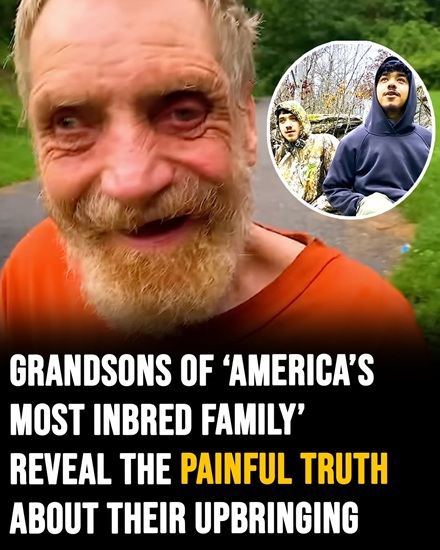
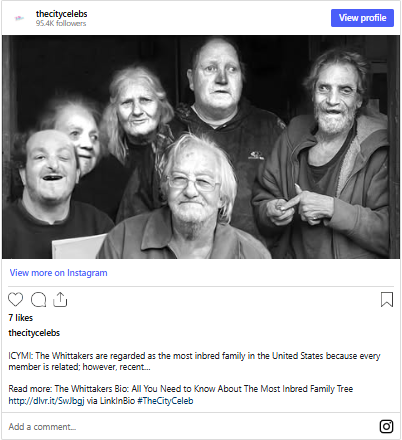
The Whittaker family of Odd, West Virginia, became widely known after photographer and filmmaker Mark Laita began documenting members of the family and later featured them on his Soft White Underbelly platform. Over time, the videos drew millions of views and turned the family into an internet phenomenon. Much of the attention focused on their complicated genealogy, disabilities affecting some relatives, and their living conditions. However, the family’s story is broader than the dramatic labels often used online, and later comments from younger relatives have added a more personal perspective on what life around that publicity was actually like.
The family’s genealogy includes marriages between close relatives in earlier generations. Publicly available family-history information has been used to reconstruct parts of the Whittaker family tree, although online versions do not always agree on every detail. What is broadly supported is that close-relative relationships occurred across generations. Because repeated consanguinity can increase the chance of certain recessive genetic conditions, that family history has attracted substantial interest. Still, it would be inaccurate to diagnose individual relatives or attribute every physical or developmental condition to one cause without specific medical evidence.
Some of the best-known family members featured in Laita’s work include Betty, Ray, Lorene, Timmy, Larry, and other relatives. Their personalities, abilities, and communication styles differ considerably. Some members appear to have significant developmental or intellectual disabilities, while others communicate more conventionally. Treating the family as though every person has the same medical condition or life experience oversimplifies a complicated group of individuals.
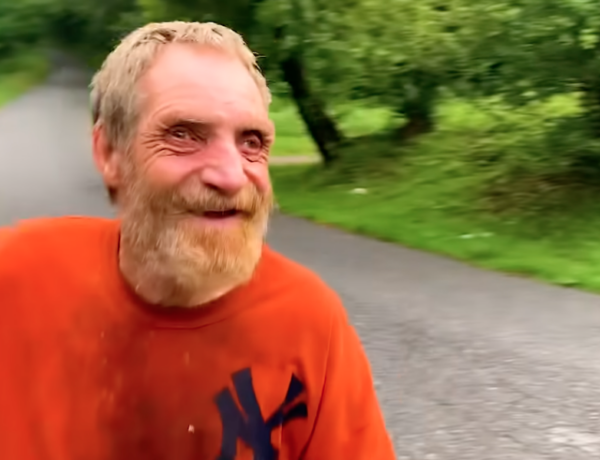
The phrase “America’s most inbred family” became closely associated with the Whittakers online, but it is a sensational media label rather than an official medical description. Such wording helped draw enormous attention to the videos, yet it also contributed to a public image that sometimes reduced real people to a single unusual aspect of their genealogy. Family members have lives, relationships, memories, and personalities that cannot be understood simply through a provocative headline.
Laita’s involvement also brought practical assistance. His audience supported fundraising efforts intended to improve the family’s home and living conditions. Videos showed repairs, gifts, trips, and other forms of assistance. For viewers, this created the impression that widespread attention might produce positive outcomes. Yet public exposure also introduced challenges that are easier to overlook when a video is consumed as entertainment.
One of those challenges was the arrival of strangers near the family property. According to accounts from younger relatives, people sometimes drove into the area simply to look at the Whittakers or provoke reactions. This changed the experience of living there. A private family home had become a destination for curious visitors who had seen online videos and wanted to observe the people featured in them.
Larry Whittaker’s grandsons, Brandon and Luis, later discussed what it was like to grow up around the family and the attention surrounding them. Their recollections offered a very different viewpoint from that of outside viewers. Instead of focusing mainly on genealogy, they described childhood instability, foster care, difficult family relationships, and the effects of having strangers repeatedly appear near the property.
One of the brothers recalled that life became especially difficult when he was around five or six years old. He said he entered foster care at six and spent his seventh birthday there. He also described restrictions that prevented him from immediately returning to the family property or seeing his grandfather after leaving foster care. These recollections are their personal accounts and should be understood as such rather than as independently verified descriptions of every event.
The brothers also spoke about serious problems involving adults around them. Their account included allegations of domestic conflict and an incident in which Larry reportedly confronted one of their stepfathers. Because these claims are based on family recollections rather than confirmed court findings presented alongside the interview, they should be described as allegations rather than established criminal facts.
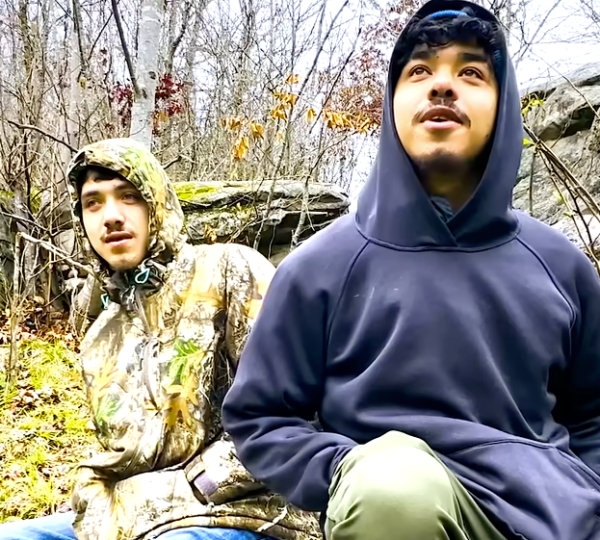
What their testimony makes clear is that they remember growing up amid instability. They described a period when their mother struggled with substance use and became less consistently involved in everyday parenting. The brothers said that by around age ten they often felt responsible for taking care of themselves. That description highlights problems far removed from the internet fascination surrounding their extended family.
At the same time, they did not describe every part of their childhood as unhappy. They also remembered enjoyable experiences at the Whittaker property, including time spent outdoors and family activities. This is an important distinction because families can experience genuine affection and positive memories even while facing poverty, addiction, foster care, disability, or serious conflict.
The presence of outsiders appears to have been one of the most frustrating aspects of the family’s later public visibility. Brandon described cars coming down toward the property and people “messing around.” He admitted that, as a younger person, he sometimes threw objects such as rocks, potatoes, eggs, or sticks toward those visitors.
Taken without context, that behavior might sound aggressive. Viewed from his perspective, however, it reflected the frustration of watching strangers arrive at a family residence as though it were an attraction. The visitors had chosen to enter the family’s environment, while the younger relatives had never chosen to become part of a viral story.
That distinction raises an important question about internet fame. A person appearing in a documentary does not stop being a private individual after the video is uploaded. Even when subjects consent to filming, widespread attention can produce consequences that are difficult to predict, including harassment, unwanted visitors, ridicule, and loss of privacy.
For the Whittakers, those consequences became especially significant because the family had previously lived in relative isolation. Millions of people suddenly knew where they lived and recognized them from videos. The difference between watching a documentary and visiting someone’s home is substantial. Curiosity does not create permission to trespass, harass, film without regard for privacy, or treat people as exhibits.
The public also frequently made assumptions about the family based on appearance. Comments about facial features, speech, or behavior circulated widely. This sometimes crossed from curiosity into mockery. Disability should not be treated as entertainment, and unusual physical characteristics do not justify dehumanizing language.
The genetics involved are also more complicated than many viral posts suggest. Children born to closely related parents can have an increased chance of inheriting certain recessive genetic conditions because both parents may carry the same rare variant inherited from a shared ancestor. When repeated across generations, those risks can increase. However, genetics is not a simple formula in which every disability or medical condition can automatically be traced to consanguinity.
An individual person would require appropriate medical evaluation before any specific diagnosis or genetic explanation could be established. Videos and photographs are not sufficient for that purpose. This is why responsible coverage should discuss the general genetic risks without pretending to medically diagnose members of the Whittaker family.
The family’s story took another complicated turn in 2025, when reports said some relatives were removed from the property and placed under protective care or guardianship. Remaining family members, including Betty and Larry, said they had limited information about where their relatives had gone and expressed distress over the separation.
Because adult protective-services matters are often confidential, public information about the reasons for such decisions can be limited. Family members reportedly believed the increased attention had contributed to what happened, but that interpretation should not automatically be presented as the official reason unless authorities confirm it.
The relatives left behind described missing those who had been removed. Betty reportedly said she had helped raise them and wanted information about where they were. Larry said he had been waiting for communication. These comments added another emotional dimension to a story that had often been framed only around unusual genealogy.
Later reporting also raised questions about money collected in connection with the family. Disputes emerged concerning fundraising and donations intended to help the Whittakers. Because allegations surrounding money can involve investigations and conflicting claims, it is important not to accuse specific individuals of theft or fraud unless such conduct is established through reliable evidence or legal findings.
This part of the story again demonstrates the complications created when private hardship becomes a large online fundraising effort. Donations can provide genuine assistance, but they also require transparency, accurate accounting, and clear communication about where money goes. When those safeguards are unclear, mistrust can quickly develop.
The younger relatives’ accounts are valuable because they move the discussion away from the spectacle surrounding the Whittaker name. Brandon and Luis spoke about foster care, difficult family situations, growing up quickly, and dealing with strangers who came to observe their relatives. Their experiences show that internet fame affected more than the people directly filmed.
Children and grandchildren can become part of a public narrative without having had any role in creating it. They may face comments at school, unwanted recognition, online jokes, and visitors to places they consider home. These effects can remain long after the original video becomes popular.
It is also important to remember that the Whittakers are not simply a genealogy chart. They are an extended family containing individuals with different needs, histories, and relationships. Some relatives require significant assistance. Others do not. Some family members appear comfortable speaking on camera, while others have limited verbal communication.
Reducing everyone to one description removes those differences. A respectful account should acknowledge their family history without suggesting that this alone defines who they are. The same principle applies to any family discussed because of disability, poverty, or unusual circumstances.
The Whittaker story also illustrates how documentary work can have both positive and negative consequences at the same time. Publicity brought money, repairs, and assistance that may otherwise have been difficult to obtain. It also brought exposure, strangers, ridicule, and scrutiny.
Both realities can be true without canceling each other out. It is possible to appreciate help provided to a family while also questioning whether some aspects of internet attention became intrusive. Ethical documentary storytelling requires considering what happens to subjects after the audience moves on.
The brothers’ description of people driving down toward the home is particularly revealing. To an online viewer, visiting the location may have seemed harmless. To people living there, repeated arrivals from strangers could feel threatening, invasive, or exhausting.
The fact that younger family members reacted defensively should be understood within that environment. Their response does not justify dangerous behavior, but context helps explain why they may have felt angry or protective. When a home repeatedly becomes the focus of unwanted attention, residents can feel as though privacy has been taken away.
This is one reason online audiences should resist the temptation to turn real families into tourist attractions. Watching publicly available material does not create a personal relationship with the people shown. Viewers do not automatically gain the right to visit, photograph, question, or confront them.
The same caution applies to comments. Humor that seems harmless to an anonymous viewer can feel very different to the family member who becomes the subject of it. People with disabilities are especially vulnerable to being treated as objects of curiosity rather than as individuals.
The story has also been complicated by inaccurate information circulating online. Family trees have been reposted with conflicting names, dates, and relationships. Some claims about medical conditions have been repeated without evidence. Dramatic summaries sometimes present uncertain information as though it were proven.
A responsible approach is therefore to separate what is documented from what remains uncertain. Close-relative marriages in earlier generations are supported by genealogical records. Some family members have visible disabilities. Laita documented the family extensively. Younger relatives have publicly described difficult childhood experiences and unwanted visitors.
Other questions, including the exact medical causes of particular disabilities, the full reasons behind protective-service decisions, or the outcome of disputes over donations, require more evidence before definitive conclusions can be made.
This distinction matters because sensational stories can become distorted as they spread. A claim repeated hundreds of times can still be wrong. Accuracy depends on evidence, not popularity.
Brandon and Luis’s comments offer an especially useful reminder that the family’s story is about more than unusual genetics. Their childhood involved foster care and unstable circumstances that could affect any family, regardless of ancestry. Their experiences should not be treated as a direct consequence of genealogy when other social and family factors were also present.
They also remembered good moments. That part of their account is sometimes lost because difficult stories attract more attention. Family relationships are rarely entirely positive or entirely negative. People can love relatives deeply while also acknowledging painful experiences.
The same complexity appears in Betty and Larry’s reactions to relatives being moved away from the property. Whatever authorities believed was necessary, those remaining expressed genuine sadness about losing everyday contact with family members.
The Whittakers’ story therefore involves multiple overlapping issues: genetics, disability, poverty, family loyalty, childhood instability, online fame, privacy, fundraising, and adult protective care. Any article reducing everything to one provocative label misses much of what actually makes the story important.
The broader lesson concerns dignity. People can be discussed accurately without being mocked. Disability can be explained without turning it into a spectacle. Family history can be examined without implying that individuals are responsible for decisions made generations before they were born.
There is also no need to romanticize the difficulties involved. Some relatives appear to have required substantial support, and the younger generation has described serious hardship. Respectful coverage does not mean pretending those problems did not exist. It means reporting them without dehumanizing the people affected.
For viewers, the most responsible response is to maintain distance between interest and intrusion. It is possible to watch a documentary and learn from it without visiting the subjects’ home or treating them as entertainment in person.
The continued interest in the Whittakers demonstrates how powerful documentary storytelling can be. A family once largely unknown outside its immediate community became internationally recognizable through online video. That transformation created opportunities for assistance while also exposing the family to consequences they could not fully control.
The comments from Brandon and Luis reveal those consequences from the perspective of younger relatives. Their memories involve growing up under difficult conditions and later seeing strangers arrive because of internet fame. This makes their testimony important because it adds context missing from many viral summaries.
Their accounts should still be presented carefully. Personal memories are valuable evidence about what someone experienced, but they are not always independently verified. Allegations about specific crimes or misconduct should remain attributed unless supported by official records.
That type of careful language does not weaken the story. It makes it more trustworthy. There is already enough documented complexity surrounding the Whittaker family without adding claims that cannot be confirmed.
Ultimately, the family’s history is not simply a shocking story about consanguinity. It is a story about real people living with the consequences of circumstances shaped by earlier generations, difficult family conditions, and unexpected internet fame.
For younger relatives, that fame was not always experienced as help. At times, it meant strangers driving down the road, staring, filming, and treating the family home as a destination. Their frustration shows how quickly online curiosity can become intrusive in the real world.
As the family’s situation continues to change, the most responsible approach is to rely on documented information, respect confidentiality when authorities cannot disclose details, and avoid speculation about individuals’ health or legal situations.
The Whittakers became famous because their circumstances seemed unusual to millions of viewers. But the later accounts from their grandchildren reveal something much more familiar: children trying to understand unstable family circumstances, relatives protecting one another, and people wanting privacy in the place they call home.
That is a more complete way to understand the story. The family’s genealogy may explain why the public first became curious, but it does not explain everything about their lives. Their experiences deserve to be treated with the same care and dignity that should apply to any family whose private struggles suddenly become public.

