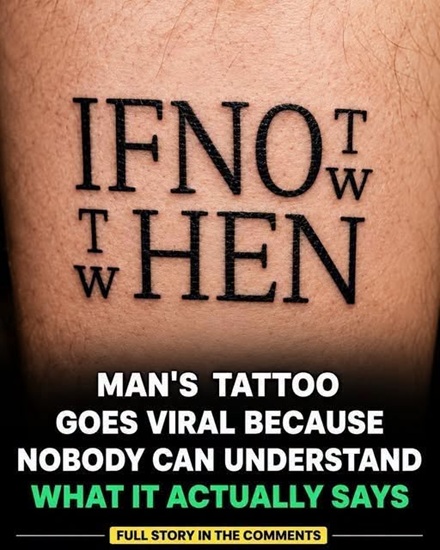
A single low-quality photograph posted online this week quickly spiraled into a massive internet discussion, turning into an unexpected global puzzle. At first glance, it showed nothing more than a forearm tattoo, but within hours it became the subject of intense debate, confusion, and thousands of comments from people trying to figure out what it actually said. The tattoo itself was designed as a long motivational quote written in bold lettering along the arm.
Its purpose was simple: to serve as a permanent reminder of discipline, timing, and personal motivation. However, the way it was executed—tight spacing, uneven alignment, and dense stacking of letters—made the final result extremely difficult to read. Once the image began circulating, users across different platforms started zooming in and analyzing every curve and stroke of the ink. Some attempted to separate letters visually, while others tried flipping or enhancing the image digitally.
Despite all these efforts, no clear interpretation emerged at first, and the confusion only grew. As more people joined the discussion, the tattoo became an online phenomenon. Every viewer seemed to see something slightly different. Some believed they could identify individual words, while others argued that the entire design looked like a random arrangement of characters with no coherent meaning at all.
This disagreement turned the comment sections into a mix of theories and interpretations. People suggested possible phrases, debated spacing errors, and even questioned whether the tattoo artist had misunderstood the original design. The image began to function almost like a visual illusion that refused to settle into one agreed-upon meaning.
After extended discussion, a commonly accepted interpretation eventually surfaced: the tattoo was intended to read “If not now, then when.” This phrase is widely used in motivational contexts and is meant to encourage immediate action rather than hesitation or delay. Even after this explanation spread, however, many viewers still struggled to visually match the phrase with the ink on the arm.
That gap between meaning and perception became the most talked-about aspect of the entire situation. The tattoo was supposed to represent clarity and purpose, yet it ended up being seen as confusing and visually fragmented. The contradiction itself became part of what made the image so widely shared.
As the conversation developed, people began to treat the tattoo as more than just body art. It became an example of how communication can fail when design choices overpower readability. What was meant to be a simple message of motivation turned into a complex visual challenge that different people interpreted in different ways.
The situation also reflected a broader pattern seen online, where small details can quickly turn into large-scale discussions. Once the image was widely shared, it stopped being just about one person’s tattoo and instead became a collective exercise in interpretation, speculation, and curiosity.
Over time, the focus shifted away from trying to decode the exact wording and moved toward understanding why it caused such widespread confusion. Many users pointed out that the issue was not just the content of the tattoo, but the way it had been visually structured and presented.
In this sense, the image unintentionally highlighted how fragile clarity can be. Even a simple sentence, when poorly formatted or visually compressed, can lose its meaning when viewed by a wider audience. What seems obvious in concept can become unclear in execution.
The man behind the tattoo became an unintentional part of an internet-wide discussion about perception versus intention. While his personal meaning may have been clear when he chose the design, the public reaction showed how easily interpretation changes once something is placed in a different context.
As the viral attention slowly began to fade, the image remained memorable not because of what it clearly said, but because of how many people struggled to understand it. The tattoo became less about the words themselves and more about the experience of trying—and failing—to read them clearly.
Eventually, the discussion shifted into reflection. Many users compared the tattoo to real-life communication problems, where intentions are strong but the final message becomes distorted. It served as a reminder that meaning is not only created by what we say, but also by how it is presented and perceived.
In the end, the tattoo remained unchanged, but its interpretation evolved far beyond its original purpose. It became a shared online moment of confusion, curiosity, and discussion, showing how quickly simple content can transform once it enters the internet’s collective attention.
Ultimately, the story is less about a tattoo and more about understanding. It highlights how easily messages can become unclear, how perception varies from person to person, and how even a simple phrase can turn into a global puzzle when clarity is lost in translation between intention and design.
